On October 17, 2025, a star system on the outer edge of the Andromeda galaxy suddenly flared — and telescopes around the world took notice. What had been a quietly monitored binary system for years violently erupted, sending a surge of light across 2.5 million light-years of space. Within weeks, astronomers secured emergency observing time on NASA’s James Webb Space Telescope. What they found, just 47 days after the blast peaked, was unlike anything captured before: two stars had become one.
A stellar eruption years in the making
The story of Bao didn’t begin in October 2025. It began with a quiet anomaly in archival data. In February 2023, astronomers reviewing archived observations from NASA’s retired NEOWISE mission noticed something odd: a star system whose brightness had held steady before 2018 was now fluctuating in unexpected ways. That irregularity flagged it for closer monitoring. By September 2024, the WINTER telescope confirmed the system was actively brightening and shedding dust — a sign that something physical was changing inside it.
Then came a particularly striking signal. In July 2025, NASA’s SPHEREx caught Bao fading in visible light while simultaneously brightening in infrared — a combination pointing to a major structural transformation already underway. The eruption itself arrived on October 17, 2025, when the Zwicky Transient Facility detected a sudden brightness surge paired with a dramatic temperature spike.
How a giant star swallowed its companion
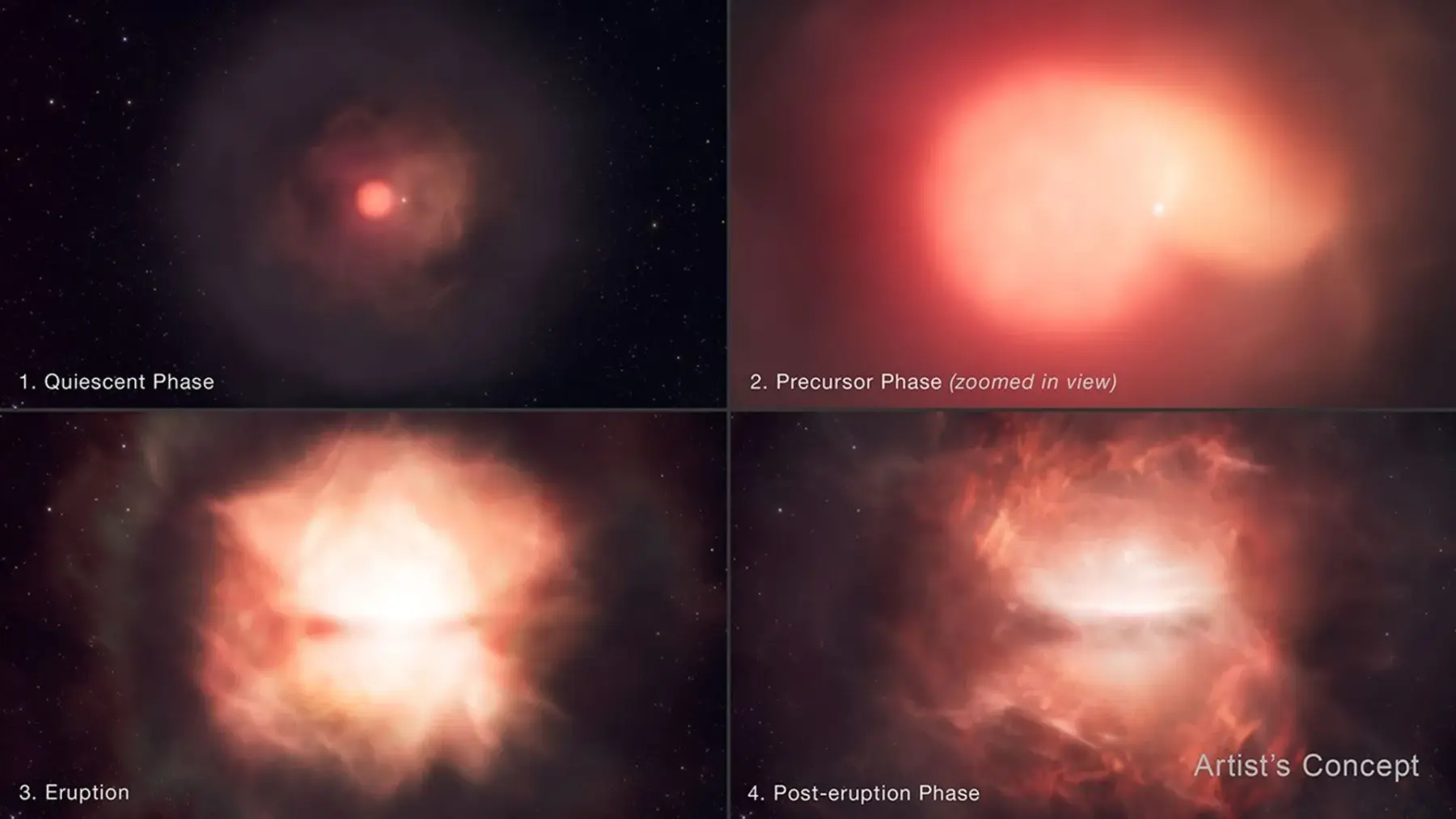
For thousands of years, two stars had orbited each other in relative stability. One — nicknamed Little Bao — was slightly smaller than the Sun, with an estimated mass of about 0.7 solar masses. The other, Big Bao, was a supergiant: roughly seven times the Sun’s mass, 350 times its radius, and 18,000 times its brightness.
Once Little Bao began grazing Big Bao’s outer atmosphere, the interaction accelerated far faster than anyone had anticipated. The two stars completed their final approach in just seven orbits — roughly seven years. Previously observed mergers involving smaller star pairs had required thousands of orbits to reach the same point. The eruption peaked within a single week, far faster than researchers expected for such an extended star, and Little Bao was ultimately dragged deep into Big Bao’s core. Researchers described the energy released as “almost like a bomb exploding inside a living star.”
What Webb revealed 47 days after the blast
Webb joined the investigation on December 24, 2025, through an urgently approved Director’s Discretionary Time program — just 47 days after the eruption peaked, making it the earliest follow-up observation ever achieved for an event of this kind. The telescope’s mid-infrared capabilities revealed centuries-old dust expelled by the giant star long before the merger — material essentially invisible at other wavelengths — giving researchers an unexpected long-term record of the system’s history.
Webb’s data didn’t stand alone. Combined with ultraviolet, visible, and near-infrared observations from multiple observatories, researchers reconstructed the system’s behavior before, during, and after the merger. Computer simulations refined using Webb’s measurements confirmed the outcome: the two stars had fully merged into a single object rather than surviving as a tighter binary.
Common envelope evolution: the cosmic process behind extreme objects
What happened to Bao has a name: common envelope evolution. It occurs when one star expands enough to engulf its companion, surrounding both in a shared outer layer of gas. As the smaller star moves through that gas, it loses orbital energy and spirals inward. Sometimes both stars survive in tighter orbits. Other times — as with Bao — the smaller star plunges to the core and merges completely.
The stakes extend well beyond any single system. Surviving binaries can eventually produce neutron stars, black holes, gravitational wave sources, supernovae, or millisecond pulsars. Bao’s case gave scientists a direct measurement of how efficiently energy and mass were transferred during the common envelope phase — data that can sharpen the theoretical models researchers rely on to predict how binary systems evolve across cosmic time.
A new era of catching stellar mergers in real time
Bao — officially designated AT 2025abao — is the first stellar merger of this specific type identified and studied as it actually happened. NASA’s Nancy Grace Roman Space Telescope, recently launched, is preparing wide-field surveys designed to catch exactly these kinds of transient events. Its Galactic Bulge Time-Domain Survey will repeatedly monitor large numbers of stars, making it well-suited to flag unusual brightness changes before they reach their peak.
“There’s going to be a large influx of similar discoveries just ahead,” said lead researcher Viraj Karambelkar of Columbia University.
The merged star’s internal structure and mass distribution remain uncertain. Future observations will track how the newly unified object evolves — and whether the energy injected by Little Bao’s final plunge truly gave its host star a second life.
Read the whole thing?
Get the week's signal, not the noise
Our sharpest reporting on energy, climate and nature — free, once a week.