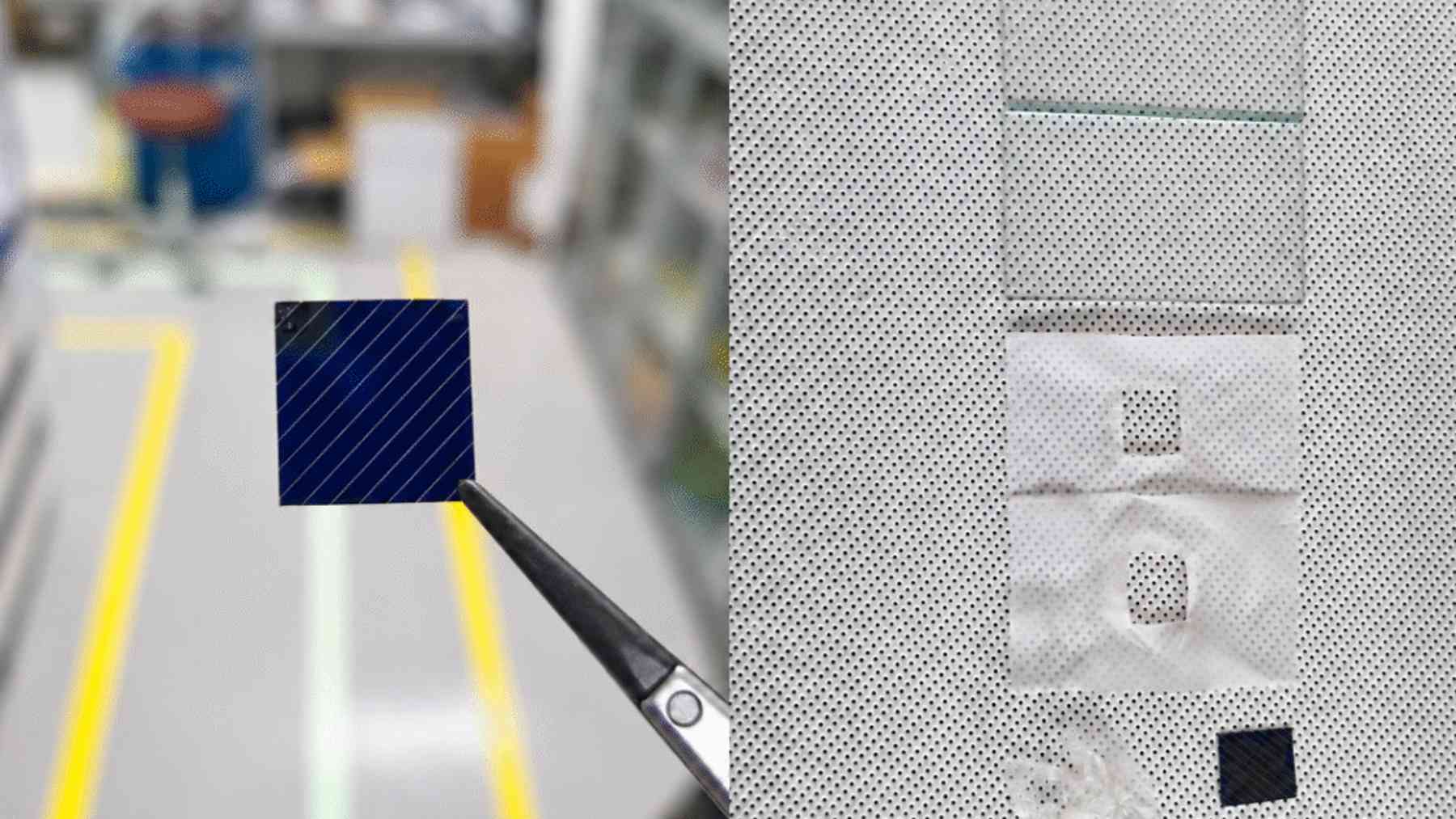
A thin square of glass lifts straight off a dark silicon wafer, clean as peeling a sticker.
No cracking.
No gummy residue left behind.
It happens on a lab bench, not in a junkyard.
The researchers say they were surprised by how quickly and cleanly the cell came free.
What made the layers let go of each other after being laminated together is the real surprise here.
A coil outside the panel heats only the metal
The trick is about where the heat goes, not how much of it there is. Researchers built a modified glass to glass module and set it against a water cooled copper induction coil, then ran an alternating current through that coil from outside the module.
The coil, operating at 270 kHz to 300 kHz, rapidly heats the cell’s metal contacts and triggers localized decomposition of the encapsulant right at the cell encapsulant interface, a method called induction heating, instead of baking the whole panel in an oven.
Because only the metal electrodes absorb the energy, the surrounding glass and plastic barely warm up at all. The corresponding researcher, Yonghwan Lee, told pv magazine the team “designed a glass-glass photovoltaic module that is easier to take apart at the end of its life.”
That narrow hot zone is the whole mechanism. Tests showed induction heating opened a gap of more than 360 degrees between the cell and the glass at a coil current of 100 amps, enough to break the glue down exactly where the two layers meet and nowhere else.
Layers separate in 5.4 seconds at full power
Speed tracked the current pushed through the coil. The modified mini modules came apart in about 18.6 seconds at 100 amps, 8.3 seconds at 150 amps and 5.4 seconds at 200 amps. Lee told pv magazine that “in our fastest test, the module layers separated in just 5 seconds.”
That stood out because conventional thermal recycling leans on ovens and hot knives working over minutes, and still often leaves layers fused or glass shattered. Microscopy of the recovered cells showed no structural damage, and spectroscopy indicated the remaining encapsulant largely kept its chemical structure.
There was no acid bath and no grinding the whole sandwich down to shards just to reach the metal underneath. That matters because crushing is the step that usually destroys a panel’s most valuable parts before anyone can recover them.
Nearly all the panel’s mass came back intact
So how much of the panel actually survived the process? Using induction heating, the team separated the layers of its test module and recovered almost all of its original mass, including the glass, the silicon cell and the polymer encapsulant, with negligible losses of glass, cells and release films. The work was reported in the journal Communications Materials by researchers at South Korea’s Korea Electronics Technology Institute and Australia’s University of New South Wales.
The demonstration was deliberately small. Simulations of heat flow through PERC cells came first, then simplified samples of a cell under an inch square laminated to tempered glass, and finally modified glass to glass mini modules holding a single cell between two tempered glass sheets roughly 2 by 3 inches.
The recovery figure matters because conventional recycling reliably reclaims the glass and the aluminum frame, which together account for most of a panel’s weight, while the silicon and the internal metals prove far harder to separate cleanly. Nothing here is a retrofit for the millions of ordinary panels already on rooftops and in fields.
Decades of aging rooftop panels still lack a fix
The timing is what gives the result its weight. Solar installations are aging out, and the stream of retired panels will only grow as early rooftop and utility scale arrays reach the end of their working lives. Even a single commercial rooftop array can carry thousands of panels, which hints at the volume now sitting on buildings that will eventually need an exit plan.
Other teams are attacking the same puzzle from different angles. A University of Glasgow group in Scotland used a fiber laser to release the plastic layer as an intact film and then pulled silver out with mild chemistry at more than 99 percent selectivity in one panel type, an approach the researchers estimate cuts recycling power use by 84 percent. That energy estimate comes from the research team itself and has not been demonstrated at commercial scale.
Both approaches point at the same stubborn problem, that the encapsulant holding a panel together was built to survive decades of sun and rain, which makes it just as hard to undo on purpose. Elsewhere in clean energy hardware, engineers testing a small underwater flap run into their own version of durability versus access, a reminder that almost every machine built to last outdoors has to be taken apart again someday.
Full sized panels face the next round of tests
None of this means a dead rooftop panel can be dropped onto an induction coil tomorrow. The method was shown on a module designed from the start to come apart, built glass to glass and yielding release films among its recovered parts, so today’s installed fleet still needs a fix of its own.
Still, the result gives manufacturers a blueprint for panels built to separate on purpose rather than by accident. That kind of forward design thinking echoes a pattern seen elsewhere in clean energy hardware, where a redesigned successor often handles its end of life better than the equipment it replaced.
The next step is testing the approach at full panel size and seeing whether a similarly fast, clean separation holds up outside a laboratory bench.
Read the whole thing?
Get the week's signal, not the noise
Our sharpest reporting on energy, climate and nature — free, once a week.