NASA has found something quite old in the extreme North of the planet. Neither the North nor the South Pole belongs to a country, which means that the land is free to explore, but it’s not that easy to study the most remote environments of the planet. Its unpredictability and weather make the exploration of the Arctic difficult, but what was once thought not to be possible is now a reality, as the space agency unveiled the existence of something under the thick ice in Greenland that is slowly melting.
Is the ice on Earth hiding mysteries?
There are a couple of military bases, laboratories, and small cities in these Arctic environments, but life is very different from what we are used to, as they have to adapt to the winter weather the whole year. NASA has been studying these areas for a while, trying to find anything that might hint at a new discovery in the universe – and it was worth it.
Inside the Arctic Ocean, there is a particle called a neutrino that traveled billions of light years until it hit Earth. There aren’t many, but the ones that labs around the world have identified are mostly in cold environments. With this in mind, NASA explored the extreme North of the planet, until it found something hidden since the Cold War.
NASA found an abandoned military base in Greenland
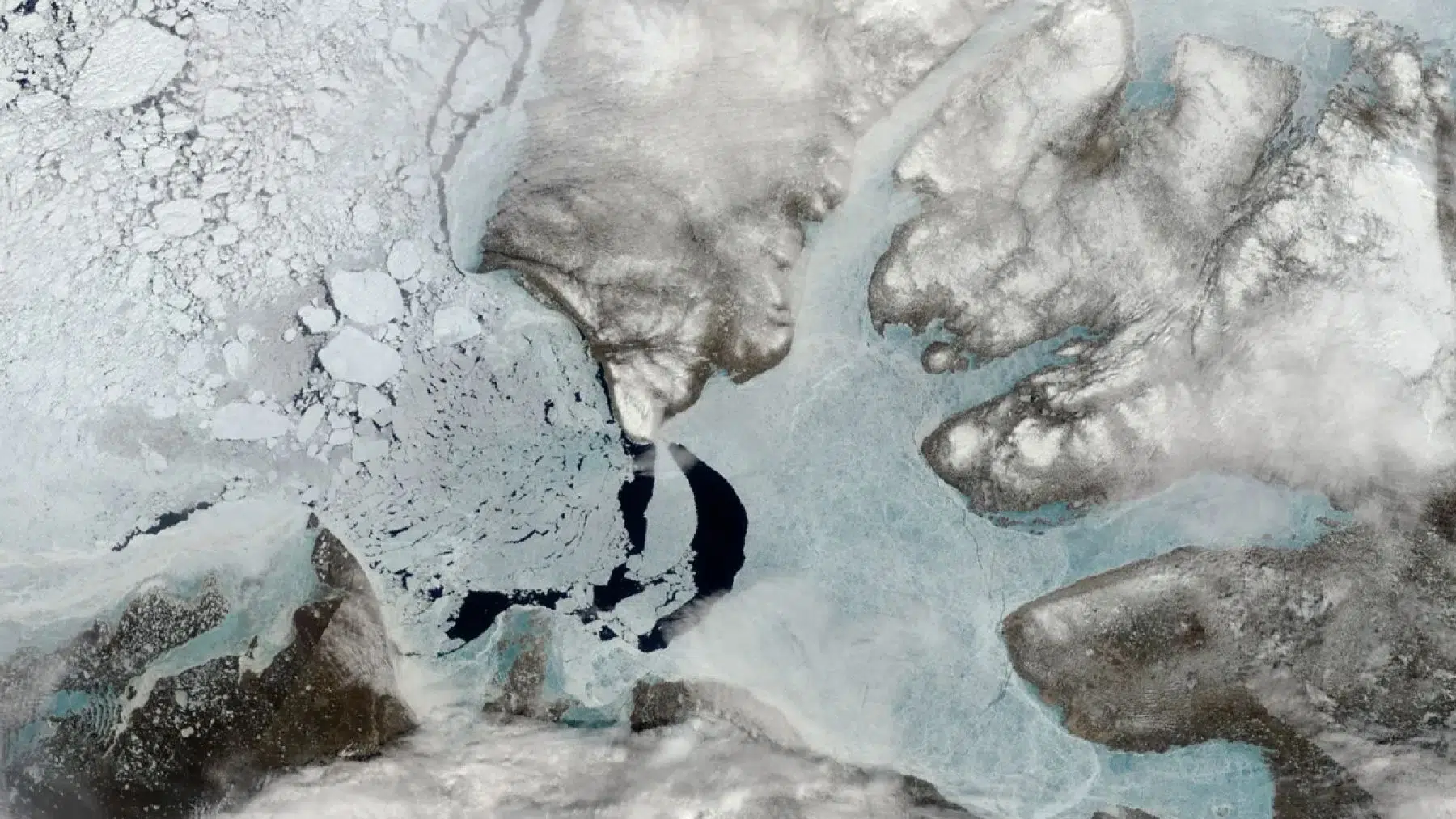
A team of NASA scientists surveying Greenland’s ice sheet came across an unexpected find: the long-abandoned site of Camp Century, a secret U.S. military base built during the Cold War. According to NASA’s Jet Propulsion Laboratory (JPL), the team was mapping the ice bed when the structure appeared in their data, puzzling researchers until they identified it as the historic site.
Although Camp Century had been spotted before in radar scans, those earlier flights used older equipment that couldn’t reveal much detail. This time, NASA used an advanced form of radar – Uninhabited Aerial Vehicle Synthetic Aperture Radar – allowing the team to clearly make out buildings and other structures that had been hidden for decades. Chad Greene, a cryospheric scientist at JPL who was on the flight, explained that the new data offered a view of the site unlike anything seen before.
Why was the base built in a remote place?
Originally built in 1959 deep within the Greenland ice, Camp Century was designed as a multipurpose site. Its official role was to test construction techniques and host scientific research in the harsh conditions of the Arctic, but it also served a more covert mission: exploring the possibility of launching nuclear missiles from deep under the ice. At its peak, the site housed between 85 and 200 soldiers and was powered by its own small nuclear reactor.
Although the base was abandoned in 1967 when the Army canceled its missile program, its legacy remained sealed within the ice. According to William Colgan, a climate and glacier scientist and research associate at the Cooperative Institute for Research in Environmental Sciences (CIRES), ice core samples taken from Camp Century continue to play a role in climate studies today.
Snow melting to reveal more of what’s underneath
The Army Corps of Engineers removed the reactor when the site was decommissioned, but much of the rest of the infrastructure and waste were left buried. Researchers now worry about what could happen as temperatures rise and ice melts. Colgan explained that climate simulations point to a shift from net accumulation of snow to net melting as soon as 2090, which could expose buried waste. Once that shift occurs, he warned, it would only be a matter of time before the waste starts to seep out, making the situation irreversible.
Read the whole thing?
Get the week's signal, not the noise
Our sharpest reporting on energy, climate and nature — free, once a week.