Artificial reservoirs and irrigation ponds in California are being put to work as locations for floating solar panels.
Installing photovoltaic systems on water is a smart way to save land and reduce evaporation and algal blooms. But birds have to adapt to the changes in their freshwater habitats.
The University of California, Davis recently published an ecological assessment of the interactions between wildlife and the new technology. What changes are being created by placing solar arrays into aquatic habitats?
How observational tracking of artificial bodies of water is carried out
The Wild Energy Initiative is run by UC Davis, and researchers were sent to evaluate PV installations operating on man-made water bodies in California. These include ponds used for agricultural irrigation, municipal wastewater facilities, and water storage reservoirs.
The construction of solar projects on land usually involves large-scale clearing of natural vegetation, which is disruptive to wildlife. Floating array platforms only need open water, presenting less of a disruption to the ecosystem.
This latest survey saw biologists recording how the diverse aquatic bird species in the state started incorporating the solar hardware into their daily routines.
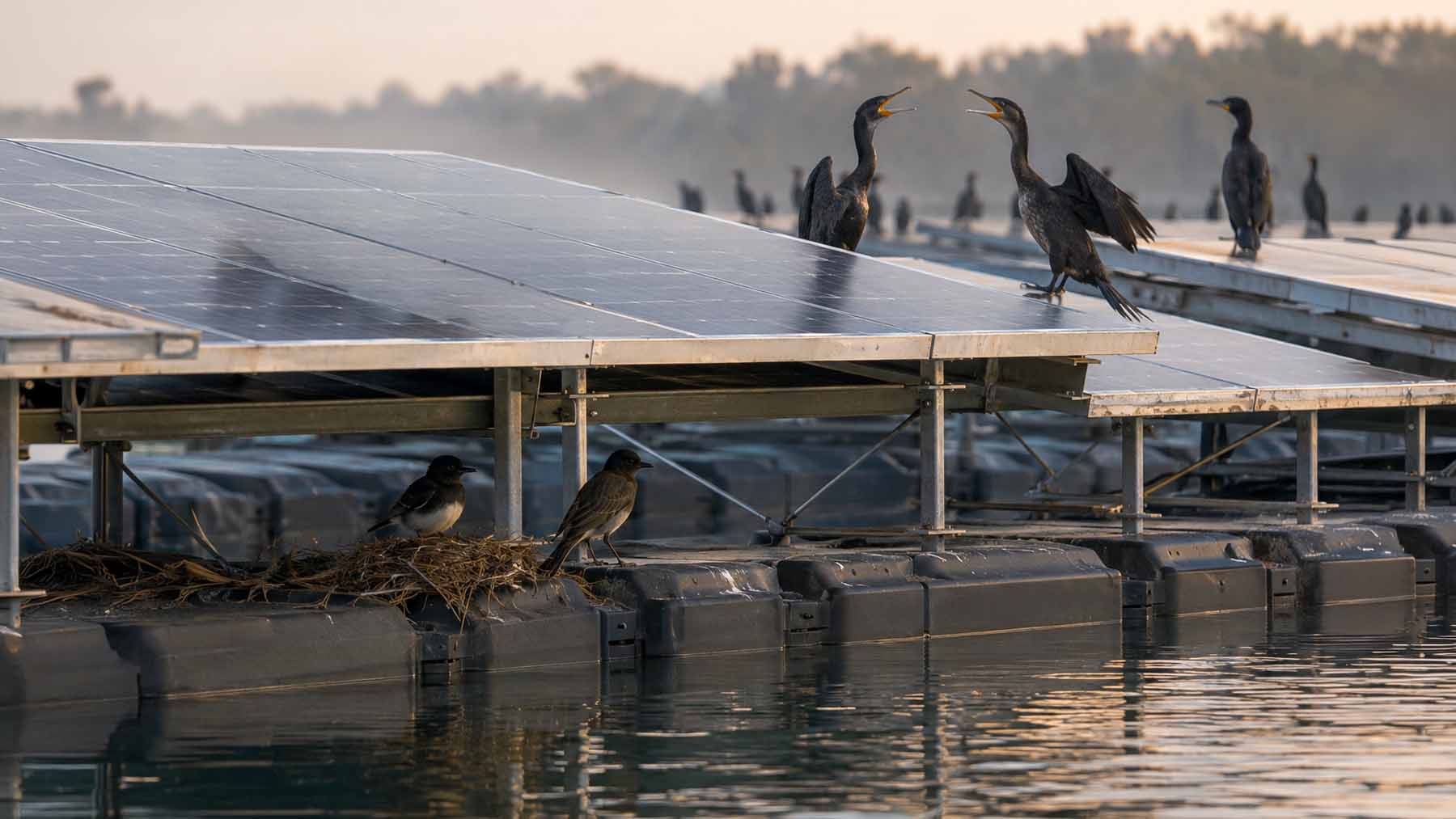
Before the sun rises, black-crowned night herons used the pontoons as roosting sites. Double-crested cormorants were seen gathering on any exposed edges to dry their wings, with fights breaking out over the most elevated prime spots.
Some smaller species moved onto the pontoons permanently, like black phoebes. These birds liked the shaded overhangs of the panel frames, building sheltered nests away from the sun.
These field observations confirmed that birds see the floating platforms as extensions of their environment rather than man-made industrial hardware to be tolerated or avoided.
Understanding floating solar technology’s ecological footprint
Energy planners working towards the global expansion of floating solar technology need to be aware of its ecological footprint.
The team from the UC Davis Department of Land, Air and Water Resources worked out a framework that identified five key ways that waterbirds interact with infrastructure on the water surface. One feature is that the arrays offer places to roost, forage, and nest. This is beneficial in agricultural or rural settings where vegetation along the edges of the water has been removed or compromised.
But on the negative side, there are ecological risks to the rapid deployment of floating solar tech. For birds that need to dive to hunt, they now have less surface area to work from. Environmentalists have concerns about drops in water quality, chemical leaching from artificial materials, and sunlight blocking.
A balance needs to be worked out between habitat creation and species displacement, with considerations being unique at every facility depending on the combination of species present.
Strategic design considerations and research limitations
The research shows that floating solar arrays do not act as simple ecological barriers. Instead, they function as novel ecosystems where different bird species experience distinct costs and benefits.
To minimize negative impacts, researchers emphasize strategic siting and structural design choices. Placing arrays on heavily modified artificial ponds rather than natural wetlands reduces habitat loss for sensitive species. Adding perching deterrents near high-voltage wiring, installing dedicated roosting platforms, and leaving open water corridors can further prevent wildlife hazards.
However, the study authors highlight several critical scientific limitations. Most observational data came from a small group of California sites over short study periods.
Long-term impacts on reproduction, foraging, and migration patterns are still unmeasured
Further multi-year monitoring across diverse geographic regions is required to confirm whether these platforms support healthy wildlife populations over time.
Ultimately, the presence of birds on floating solar farms shows how wildlife adapts to expanding clean energy infrastructure.
As developers deploy solar platforms across agricultural reservoirs, thoughtful ecological design can align renewable energy targets with regional conservation goals.
The full study can be read here: Hernandez, R.R., Forester, E., Cagle, A.E. et al. Aligning floating photovoltaic solar energy expansion with waterbird conservation. Nat Water 3, 525–536 (2025). https://doi.org/10.1038/s44221-025-00429-4
Read the whole thing?
Get the week's signal, not the noise
Our sharpest reporting on energy, climate and nature — free, once a week.