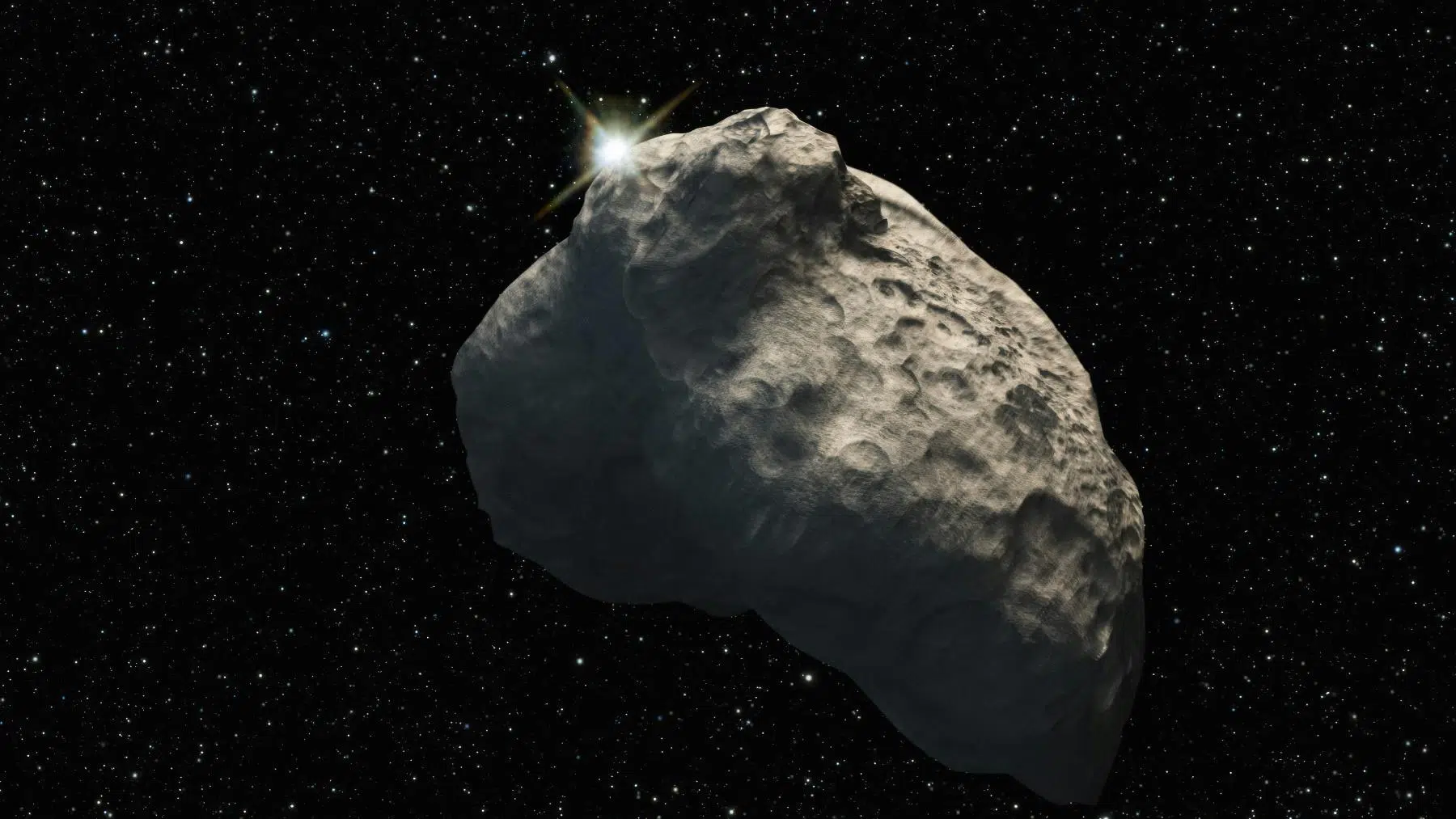
On Friday, April 13, 2029, an asteroid roughly the size of the Empire State Building will pass closer to Earth than our own geostationary satellites — visible to the naked eye from the ground. Apophis won’t hit us. But at 1,500 feet wide, it wouldn’t need to in order to cause catastrophic damage if its trajectory were ever slightly different.
For decades, planetary defense has remained a niche concern, chronically underfunded and largely left to government agencies stretched thin across competing priorities. Now, with the 2029 flyby less than four years away, a small Southern California startup is making the case that the private sector shouldn’t be waiting on the sidelines.
A once-in-a-lifetime close encounter
Apophis isn’t just another asteroid flyby. On April 13, 2029 — a Friday the 13th — it will pass closer to Earth than the geostationary communications satellites that carry our television signals and weather data. Radar measurements place it at roughly 1,500 feet wide and 550 feet tall, large enough to cause regional devastation if it ever struck. The naked-eye visibility alone will make it a global event unlike anything most living people have witnessed.
Astronomers have confirmed there’s no impact risk in 2029. That reassurance, though, hasn’t dampened the scientific urgency. The confirmed safe passage has actually freed researchers to treat the flyby as something else entirely: a rehearsal. Nations around the world are already coordinating observation plans at various stages of the asteroid’s approach, treating Apophis as a live test of how well humanity can actually monitor, study, and respond to a potential threat.
The event is, in a real sense, a deadline — one that has focused attention on how much work remains.
NASA’s underfunded blind spot
The scale of that remaining work becomes clearer when you look at the resources currently allocated to it. James Orsulak, co-founder of Exploration Labs (ExLabs) and chairman of the Planetary Defense Trust, put the problem directly: NASA’s planetary defense budget represents less than one percent of the agency’s total funding. “That’s not enough to ever do anything,” he told Space.com.

The structural problem runs deeper than budget lines. Deep-space missions today typically require billion-dollar budgets and decade-long development timelines — a model that makes rapid response to an emerging asteroid threat essentially impossible. By the time a mission could be designed, funded, and launched under current government frameworks, the window for meaningful deflection could already be closed.
Former NASA Administrator Jim Bridenstine, now managing director of the Artemis Group, argued at the Space Foundation’s 41st Space Symposium that the solution is a structural shift, not just more government spending. “You want the government to be one customer of many customers for a very robust commercial marketplace,” he said, pointing to how competition between commercial providers has already driven down costs and expanded access across other areas of space activity. Experts on the symposium’s planetary defense panel largely agreed: the gap between current capability and genuine readiness is significant.
Apophis EX: the first commercial deep-space ride-share
ExLabs is proposing to help close that gap with a mission it calls Apophis EX — billed as the first commercial deep-space ride-share mission. The plan calls for a rendezvous with Apophis both before and after its 2029 Earth flyby, generating scientific data on asteroid dynamics, refining impact risk models, and testing deflection strategies in a real-world environment.
Orsulak frames the mission as more than a single spacecraft. It’s meant to be a proof of concept for a new operating model: deep-space exploration that is, in his words, “consistent, collaborative, and commercially driven.” The company’s stated goal is to transform planetary defense from a niche scientific discipline into a genuine global priority — one supported by repeatable, affordable infrastructure rather than one-off government programs. The ambition is considerable for a startup, but the argument follows a logic that has already reshaped commercial launch: bring down the cost, increase the cadence, and capability follows.
What deflecting an asteroid actually takes
Even with better mission infrastructure, the technical challenges of planetary defense remain substantial. At the symposium panel, experts outlined the range of deflection methods currently under consideration — gravity tractors, ion beams, kinetic impactors, and nuclear detonation among them. Each approach carries different requirements, lead times, and uncertainties.
David Bearden of JPL’s Office of Strategic Planning stressed that the field needs real missions to answer basic questions: Do these techniques work? Under what conditions? That knowledge can’t be modeled into existence — it has to be earned through flight experience.
Edward Lu, former NASA astronaut and co-founder of the B612 Foundation, pushed back on the idea that any single deflection technology could be designated the right answer. “You’ve got to get that out of your mind,” he said. Every scenario is different, and matching the response to the specific threat requires a depth of operational knowledge the field simply doesn’t yet have. Lu’s prescription: a high mission flight rate. The same industrial logic that made commercial launch reliable and affordable — fly often, learn fast, drive down cost — applies directly here. “You get safety, reliability… because you know what works, what doesn’t work, and you get cost reduction,” he said.
Making planetary defense a spectator sport
ExLabs isn’t thinking only about the science. Orsulak is actively pursuing partnerships with IMAX and broadcasters to stream the Apophis flyby live in prime time, predicting viewership that could rival the Super Bowl. The goal is a deliberate reframing: away from disaster-movie narratives like Armageddon and toward real, evidence-based planetary science. “It’s time to tell the truth of science fiction becoming science fact,” he said.
The public engagement angle isn’t incidental. Sustained investment in planetary defense depends on sustained public awareness. A generation that watches Apophis pass in real time, with context and scientific explanation, is a generation more likely to support the infrastructure needed to address the next one.
Lu sees the private sector already moving at a pace that would have seemed implausible a decade ago. Spacecraft that once took ten years to build can now be completed in a year. That compression of timelines is what makes the broader vision credible: an industrial capacity capable of launching a planetary defense mission on short notice, not after years of appropriations battles. Whether ExLabs can execute on Apophis EX before the 2029 window closes remains to be seen. But the flyby is coming regardless — and the question of who’s ready to meet it, and how, is one the next few years will begin to answer.
Read the whole thing?
Get the week's signal, not the noise
Our sharpest reporting on energy, climate and nature — free, once a week.