On a leaf covered trail in the eastern woods, a hiker steps within inches of a copperhead and never sees it.
The snake does not rear back or strike.
It simply freezes, its banded body melting into the brown litter.
You could stand right over it and walk on none the wiser.
That stillness is not luck, it is the whole plan.
So why will a copperhead not bite, and what is hiding in its venom?
Two bites out of sixty nine
A team of researchers set out to test how quick copperheads really are to strike. Working with 69 wild snakes, they pressed a padded boot down beside each one, then right on top of it, then lifted it with tongs, the way a careless hiker might. Only 2 of them ever tried to bite.
The tests were run on wild snakes out in the field, not cornered animals in a cage, and each one faced a boot set beside it, a boot pressed on top of it, and a gloved grab with tongs. That works out to barely three in a hundred, and even those two struck only after being handled directly.
The rest froze, slid away, or did nothing at all, even with a boot resting on their backs. The researchers concluded the snakes rely on camouflage and flight far more than on their fangs, treating a bite as an absolute last resort.
Built to be stepped over, not to strike
The copperhead’s real weapon is its skin, not its teeth. Its coppery hourglass bands break up its outline against dead leaves so well that it may have the best camouflage of any snake in the country. An ambush hunter, it wins by not being seen.
So its instinct is to hold perfectly still.
When a footstep lands nearby, the snake’s first move is no move at all, betting that stillness will let the danger pass. Lunging at a creature far too big to eat would blow that cover and invite a stomping boot in return.
That is why nearly all copperhead bites happen at the very moment of contact, when a hand or foot lands right on the snake before it can slip away, not from a snake charging across a yard.
Why a copperhead would rather not bite
There is a cost to biting that people rarely think about. Venom is expensive to make, brewed slowly by the body and meant for catching prey, not for arguments with hikers. Spending it on something it cannot swallow is a pure loss for the snake.
A defensive bite is also a gamble.
The moment a copperhead strikes a person, it gives away its position and risks being killed on the spot. Over countless generations, the snakes that stayed hidden and kept their venom left more young than the ones that lashed out, and that caution is now baked in.
It helps that a copperhead bite is rarely a death sentence. Their venom is among the milder of the country’s pit vipers, they often inject little or none in a warning strike, and healthy adults almost always recover with care.
The other thing hiding in the venom
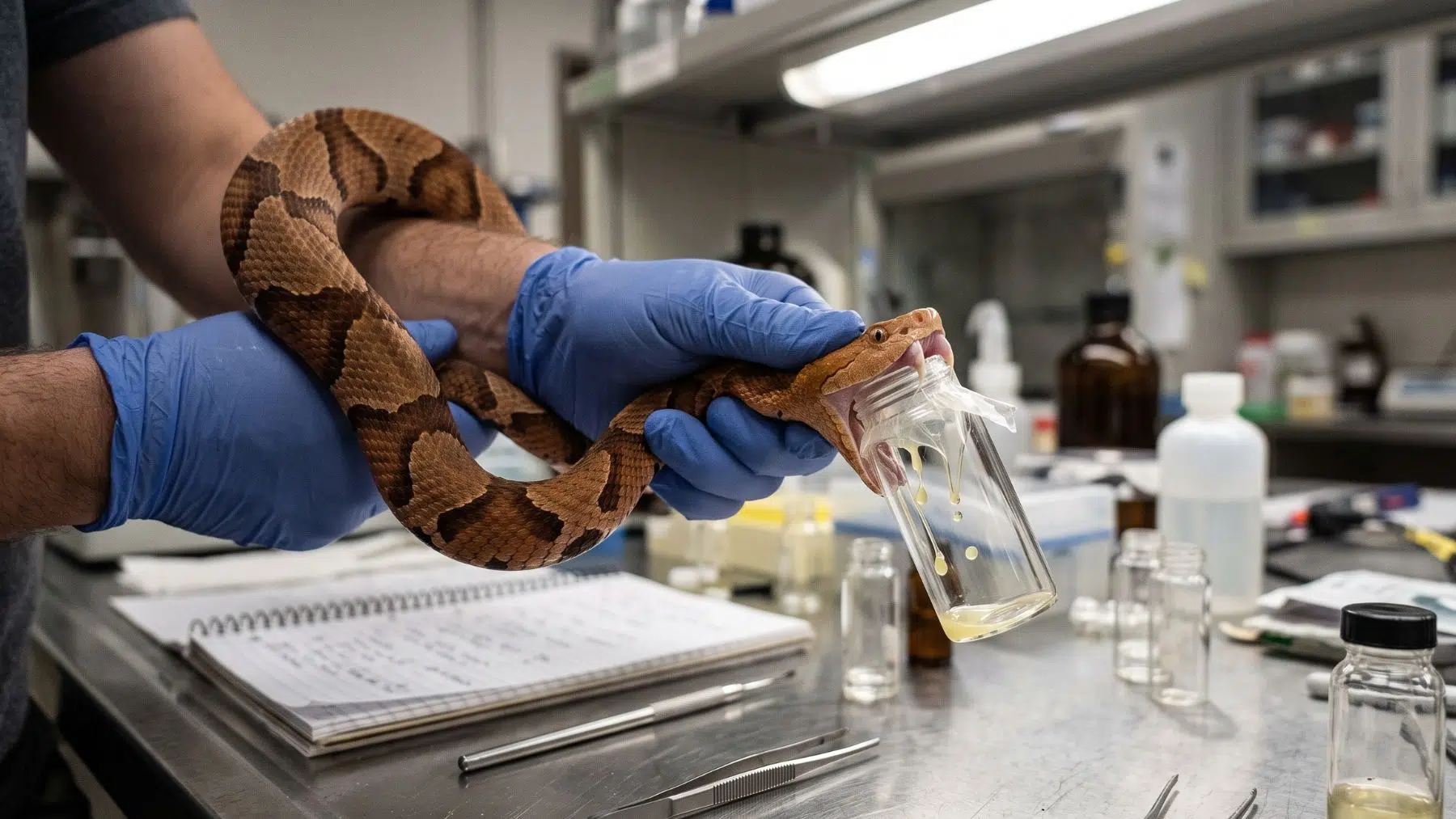
Here is where the feared part of the animal turns useful. Deep in copperhead venom sits a protein that does something startling in the lab, it stops cancer cells from gripping and spreading, the same patient science behind an offshore wind survey.
The molecule jams the docking points cells use to move, so they can no longer crawl into new tissue. In lab studies and in mice, the venom protein slowed the growth and spread of breast cancer, choking off the new blood vessels a tumor needs and blocking the grip of tumor cells. The same chemistry that subdues a mouse may one day help corner a tumor.
Researchers even packed the protein into tiny fat bubbles so it could travel the bloodstream intact, a delivery trick meant to carry it straight to a tumor.
A snake worth more alive
None of this is a cure yet. The work is still early research, tested in dishes and animals rather than people, and a promising molecule can take many years to become a drug, if it ever does. Honesty about that timeline matters. The venom protein is one of thousands snakes make, and only a handful of such compounds ever reach a clinic.
Still, the irony is hard to miss.
A snake most people would kill on sight turns out to almost never want to bite, and to carry in its venom a possible weapon against cancer, the way a fox makes a home around some solar panels. The animal is worth far more left alone than dead.
Copperheads already range across more than two dozen states, doing their unseen work in the leaf litter of backyards and trails alike.
The next time the leaves seem to shift underfoot, the best move is the snake’s own. Stand still, look, and step around.
Read the whole thing?
Get the week's signal, not the noise
Our sharpest reporting on energy, climate and nature — free, once a week.