Space is filled with mysteries that have confounded us for generations.
But when a team of researchers “heard” a cosmic explosion in space, they were in for the shock of their lives when they turned their telescopes towards it. Our development of infrared imaging telescopes has enabled us to gaze past the clouds of space dust that have blocked our view of the cosmos.
How did our Moon come to be where and what it is today?
How infrared imaging technology has changed the way we “look” at space
Astronomers have developed their own version of Predator Vision straight out of the films.
Infrared technology has allowed us as a society to peer through the “space curtains” to reveal the truth about the cosmos that we never knew existed. Infrared light has significantly longer wavelengths that can slip through the gaps of space dust out in the universe.
As we know, the universe has been expanding for eons, with the light from the very first stars being stretched over billions of years.
And by the time that this starlight reaches us, it is no longer visible to the naked eye. Infrared imaging allows us to see this “invisible” light as it has shifted to the unseen wavelength. Without infrared technology, we would never even know this light existed.
Our understanding of space and time has been revolutionized
As a society, we have come extremely close to unraveling the mysteries of the universe over the last few decades.
Astronomers have spent the best part of the last 100 years searching for answers as to what “cosmic concrete” is holding the universe together. We know that gravity can stretch and bend, thanks to the iconic mind of Albert Einstein.
Science has proven that the universe has been expanding since the Big Bang, meaning that, as it had a beginning, it may have an end too.
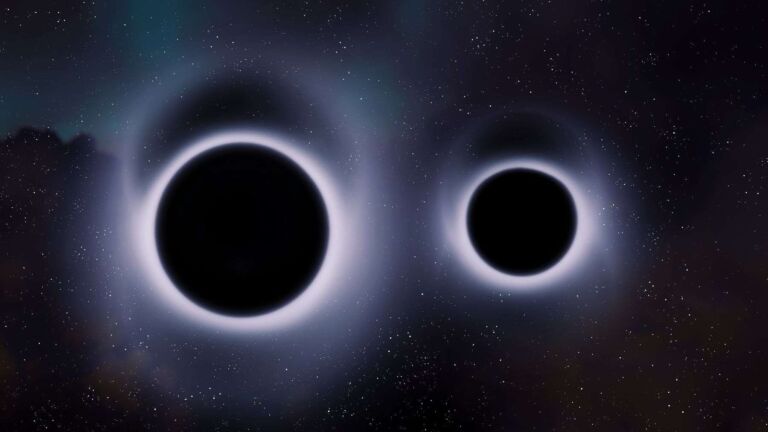
The discovery and proof of black holes’ existence has been a major challenge for science. Black holes can only really be identified through their gravity, although the very first image of a black hole has recently given us definitive proof that they exist.
A team from the University of Washington has made a remarkable discovery that builds on the theory presented in the study, “Gaia-GIC-1: An Evolving Catastrophic Planetesimal Collision Candidate,” published in The Astrophysical Journal Letters.
A flickering light in the deepest regions of space has been explained
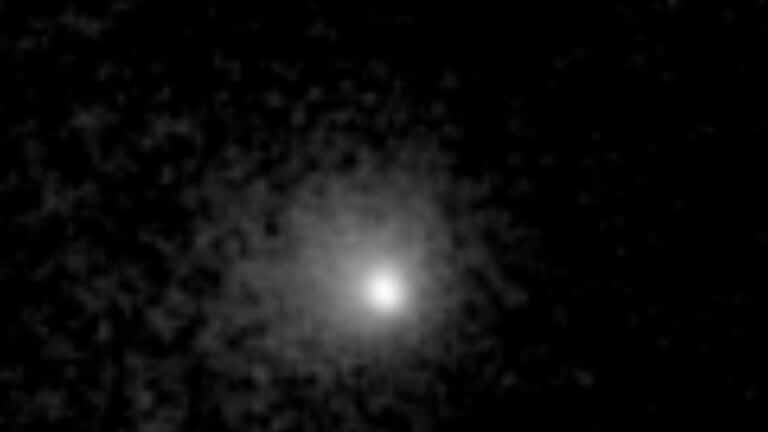
A star much like our own, namely Gaia20ehk, was going about its business 11,000 light-years away when it started to flicker like a light switch being turned on and off, over and over again.
A doctoral candidate from the University of Washington, Andy Tzanidakis, noticed the faint flickering and decided to do some space investigation.
What he found is that the on-and-off motion of the light from Gaia20ehk was caused by two massive planets that collided with each other in a remarkable space crash of epic proportions. He noted that most likely the two planets had grazed each other, which caused the infrared light to be blocked from view initially.
Two planets came together to block infrared light from billions of light-years away
He found that the two planets eventually had a full-on head-on collision that created a massive, glowing cloud of hot rock that he now believes is most likely how our moon came into existence.
Astronomers have been searching for the origin of the Moon for decades, and have even begged NASA to fast-track the next lunar mission to get more answers. But the findings made by Tzanidakis have shown us that cosmic collisions can create new planets and Moons around the universe under the right conditions.
With the recent “blood moon” fresh in our memories, we now have a better idea of how the Moon came to be what it is today.
Read the whole thing?
Get the week's signal, not the noise
Our sharpest reporting on energy, climate and nature — free, once a week.