March is about to feel different after sunset. A familiar full Moon will suddenly glow an intense shade of red. Two bright planets will appear to drift toward each other in the fading twilight. And somewhere between those moments, Earth itself will cross an invisible seasonal line in space. None of this requires special equipment. Just a clear sky, the right timing, and a reason to step outside. Over the next few weeks, the sky will stage a sequence that feels almost carefully planned.
A shadow that changes the Moon
The first act begins on March 3, and it starts with alignment. When the Sun, Earth, and Moon line up perfectly, our planet moves directly between the Sun and the full Moon. Earth’s shadow slowly slides across the lunar surface. At first, it looks subtle. Then the darkness deepens.
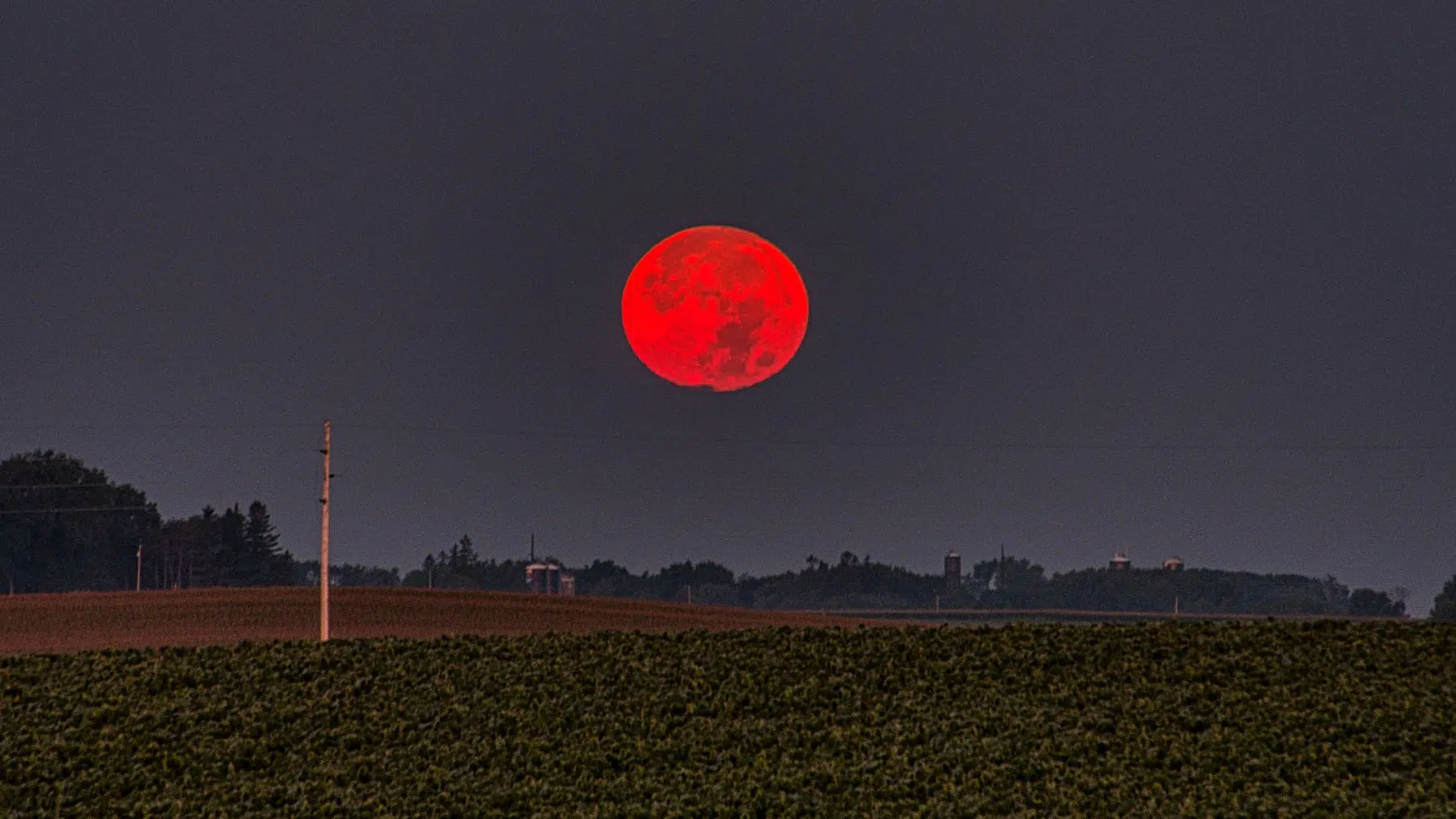
During a partial lunar eclipse, only part of the Moon slips into Earth’s shadow. But during a total lunar eclipse, the alignment is exact. The Moon moves fully into the darkest part of that shadow, known as the umbra. And that is when the transformation becomes unmistakable.
Instead of disappearing into blackness, the Moon begins to glow. Not white. Not silver. But a deep copper red. Many call it a “blood moon,” and once you see it, the name makes sense.
Why the Moon glows instead of vanishing
It may seem strange that a completely shadowed Moon does not simply go dark. But Earth’s atmosphere has other plans. As sunlight passes through it, shorter wavelengths scatter away. The red and orange light bends and continues onward, wrapping around the planet.
That filtered sunlight reaches the Moon and bathes it in a warm glow. What we see is sunlight that has traveled through Earth’s atmosphere before touching the Moon. It is a reminder that even in shadow, our world plays a role in shaping what we see.
This total lunar eclipse will be visible from eastern Asia and Australia in the evening, across the Pacific at night, and across most of North and Central America as well as western South America in the early morning hours. For many, the red Moon will rise or hang above city skylines, quiet and almost surreal.
Planets draw close and the season quietly shifts
March does not stop with a red Moon. Just days later, on March 8, Venus and Saturn will appear unusually close together in the western sky after sunset. The two planets will be separated by only about one degree — roughly the width of a single finger held at arm’s length.
This event is called a conjunction. From Earth, the planets seem to “cozy up” to each other, even though in reality they are nearly a billion miles apart. Perspective turns distant worlds into temporary neighbors.
Then on March 20, something less dramatic but just as important happens. The vernal equinox arrives. Astronomically, this is when the Sun crosses above Earth’s equator while moving from south to north. In the northern hemisphere, it marks the beginning of spring. In the southern hemisphere, autumn begins.
On this day, daylight and darkness are nearly equal. Both hemispheres receive almost the same amount of sunlight. For a brief moment, day and night balance almost perfectly at twelve hours each.
Three separate sky events. One month. A red Moon, a planetary pairing, and a seasonal turning point.
A sky that keeps moving, even when we don’t notice
March’s events are not rare in cosmic terms. Eclipses, conjunctions, and equinoxes follow predictable patterns. But when they arrive together, they create a rhythm overhead that feels intentional.
A red Moon reminds us that Earth’s shadow can paint the sky. A conjunction shows how distance and perspective shape what we see. An equinox marks the steady tilt and motion of our planet around the Sun.
Throughout the month, the Moon will move through its phases as well: full on March 3, third quarter on March 11, new on March 18, and first quarter on March 25. Each phase shifts the night’s light, subtly changing the sky week by week.
None of this demands a telescope or advanced knowledge. All it asks is attention.
March offers something simple but powerful: a reminder that the sky is never still. Even when we are busy below, shadows are moving, planets are aligning, and seasons are turning.
All it takes is looking up at the right moment to see the story unfolding above us.
Read the whole thing?
Get the week's signal, not the noise
Our sharpest reporting on energy, climate and nature — free, once a week.