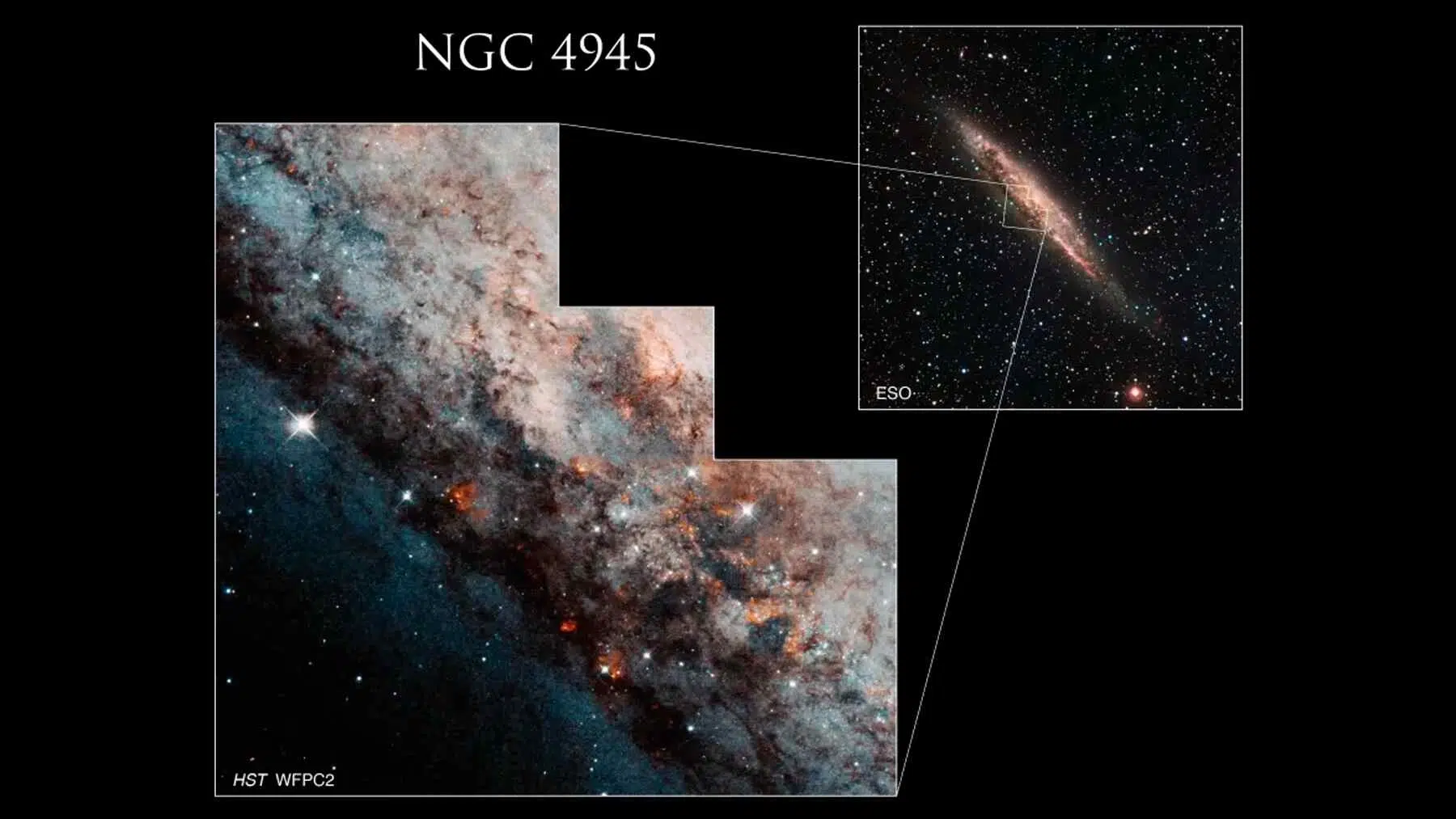
Credits: Ground-based image: European Southern Observatory; Hubble image: NASA, ESA, and H. Falcke (Max Planck Institute for Radio Astronomy); Processing: Gladys Kober (NASA/Catholic University of America)
A distant galaxy, faint and elongated, drifting quietly in deep space. Nothing unusual. Just another structure shaped billions of years ago.
Astronomers even had a name for objects like this.
Cosmic fossils.
Remnants of the past, unchanged, predictable.
But then something didn’t add up.
Because this one wasn’t behaving like a fossil at all.
It was shining—brightly—and in a way no one expected.
So what exactly was hiding inside it?
How a familiar galaxy started raising unexpected questions
The object is known as Caldwell 83.
Located about 13 million light-years from Earth, it initially appeared to be a typical spiral galaxy. From ground-based telescopes, it looked like a narrow streak of light, almost like a glowing cigar in the darkness.
Nothing about it suggested anything unusual.
Until astronomers compared it more closely to our own galaxy.
That’s when the first question appeared.
Why was it so bright?
Galaxies like the Milky Way emit light, but within a certain range. Caldwell 83 seemed to exceed that, radiating far more energy than expected.
At first, it was easy to assume something simple.
Maybe a higher concentration of stars.
Maybe a different structure.
But the more data came in, the harder it became to explain.
A signal that couldn’t be seen—but couldn’t be ignored
The real turning point came when scientists began observing Caldwell 83 using the Hubble Space Telescope.
From Earth, thick clouds of gas and dust obscure much of what’s happening inside distant galaxies. But Hubble doesn’t rely on visible light alone.
It uses multiple wavelengths, including X-rays, to see through those barriers.
Hidden behind the dust, Caldwell 83 was emitting energy in a range invisible to the human eye.
An “impossible” color.
Not because it breaks the laws of physics—but because it exists outside the narrow band of light humans can perceive.
Another image of Caldwell 83 taken by Hubble’s Advanced Camera for Surveys (ACS) – Ground-based image: European Southern Observatory; Hubble image: NASA, ESA, B. Williams (University of Washington), W. Li (University of California – Berkeley), and ESO; Processing: Gladys Kober (NASA/Catholic University of America)
This radiation, detected through advanced instruments, revealed activity that had been completely hidden before.
Something powerful was happening at its core.
The real explanation behind the “cosmic fossil”
Caldwell 83 is not a fossil.
It is a Seyfert galaxy—a type of galaxy with an extremely active center.
At its core lies a supermassive black hole.
According to NASA Science, that’s where the light is coming from.
Not from the black hole itself, but from the material around it.
Gas and dust are constantly being pulled inward by the black hole’s gravity. As this material spirals closer, it heats up to extreme temperatures.
Warren van der Sandt is a skilled editor known for his clean, precise writing and strong background in science. Combining clarity with depth, he brings complex ideas to life in an accessible way, always with a friendly and approachable touch.