The torch moves along the plate at walking speed and the slag comes off in a bright spray.
Under it is a wall of mill steel about an inch thick, rolled into a curve twenty years ago.
Work on this ranchland ran from the twenty fourth of May to the nineteenth of December, 2022.
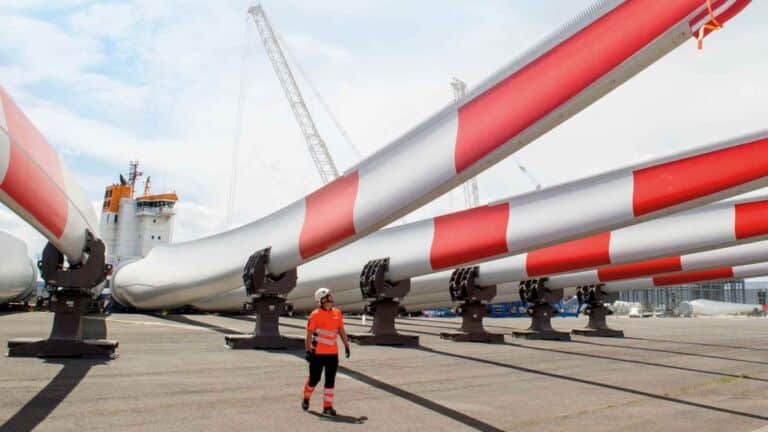
Two piles grew that summer. One was cut metal. The other was torn white composite.
Both left on trucks. Only one of them left with money moving toward the seller.
Which is the part of a teardown nobody writes down.
Why 1 pile has a bid and the other a fee
Steel is remeltable, and that single property decides everything downstream.
An electric arc furnace takes structural scrap by the ton and does not care what it used to be. A tower wall, a bridge girder and a car body all come out of the melt as the same liquid.
Because the melt is indifferent, the metal has a published price. There is a bid every morning, and a dealer can calculate what a field of towers is worth before a single cut is made.
Blade composite is the opposite kind of material. The resin holding the glass fiber is thermoset, meaning the molecules are cross linked during curing, so heating it does not soften it back into a liquid. It chars.
Nothing bids on a material that cannot be remelted. Whoever takes it charges to take it, and that charge is a line in the demolition budget rather than a credit against it.
So one stream is a receivable and the other is a payable.
160 machines on 10,000 acres of ranchland
The site sits near Fluvanna, spread across Borden and Scurry counties in west Texas.
It went into service in December of 2003 with 160 turbines, each rated at 1 megawatt, spread over roughly 10,000 acres of working ranch.
Taking them down was a cutting job, not a recycling job. A crew of torch cutters worked through the standing towers while flatbeds, lowboys and gondola trailers carried the pieces out.
What replaced them is a smaller field. Thirty eight machines rated at 4.8 megawatts each, bringing the site to 182 megawatts, which is about 14 percent more capacity standing on 122 fewer towers.
Construction of the new field started in the second quarter of 2022 and finished in the closing months of 2023.
The ribbon was cut in April of 2024.
22,078 tons on a ledger against 2,100 in a release
The two numbers that make this story exist were never published together, and they come from opposite kinds of document.
The fiberglass figure is the operator’s. It says it contracted the removal and repurposing of 2,100 tons of fiberglass from the blades of those 160 turbines, bound for products used in concrete, asphalt, composites and bulk molding.
The handler is described only as a repurposing company local to the Lubbock area. It is not named, and no process is described.
The metal figure is not in any release. It is a row on a scrap dealer’s project list, next to a start date, a finish date and an estimated payout above 7.5 million dollars.
That row reads 22,078 tons, bought from the demolition contractor working the site.
Per machine that is roughly 138 tons of metal against 13 tons of blade.
What the 7.5 million dollar check did not cover
Set the two against each other and the composite comes to under a tenth of what left the ranch.
That is the finding, and it matches an earlier count putting blades under 8 percent of a turbine’s mass, in the way that an Iowa shredder turns into a tidy answer.
Four cautions belong with it. The dealer’s own page says over 22,000 tons in its text and 22,078 in its table, and the buyer’s list books that figure in gross tons, which run 2,240 pounds rather than 2,000.
The fiberglass figure carries no stated unit at all, so the ratio is about ten to one and not a number to put a decimal on, as the trade account reports it.
The dealer also says it took all processed scrap accumulated, so nacelle and hub steel sit inside that tonnage alongside tower plate.
And nothing documents what happened to the composite after the gate.
The 8 percent that nobody melts
None of this makes the blade problem smaller than it is.
It makes it specific. The heavy part of a wind farm was never an engineering question, because a commodity price solved it before anyone asked.
The light part is unsolved for one reason, and it is not chemistry. No furnace bids.
Every route now being built, grinding into concrete filler, cement kilns, solvent baths, is an attempt to manufacture a buyer where the market did not supply one.
Watch the direction the money runs at the next teardown.
When somebody writes a check for blade fiberglass, that is the day the problem stops being one.
Read the whole thing?
Get the week's signal, not the noise
Our sharpest reporting on energy, climate and nature — free, once a week.