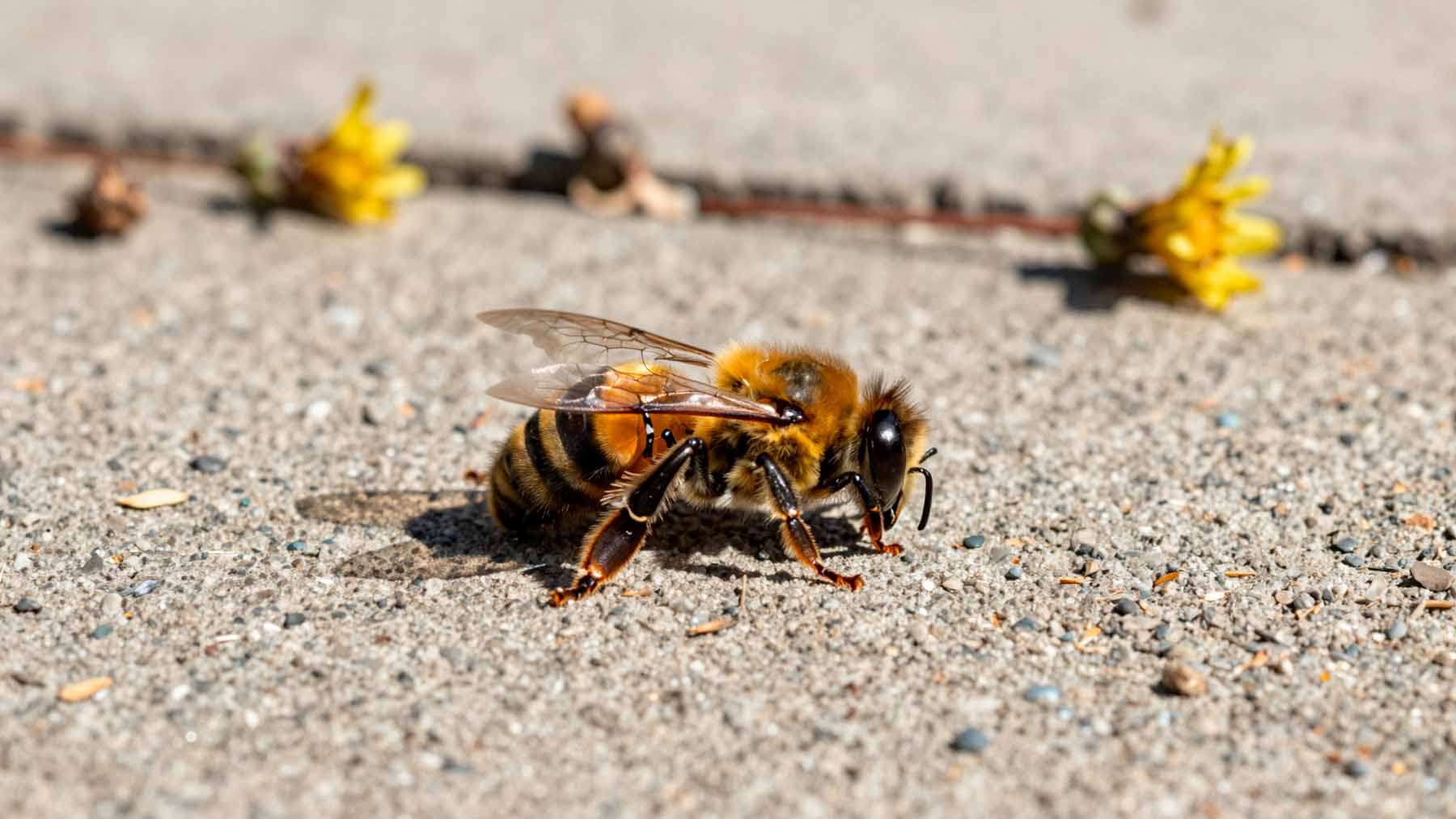
Every summer, small dark bodies appear on sidewalks and pavements — bumblebees, scattered across the concrete, easy to step over and forget. The sight has become familiar enough to seem unremarkable.
But the numbers are growing, and the causes run deeper than a warm season. Bumblebees support an estimated 75% of global crop pollination, making their decline far more than a seasonal curiosity.
A natural cycle — but not the whole story
Bumblebee workers live fast and die young. Their natural lifespan runs just four to six weeks, and colonies don’t let the dead linger. Healthy young workers carry deceased bees away from the nest — a behavior that limits disease spreading through the colony. Some of what you see on the pavement, then, is simply biology doing its job.
That context matters. It keeps things in perspective.
The baseline, though, has shifted. The frequency of bee deaths observed in recent summers goes well beyond what natural colony turnover can explain. Several forces are driving the numbers up simultaneously, each compounding the others.
When heat becomes a killer
June 2026 was the warmest on record in England, and the second hottest across the UK as a whole. For bumblebees already working at the edge of their physical limits, that kind of heat isn’t just uncomfortable — it’s lethal. Extreme temperatures disrupt reproduction, impair flight, and reduce foraging ability. Colonies can cool themselves by fanning their wings, but prolonged exposure overwhelms even that.
Heat also changes foraging behavior in ways that accelerate the toll. As temperatures climb, bees range farther to find food, burning more energy with each trip. Bees can redistribute heat around their bodies while in flight — a form of thermoregulation — but extreme conditions push past what that system can handle. More distance, more effort, more deaths.
Pesticides and the plants that disappear with them
Pesticides hit bees directly and indirectly. Insecticides including organophosphates, synthetic pyrethroids, and phenylpyrazoles can cause paralysis, death, and disruption of the navigation systems bees depend on to find their way home.
The indirect damage is subtler but just as serious. Herbicides eliminate flowering plants that bees rely on for food. Dandelions are a prime example — a critical nectar source, yet routinely targeted by homeowners and land managers alike. Remove the dandelion, and you remove the meal.
The EU and UK have banned the most harmful neonicotinoids, which is meaningful progress. Pesticide use remains widespread, however, and the knock-on effects on pollinators haven’t disappeared with the bans. The problem is structural, not solved.
Habitat loss and the timing trap
Bees need space — not just flowers, but contiguous, reliable landscapes where they can nest, forage, and overwinter. Urban development, intensive agriculture, and road construction are steadily eating into that space. As habitats fragment, populations shrink and grow more vulnerable to every other stressor stacked on top, according to The Conversation.
Climate change adds another layer of disruption through what scientists call phenological mismatch. Bees and the plants they depend on are increasingly out of sync — a bee may emerge from hibernation too early and find nothing in bloom, or flowers may peak before the bees arrive. Either way, both species lose. The number of wild bee species considered at risk of extinction in Europe has more than doubled, from 77 in 2014 to at least 172 today. That’s roughly 10% of assessed species, and the trend is moving in the wrong direction.
Why losing bees means losing more than honey
Bees support an estimated 75% of global crop pollination and nearly 90% of all flowering plant species. Those aren’t abstract figures. They represent the food on your table, the stability of agricultural systems, and the health of ecosystems that humans depend on.
Beyond pollination, bees serve as decomposers, pest controllers, and food sources for other animals — what scientists group under the term ecosystem services, the invisible infrastructure that keeps natural systems functioning. If pollinator populations collapse, the effects won’t stay contained to wildflower meadows. A cascading food crisis is a realistic outcome, and managed honeybee colonies, while useful, can’t replace the full diversity of pollination that wild bees provide. There are few ready substitutes for what’s being lost.
Small actions that can make a real difference
The scale of the problem can feel paralyzing, but individual choices do add up. One of the most straightforward things you can do is stop treating dandelions as weeds. Leave patches of lawn unmown, and plant a diverse range of native flowering species. These steps create nectar corridors that help bees survive in urban and suburban environments — small interventions with outsized effects when enough people make them.
As a consumer, supporting farmers who use nature-friendly practices matters — not necessarily only organic producers, but those who weigh the environmental impact of how food is grown. At home, try non-chemical alternatives before reaching for pesticides, and apply anything you do use sparingly. And if you spot a bee struggling on hot pavement this summer, a small mixture of sugar and water — two parts sugar to one part water — can help revive it. Moving it gently to shade or a nearby flower helps too.
None of this solves the larger crisis. But it’s a starting point, and it signals something important: the trend isn’t yet irreversible. What happens next depends heavily on how seriously the compounding threats — heat, pesticides, habitat loss — are addressed at every level, from garden beds to government policy. The bees on the pavement are a warning. The question is whether enough people are paying attention.
Read the whole thing?
Get the week's signal, not the noise
Our sharpest reporting on energy, climate and nature — free, once a week.