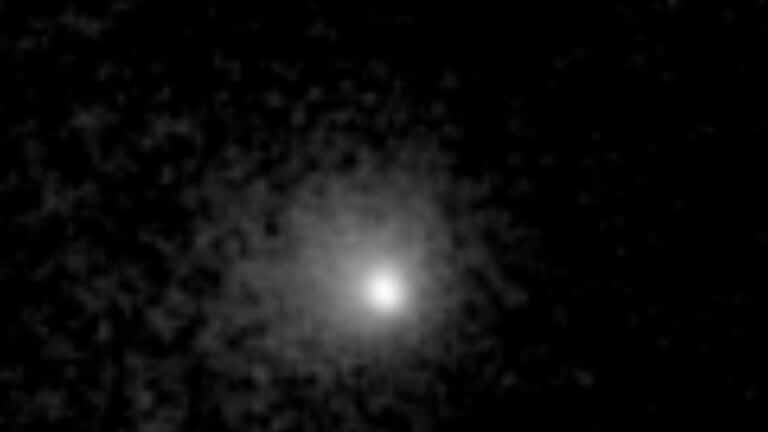
On a clear winter night last December, something rare was slipping past Earth through the dark. It had come from somewhere far beyond our solar system, looped around the Sun, and turned back toward the void. Almost no one knew to look up for it. But a space telescope was watching, and what it found locked inside this cosmic stranger is forcing scientists to rethink what the rest of the galaxy is actually made of.
A visitor nobody expected
The discovery of the object in mid 2025 became one of the most thrilling chapters in recent space science. It was only the third interstellar object ever spotted passing through our solar system.
It was also just the second confirmed comet to arrive here from another star. The first had come and gone years earlier, leaving astronomers hungry for the next.
Astronomers knew it was a true outsider from its path. The object traced a hyperbolic orbit, an open trajectory showing it had formed far outside the Sun’s gravitational reach.
In plain terms, the Sun had no hold on it. It was just passing through, bending around our star like a hitchhiker who never planned to stay.
These travelers are bits of rock and ice that formed around other stars and were later flung out. This one had drifted through the cold dark for an unknown stretch of time before our Sun’s warmth stirred it awake.
The comet that woke up in our backyard
As the visitor swept closer to the Sun, something started to happen inside it. Heat worked its way down through ice that had been frozen solid for perhaps billions of years.
Gases that had never felt warmth began to stir. Layer by layer, the comet started breathing out the chemistry of a world that orbited a different sun.
Early readings already hinted at a strange origin. It showed a higher ratio of carbon dioxide to water, and a little more nickel than iron, both reflecting the makeup of its home star system.
Those small differences were a clear sign this comet came from a very different neighborhood. And the surprises kept coming.
It also sprouted an anti tail, a short spike of dust pointed toward the Sun. Such tails are usually an optical illusion, but this one was genuinely real, something no one had recorded on an interstellar visitor before.
Webb turned its eye on the stranger
As the comet began its long climb back out of the solar system, scientists swung the James Webb Space Telescope toward it. They wanted to catch its chemical signature before it vanished for good.
The team observed it with Webb’s MIRI instrument on two dates after the comet rounded the Sun. The first look came December 15 to 16, when it sat about 205 million miles out.
A second look followed on December 27, when the comet had drifted to roughly 236 million miles away. Each pass added detail to a portrait no one had ever painted.
Webb used MIRI’s Medium Resolution Spectrometer, an instrument built to split infrared light into its component wavelengths. It maps which gases sit where around the comet’s icy core.
The chemical fingerprint that changed everything
Here is where the story turns extraordinary. On June 1, 2026, researchers announced the first ever detection of methane on an interstellar object.
Methane is highly volatile, sliding from solid ice into gas at the faintest touch of heat. Its delayed appearance suggested it had been buried, shielded until warmth from the close pass reached the deep frozen layers.
It had been locked away, perhaps since the birth of a star we will never see. The amount of methane compared to water was startlingly high, with few matches anywhere in our own solar system.
The findings, published in a leading journal, read like a letter from another star, written in frozen gas and delivered across light years. The NASA report calls it Webb’s first full mid infrared fingerprint of such an object, and scientists studying frozen molecules finally have a point of comparison from beyond our own star.
What a passing stranger leaves behind
Both findings point to a formation environment unlike most comets born inside our solar system. That single idea carries enormous weight for how we picture other worlds.
It means the building blocks of planets around distant stars are not identical to ours. For a few months, this comet was a free sample from the rest of the galaxy, handed to us at no cost.
Scientists are honest that questions remain. Webb watched a sharp drop in gas production as the comet pulled away, with water fading fastest, and its window to study the object is closing.
Still, the image that lingers is a hopeful one. On a December night, while most of us sat indoors with our families, an ancient ball of ice from another star crossed our sky.
It carried a chemistry no one on Earth had ever measured. It came, it gave up its secrets, and now it is gone, proof that the universe is generous with its strangers.
Read the whole thing?
Get the week's signal, not the noise
Our sharpest reporting on energy, climate and nature — free, once a week.