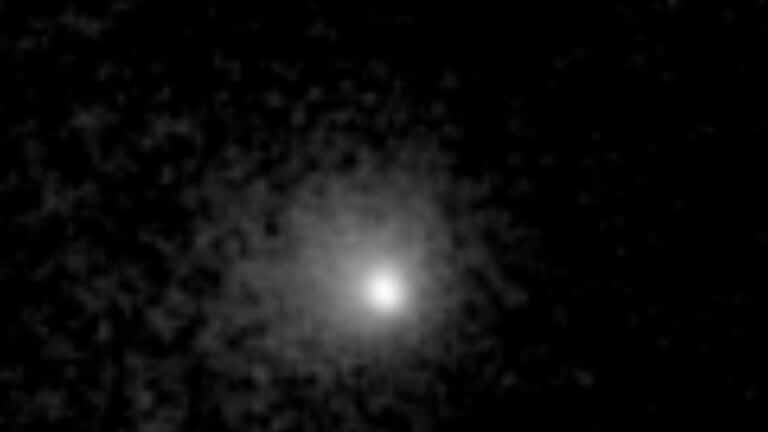
When astronomers turned the James Webb Space Telescope onto a tiny red speck of ancient light — a source that existed just 1.8 billion years after the Big Bang — they didn’t expect what came back: more than 40 spectral lines from a single, faint object.
Since 2022, Webb has been quietly cataloging these mysterious “little red dots” scattered across the early universe, and scientists have been struggling to explain what they actually are. One particular dot, known as GLIMPSE-17775, has now produced the deepest spectrum ever captured of such an object — and the data may finally be pointing toward an answer.
A mysterious class of objects in the early universe
When Webb began science operations in 2022, it quickly surfaced something unexpected: a population of compact, red objects scattered across the early universe, emerging roughly 600 million years after the Big Bang. Astronomers called them “little red dots,” and they immediately sparked debate. Were they dense star-forming galaxies? Active black holes? Something else entirely?
Several competing explanations emerged. One of the most compelling is the black hole star, or BH* scenario — a model proposing that a rapidly accreting supermassive black hole sits at the center of a dense, partially ionized gas cocoon. That cocoon reprocesses light from near the black hole, producing the distinctive red glow astronomers observe. Some researchers initially worried these objects suggested galaxies had grown impossibly large too quickly, a concern that has since become a key motivation for studying them more carefully.
How GLIMPSE-17775 came into focus
GLIMPSE-17775 was not the original target. It was captured serendipitously during a Webb program searching for Population III stars and faint galaxies near the galaxy cluster Abell S1063. The little red dot sits behind the cluster, and gravitational lensing — the bending of light by the cluster’s mass — acted as a natural magnifying glass, amplifying what would otherwise have been undetectable detail.
That lensing effect transformed 30 hours of Webb observation into the equivalent of roughly 80 hours of telescope time. The result was remarkable: more than 40 spectral lines from a single faint source. GLIMPSE-17775 has a cosmological redshift of 3.5, placing it 1.8 billion years after the Big Bang. No little red dot had ever been studied in this much detail before.
Forty lines of evidence: what the spectrum reveals
The spectral data contains several independent indicators, each pointing in the same direction. Hydrogen, oxygen, and helium lines do not fit a simple rotating gas cloud model. The best fit instead requires electron scattering broadening — a signature of a dense, layered gas cocoon surrounding the central source.
Sixteen iron lines, dubbed an “iron forest” by the research team, along with specific oxygen lines, demand a high-energy source to produce them. A rapidly accreting black hole fits that requirement. The spectrum also shows helium fluorescence and helium absorption — both effects, identified independently, suggest a powerful central engine wrapped in a thick medium. The BH* model further explains why most little red dots appear faint in X-rays: the dense cocoon likely absorbs high-energy emission before it can escape, making these objects dimmer than a typical active black hole would appear.
The host galaxy clue and what it means for cosmology
One detail initially stood out as inconsistent. GLIMPSE-17775 shows a weaker Balmer break — a characteristic dip in emitted light — than other little red dots typically display. To investigate, the team incorporated archival data from NASA’s Hubble Space Telescope, drawn from the Frontier Fields and BUFFALO observing programs.
The combined Webb and Hubble data revealed a giant host galaxy surrounding GLIMPSE-17775. That galaxy’s starlight accounts for the excess blue light and explains the weaker Balmer break. Far from contradicting the BH* model, this finding is consistent with it — the model already attributes that excess blue light to stars in the host galaxy.
The findings also ease earlier cosmological concerns. Because black hole masses do not need to be extraordinarily high to explain the broad emission lines observed, GLIMPSE-17775 fits comfortably within the existing framework of how the universe evolved. As lead researcher Vasily Kokorev put it: “Everything fits, nothing is broken.”
What comes next for little red dots
The scientific community appears to be converging on the BH* model as the dominant explanation for little red dots. But the exact nature of the central engine powering these objects remains an open question, and Kokorev has noted that other theories are still being explored, keeping the field genuinely competitive.
GLIMPSE-17775 sets a new benchmark for what is achievable when Webb’s capabilities are paired with gravitational lensing. As more deep spectra are gathered from similar objects, the picture should sharpen considerably — Kokorev expects a clearer answer within one to two years. For now, the little red dots remain one of the most intriguing puzzles the early universe has offered, and Webb is only beginning to read them.
Read the whole thing?
Get the week's signal, not the noise
Our sharpest reporting on energy, climate and nature — free, once a week.