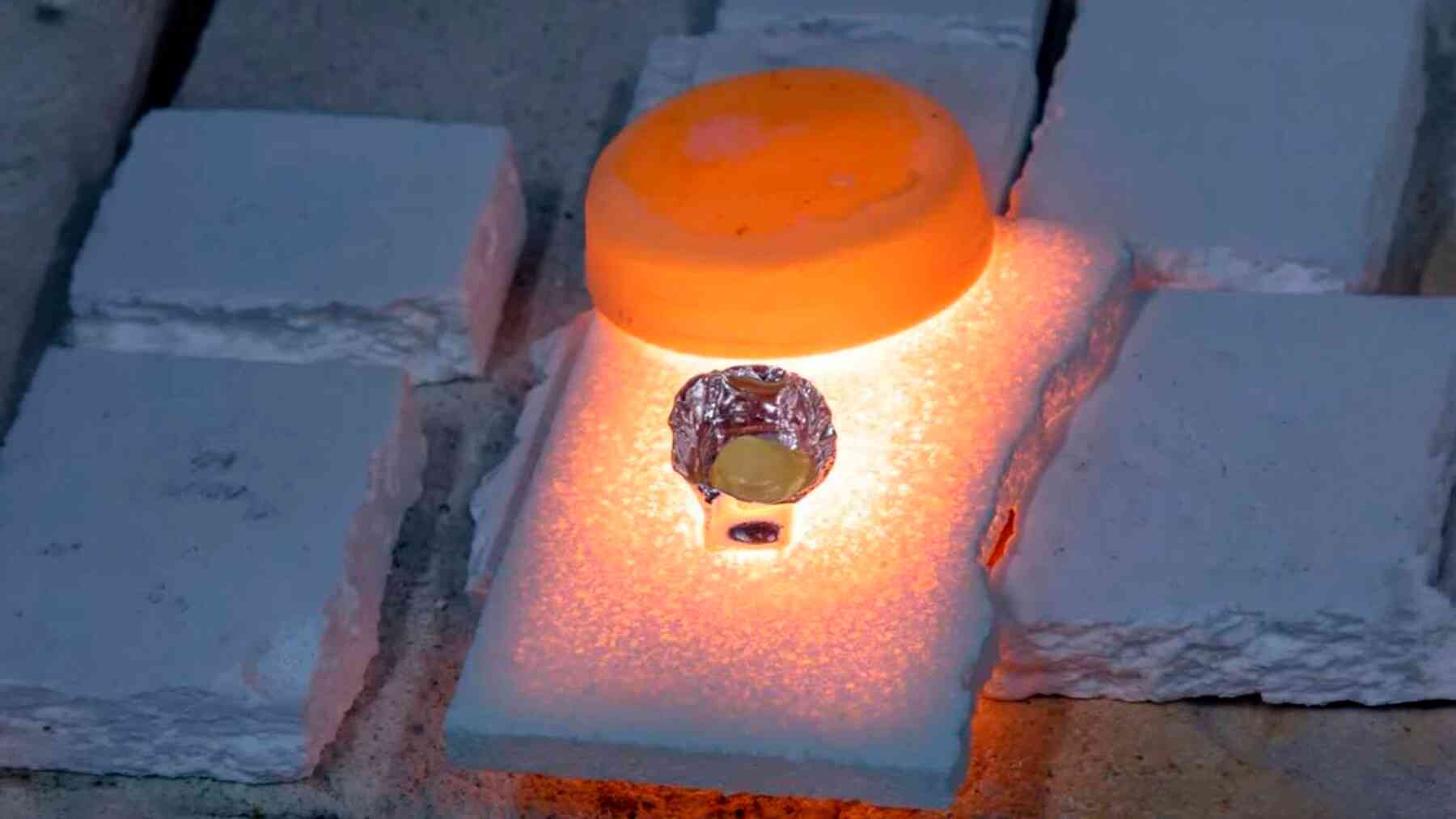
Inside a Cleveland laboratory, two NASA researchers were running what should have been a routine test — heating simulated lunar dust inside a red-hot furnace to see how certain materials held up against it. Nothing about the experiment suggested they were about to make history.
Then the results came back. The substance that had formed in that furnace did not match a single entry in a database of more than one million known materials. Dr. Jamesa Stokes and Dr. Kevin Yu had made something that, as far as science could tell, had never existed before — and it might be exactly what future astronauts need to survive on the Moon.
An accidental find inside a red-hot furnace
The discovery did not come from a dramatic moment of inspiration. Six months of patient, methodical work led them there. Yu and Stokes were studying how various substances interacted with liquefied Moon dust as part of a NASA Space Technology Graduate Research Opportunities fellowship. When they combined simulated lunar dust with scandium oxide and applied heat, something unexpected formed inside the furnace.
They checked their results carefully. Then they checked again. The substance matched nothing in an X-ray analysis database containing more than one million known materials — leaving the team with no existing reference to draw from. They had to start entirely from scratch, measuring the material’s chemical composition and rebuilding their understanding piece by piece.
What the new material actually is — and how it’s made
To produce isolated samples for further testing, Yu and Stokes used specialized lab equipment to crush around eight basic oxide components in ethyl alcohol, then baked the mixture at over 2,900 degrees Fahrenheit.
The process even comes with a visual cue. “It goes in pink, almost like strawberry milk,” Yu explained. By the time the reaction is complete, the powder turns a light beige or tan — a built-in color indicator that tells researchers the process worked as intended. Because its exact composition had never been studied before, every property had to be characterized from first principles.
The material is based on scandium oxide, which can be costly, but it is far cheaper than precious metals like platinum typically used in high-temperature industrial processes.
Why melting Moon rocks matters for deep-space exploration
NASA’s broader strategy for lunar exploration centers on what the agency calls in-situ resource utilization, or ISRU. The idea is straightforward: instead of carrying everything from Earth, future astronauts would extract what they need directly from their surroundings.
Melting lunar regolith — the loose rock and dust covering the Moon’s surface — could yield metals useful for building infrastructure, along with oxygen for fuel and life support. The challenge is that keeping Moon rock liquid requires temperatures up to six times hotter than a standard kitchen oven. Any container, pipe, or basin holding that molten material must survive those extremes without degrading, and that kind of durable, affordable material has been a missing piece in current lunar hardware designs.
Performance advantages over existing materials
The newly discovered substance clears several of those demanding bars at once. It resists corrosion from molten lunar dust and holds up under the extreme temperatures required to keep that dust liquid.
Compared to current state-of-the-art coating materials, it is lighter, less dense, and a better heat insulator. Those are meaningful advantages when every kilogram launched from Earth carries a significant cost. The material’s properties also make it a strong candidate for protective coatings inside jet engines, which reach similarly extreme temperatures — a dual-use potential that adds practical weight to what began as an accidental laboratory result.
Next steps: purification, affordability, and Earth-side benefits
Yu and Stokes have completed their initial round of testing, but the work is far from finished. They plan to refine the material further, with goals of purifying it and reducing production costs. The research is supported by NASA’s Space Technology Mission Directorate and Aeronautics Research Mission Directorate.
History suggests that materials breakthroughs developed for extreme environments often ripple outward in unexpected ways — technologies refined for space have previously found applications in medicine, manufacturing, and transportation. Yu put it plainly: “Trying to push what’s possible with materials also allows for a lot of breakthroughs on the terrestrial side.” For him, that broader potential is inseparable from NASA’s core mission.
The next phase will move this material from laboratory samples toward engineering prototypes. If Yu and Stokes can bring down production costs and refine its purity, it could find its way into both the pipes of a lunar resource extractor and the inner walls of a next-generation jet engine — two very different machines, connected by one accidental pink powder.
Read the whole thing?
Get the week's signal, not the noise
Our sharpest reporting on energy, climate and nature — free, once a week.