Picture a world squeezed into the shape of a lemon by forces so violent they would shred almost anything else in the universe. Its sky is choked with black soot, and when those clouds grow heavy enough, they do not rain water. They rain something far stranger. Scientists had never seen anything like it, and when the data first arrived, their reaction was as human as it gets: “What the heck is this?”
A planet that should not exist
For most of the history of astronomy, scientists assumed the best places to hunt for planets were the quiet ones, stars that burn steadily and politely like our own sun.
That assumption made perfect sense. Planets need time and calm to form. But the universe, it turns out, has not read that rule book.
Some of the most astonishing worlds ever found orbit the most extreme objects in the cosmos, including burned out stellar cores that spin so fast their behavior borders on the impossible.
These cores are pulsars, the ultradense remains of stars that exploded as supernovas, firing radiation in brief, regular pulses.
They are violent, relentless, and deeply inhospitable. The idea of a giant planet surviving in their grip was something most scientists would once have dismissed outright.
So when a survivor turned up, the only question was how it got there.
The dead star with a secret companion
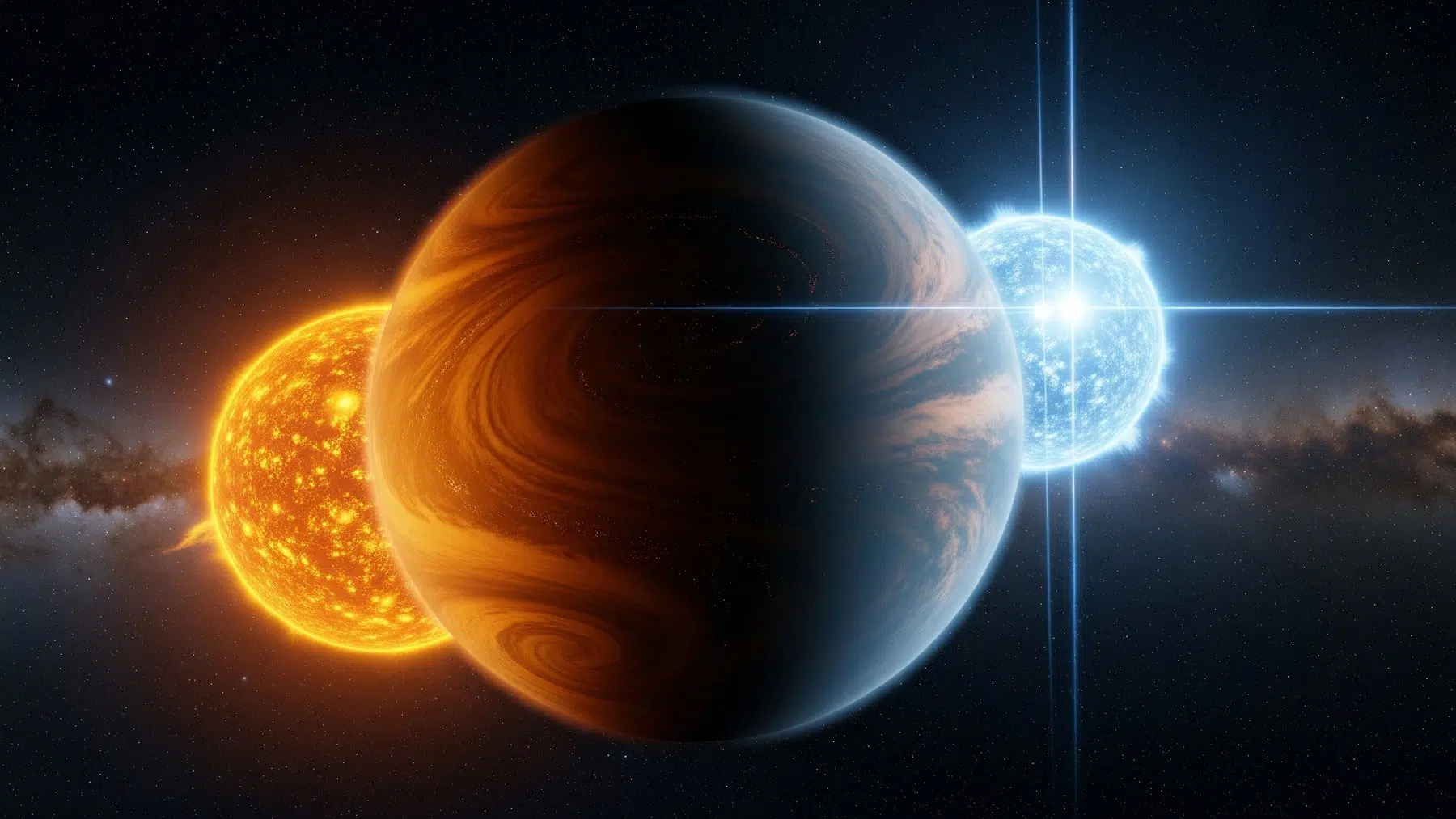
Far out in the constellation Pisces Austrinus, one such pulsar has been spinning for millions of years, sweeping twin beams across space like a lighthouse no ship was ever meant to find.
And yet, something has been circling it all along.
From just around 1 million miles away, this companion completes a full orbit once every 8 hours or so.
For context, Earth takes 365 days to circle our sun from nearly 100 times that distance.
Gravity from the much heavier pulsar is dragging the Jupiter mass world into a bizarre lemon shape.
Imagine Jupiter being slowly kneaded by invisible hands, stretched lengthwise into something you might pull from a kitchen bowl, and you start to see the picture.
An atmosphere like nothing in the sky
The lemon shape is extraordinary enough. But what floats inside that atmosphere is what truly stopped scientists cold.
On Earth, clouds are made of water droplets. On some distant gas giants, they form from silicate minerals.
On this world, the clouds are made of carbon soot, drifting through air dominated by helium and carbon unlike any atmosphere ever seen.
And deep within those dark clouds, something remarkable begins to happen as the carbon cools and condenses.
It does not stay soot. It hardens, gathers, and starts to fall, a slow and permanent rain of crystals through one of the most alien skies in the known universe.
No weather report could ever prepare you for what is actually drifting down.
What Webb saw that no other telescope could
Scientists using NASA’s James Webb Space Telescope found that those crystals are diamonds, falling endlessly through the haze of a world named PSR J2322-2650b.
The discovery, published in The Astrophysical Journal Letters, describes an entirely new kind of exoplanet whose chemistry challenges how we think these worlds form.
Webb had a peculiar advantage here. The pulsar mostly emits gamma rays, invisible to the telescope’s infrared eyes, so no blinding starlight gets in the way.
That gave researchers a clear, unobstructed view across the planet’s entire orbit, something almost impossible for worlds packed with organic molecules circling brighter stars.
The bigger puzzle now is how such a planet formed at all. Its carbon heavy air and its impossible closeness to a dead star point to an origin story nobody has yet written.
A universe full of rooms we haven’t opened yet
This find matters far beyond the spectacle of diamond rain. It is a reminder that our models of planet formation, built patiently over decades, still hold enormous blind spots.
The results offer fresh insight into how giant planets evolve, especially those that likely formed far from their stars before migrating inward, where intense heat can strip their gases away.
A pulsar planet with a lemon shape and a carbon sky fits none of the tidy categories scientists once trusted.
It joins a growing list of surprises, from frozen molecules around distant stars to galaxies that lit up far too early, all hinting that the cosmos is stranger than our theories can hold.
Scientists are candid about how much they still do not understand, and that honesty is the whole point.
For now, the planet keeps spinning around its dead star, raining diamonds into a sky no one predicted, in a system that was never supposed to exist. That is not a failure of science. That is science working exactly as it should.
Read the whole thing?
Get the week's signal, not the noise
Our sharpest reporting on energy, climate and nature — free, once a week.