Everyone has one in their yard, their park, or their neighborhood trail. Chubby cheeked and perfectly harmless, the ground squirrel is the one wild animal almost no American ever thinks twice about.
It stuffs acorns, it digs holes, and it freezes when it spots you before bolting for the nearest burrow. Researchers at a California park had been watching them for 12 straight years and had never seen anything to change that picture.
Then came the summer of 2024.
The animal everyone thinks they already know
Briones Regional Park sits in the rolling hills of Contra Costa County, not far from Oakland and Berkeley, and it is the kind of place where families hike on weekends and hawks circle overhead in the afternoon heat.
California ground squirrels are everywhere there, popping up from burrows between the dry grasses, cheeks bulging, tails flicking in that endlessly familiar way, and across the United States they are probably among the most watched wild animals alive, studied in backyards and city parks from coast to coast.
Scientists classify them as granivores, creatures built around seeds, nuts, and grains, and they had been that way, as far as anyone knew, for as long as the species had existed on the continent. Nobody had ever filmed one doing what a field team was about to film in the summer heat of June 2024.
A summer that started like every other
The researchers arrived at Briones with the same equipment and the same expectations they had carried for over a decade, tracking population patterns, foraging habits and the usual rhythms of a well studied animal.
The grass was bone dry, golden and crackling underfoot, the way it always gets in a California summer, and voles, small mouse like rodents that live in meadow grass, were abundant that season. The vole population had spiked to roughly seven times the ten year average, which was unusual even by local standards.
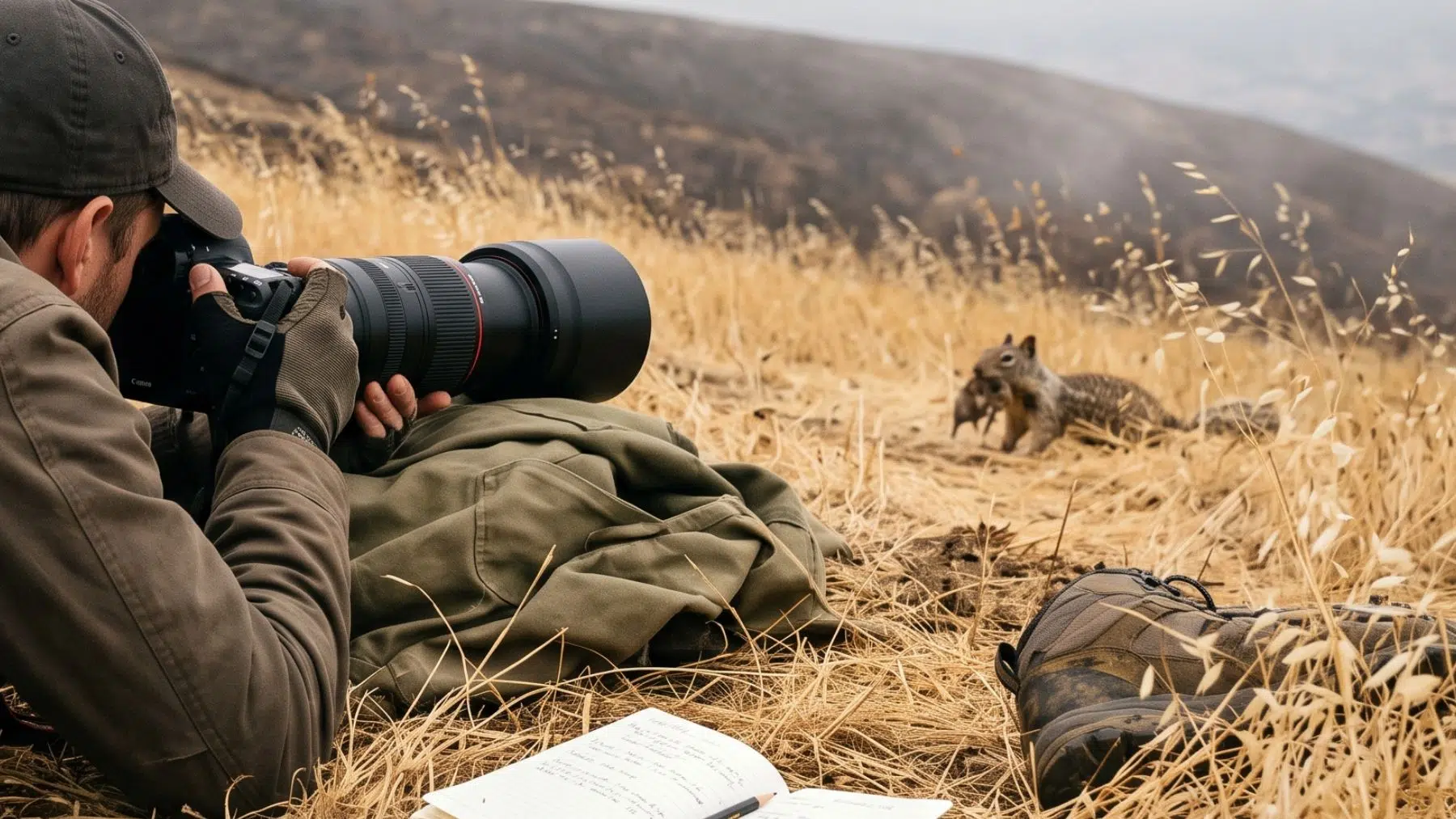
Then one of the observers looked up from their notebook, and a ground squirrel was not foraging. It was stalking something, low to the ground, body flat, moving with a deliberate slowness that looked nothing like the frantic seed gathering the team had spent years watching.
The observer raised a camera and pressed record.
74 interactions, and it was not a coincidence
That first sighting could have been a fluke, an odd moment of curiosity from a single animal, but it happened again the next day, and the day after that.
By the end of the season the team had recorded 74 separate interactions between ground squirrels and voles, and in 42 percent of those encounters the squirrels were actively hunting live prey rather than scavenging animals that were already dead. They were chasing voles across open ground and into the mouths of burrows, then killing and consuming them.
Some hunts lasted only seconds while others stretched for several minutes of focused pursuit, and the behavior appeared across multiple individuals, which meant it was not the habit of one unusual animal. It was spreading, or had perhaps always been there, undetected beneath a blanket of assumption.
A granivore that hunts
The footage, later published and reviewed by the wider research community, forced a serious rethink across the field, because California ground squirrels are not strict granivores. When prey is abundant and easy to catch, they switch strategies entirely and hunt warm blooded animals.
The behavior is thought to be driven by the sudden availability of easy prey during a rare vole population peak, and researchers are now asking whether the resulting protein rich diet gives squirrels a reproductive edge that seeds and nuts alone cannot provide. It mirrors what biologists have found in other supposedly plant eating species when the right conditions arise.
For a deeper look at how animals navigate using senses that defy easy explanation, the pigeon compass story offers a striking parallel, and the way ground squirrels may pass a new learned behavior between individuals echoes findings in animal detection research, where shared instinct and trained habit are harder to separate than they look.
The discovery does not make the ground squirrel dangerous or alien. It makes it more interesting than anyone gave it credit for.
What the backyard animal was always hiding
Briones Regional Park looks exactly the same as it did before the summer of 2024. The squirrels still pop up between the grasses, cheeks full, tails flicking, and hikers still walk past them without a second glance.
But the researchers who spent 12 years on those hills now watch differently, because every pause, every low crouch and every slow crossing of open ground carries a new possibility.
The most familiar wild animal in the American backyard turns out to have been running a second life alongside the one everyone thought they understood, a finding independently confirmed by scientists and science journalists across the field. Nature has a habit of doing that, hiding complexity in plain sight, right at the edge of the picnic blanket, and the ground squirrel just happens to be one of its better kept secrets.
Read the whole thing?
Get the week's signal, not the noise
Our sharpest reporting on energy, climate and nature — free, once a week.