
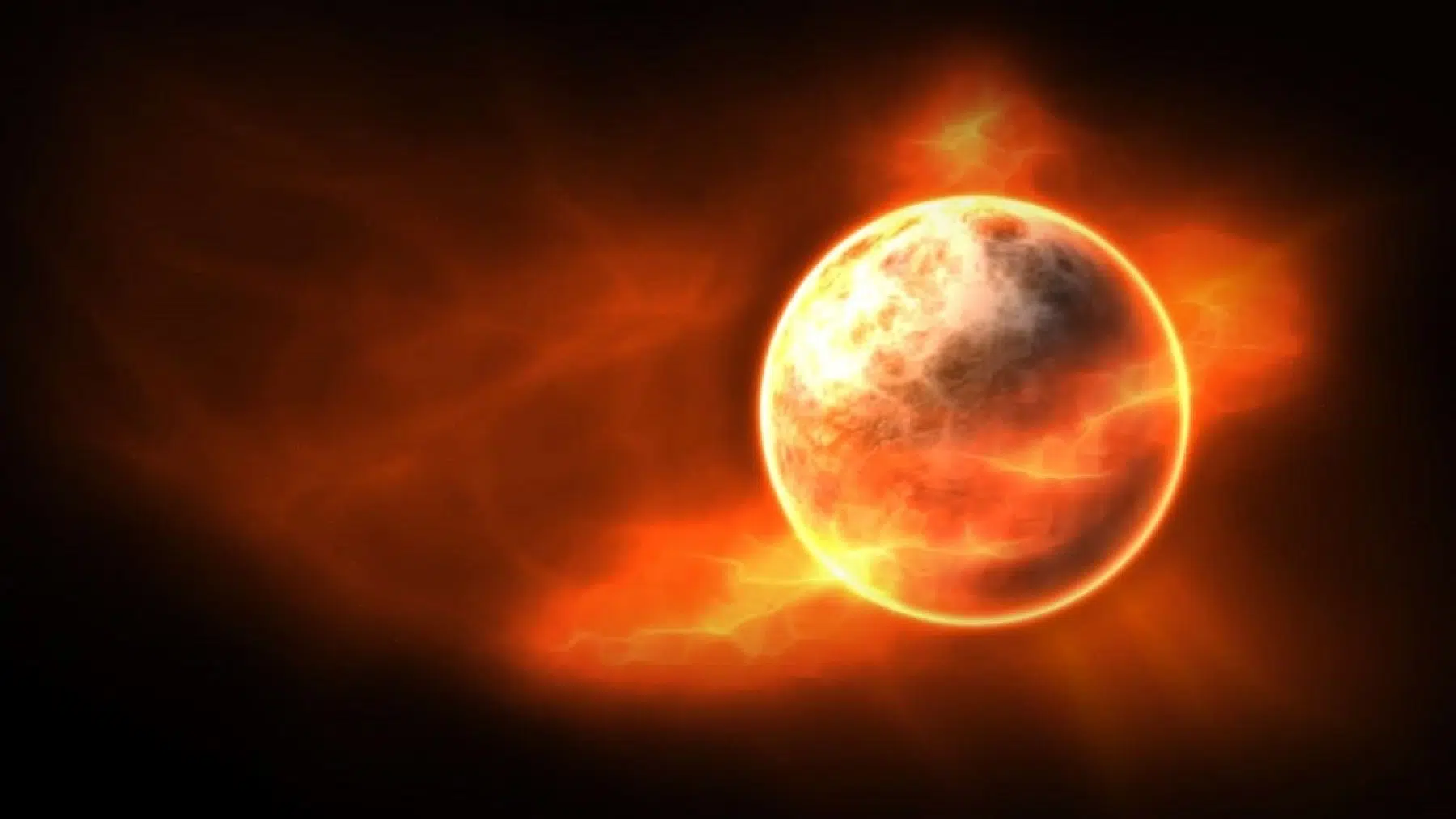
Theories about another cosmic object close to Mercury, but its proximity to the sun “blinds” NASA. However, a truth about a fire planet has been unveiled, as there wasn’t anything in the expected location. Scientists, researchers, astronomers, and everyone else have been searching for a hypothetical extra planet in the solar system for more than a century—since Pluto is not considered a planet because it does not have the size and still has its debris disk, the current formation of our system has eight planets.
The ‘fire planet’ between Mercury and the sun
The theory of a planet in the solar system orbiting between Mercury and the Sun is directly connected to the theory of general relativity created by Albert Einstein to explain why the Earth and other planets orbit the sun. According to the German scientist, every massive object in the universe causes a deformation in space-time, and for that reason, there is gravity — so the planets are actually falling towards the Sun.
If the Sun attracts eight planets with considerable mass, there might be more objects close to the big star that we cannot see because of its brightness, but there’s also another motivating factor for scientists who believe that there is a planet around Mercury: the anomaly in the eccentric orbit of Mercury.
Back in 1859, a scientist called Urbain Le Verrier noticed that the planet’s orbit shifted more than Newtonian mechanics could account for. Its perihelion (the closest point to the sun) shifted by an extra 43 arc seconds per century, which means there might be another planet between Mercury and the sun causing the distortion — or so it was thought to be there.
Einstein’s relativity theory prove the nonexistence of Vulcan
The author of the book “No Shadow of a Doubt: The 1919 Eclipse That Confirmed Einstein’s Theory of Relativity,” Daniel Kennefick, who also is a physics professor at the University of Arkansas, said that some people thought they had seen Vulcan (nickname of the fire planet) during total solar eclipses, a moment when the search for the fire planet was on full speed because the sun’s glare was eliminated.
Mercury itself is hard to observe, and only a handful of times in history have scientists been able to take a look at the planet. In 1918, there was a movement made by some Americans to test Einstein’s theory of general relativity, but they were also looking for the fire planet (Vulcan). A year later, by accident, the British astrophysicist Sir Arthur Eddington and his assistant Edwin Cottingham traveled to Príncipe Island off the west coast of Africa for the historical solar eclipse of May 29, 1919, helping to prove the non-existence of another planet between the sun and Mercury.
A photograph shot from Brazil changed everything
While Eddington and Cottingham observed the eclipse from Príncipe, some scientists in Sobral, Brazil, photographed the stars around the sun during the total sun eclipse, and nothing besides some stars in the Hyades open cluster and in the constellation of Taurus was found — in the position Einstein predicted in the theory of general relativity, which, by extension, disproved the existence of the fire planet
Science fiction writer helped other planet to be found
Sometimes, the theoretical planet comes back to the public’s attention, especially in the Star Trek movie series. In the fictional world, the fire planet is the home of Spock, one of the main characters. The creator of the series, Gene Roddenberry, even argued that the planet would be orbiting around 40 Eridani, a star system in the constellation of Eridanus. For the surprise of many, in September 2018, astronomers at the University of Florida found an exoplanet exactly where the author said it would be.
Read the whole thing?
Get the week's signal, not the noise
Our sharpest reporting on energy, climate and nature — free, once a week.


