What if you could create a black hole bomb without leaving Earth? That’s exactly what a team of physicists from the University of Southampton, the University of Glasgow, and the Institute for Photonics and Nanotechnologies at Italy’s National Research Council has managed to do. Using equipment that wouldn’t look out of place in a garage, they built an experiment that models one of the wildest theories in astrophysics.
The 50-year-old theory behind the black hole bomb
The idea of a “black hole bomb” goes back to the 1970s. Physicists William Press and Saul Teukolsky proposed the concept, expanding on earlier ideas by Roger Penrose and Yakov Zel’dovich. The theory suggested that under certain conditions, energy could be extracted from a rotating black hole through a process called superradiance.
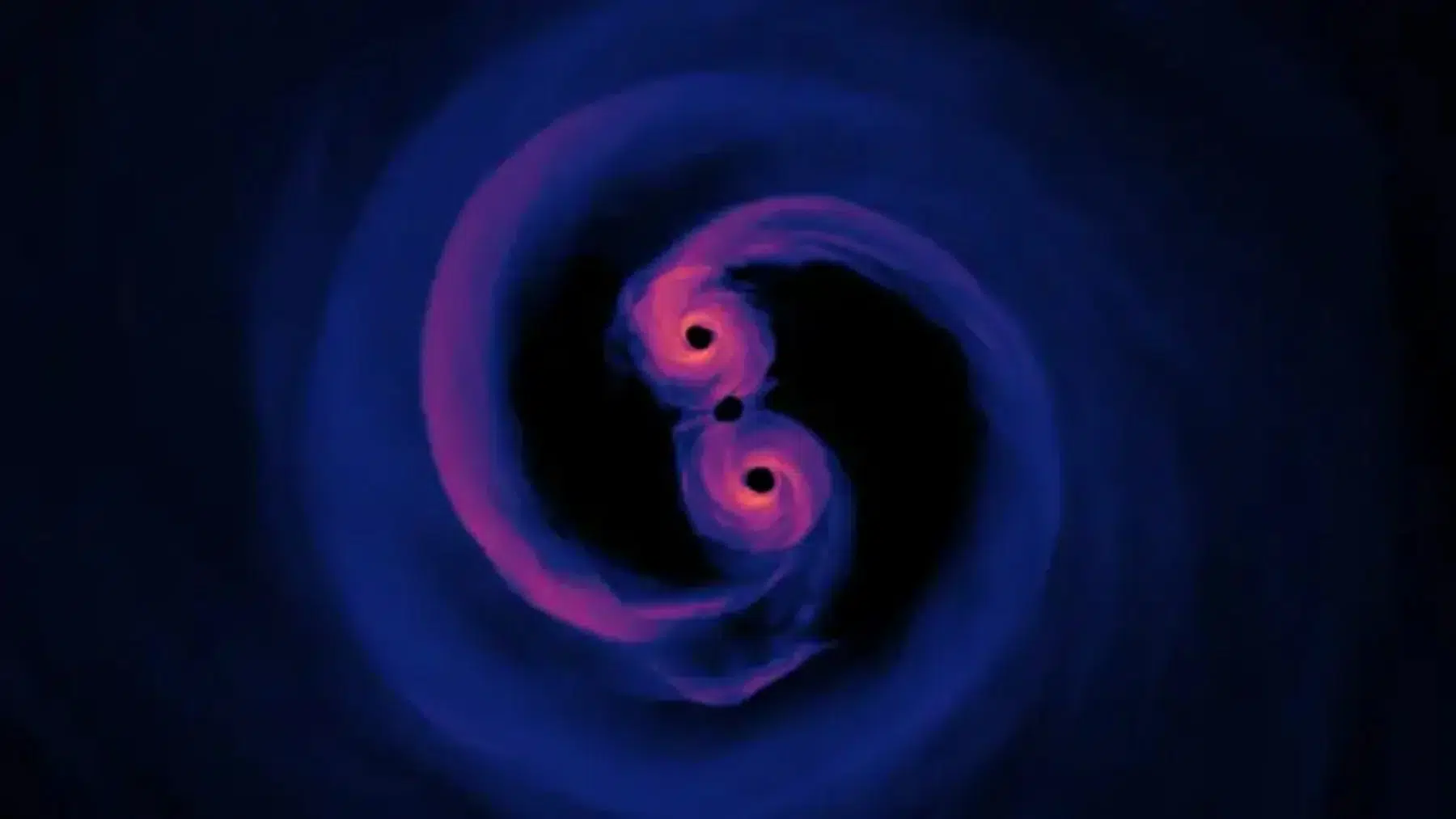
When waves, such as electromagnetic or scalar waves, interact with a spinning black hole, those waves can pick up energy. If they’re trapped inside a reflective barrier, the waves bounce back and forth, gaining more energy with each pass.
This creates a powerful feedback loop, making the system unstable and causing energy levels to skyrocket. The result is a theoretical explosion of energy—a black hole bomb. While elegant in theory, this idea had never been tested experimentally due to the extreme and distant conditions involved—until now.
Bringing black hole physics into the lab
In this groundbreaking experiment, scientists recreated conditions similar to those around a spinning black hole. But instead of space and gravity, they used magnetic fields, electric circuits, and an aluminum cylinder.
The experiment was built around the Zel’dovich effect, which predicts that a rotating object can amplify certain waves if it moves faster than the wave’s phase velocity. The setup involved spinning an aluminum cylinder while surrounding it with magnetic coils attached to an electric circuit.
Once the cylinder was in motion and an initial weak magnetic field was removed, the circuit began generating its own waves. These waves were then amplified by the cylinder’s rotation.
The experiment is the first to show both wave amplification and spontaneous wave generation in a system that mimics black hole-like conditions in a controlled environment. Maria Chiara Braidotti, a research associate at the University of Glasgow, highlighted its importance:
“Our work brings this prediction fully into the lab, demonstrating not only amplification but also the transition to instability and spontaneous wave generation.”
No real black hole was involved, of course. But the core physics—rotational energy extraction through wave amplification—was successfully demonstrated. This shows that the black hole bomb concept isn’t just theoretical anymore.
Explosive results coming from the black hole bomb
The researchers pushed the system hard, and sometimes, that had dramatic consequences.
“We sometimes pushed the system so hard that circuit components exploded,” said Marion Cromb from the University of Southampton. “That was both thrilling and a real experimental challenge.”
The experimental success of the black hole bomb offers new tools to explore energy generation, rotational dynamics, and even quantum and thermodynamic phenomena.
Since actual black holes are incredibly distant and difficult to observe, recreating some of their behaviors in a lab helps bridge the gap between theory and reality. More importantly, it allows scientists to tweak conditions and learn in real time.
The replicate system now allows new discoveries in the lab
This analog system proves that exponential wave amplification, once thought to exist only in deep space, can occur right here on Earth under the right conditions. It confirms the universal nature of certain physical laws and opens new research pathways in energy physics and cosmology. It’s not every day a half-century-old cosmic theory comes to life in a lab. But when it does, the impact can be as explosive as the theory itself.
Read the whole thing?
Get the week's signal, not the noise
Our sharpest reporting on energy, climate and nature — free, once a week.