“When that moon is big and bright, It’s a supernatural delight; Everybody’s dancing in the moonlight.” The popular song by King Harvest gets some new meaning after the first moonlight panel in history was announced. The innovative invention revolutionizes the application of sustainable energy, making it more easily accessible in regions plagued by drought, as well as areas without the privilege of power. While the panels are still in the beginning phases, they could lead to a new era in photovoltaics.
The first moonlight panel in history creates a new era
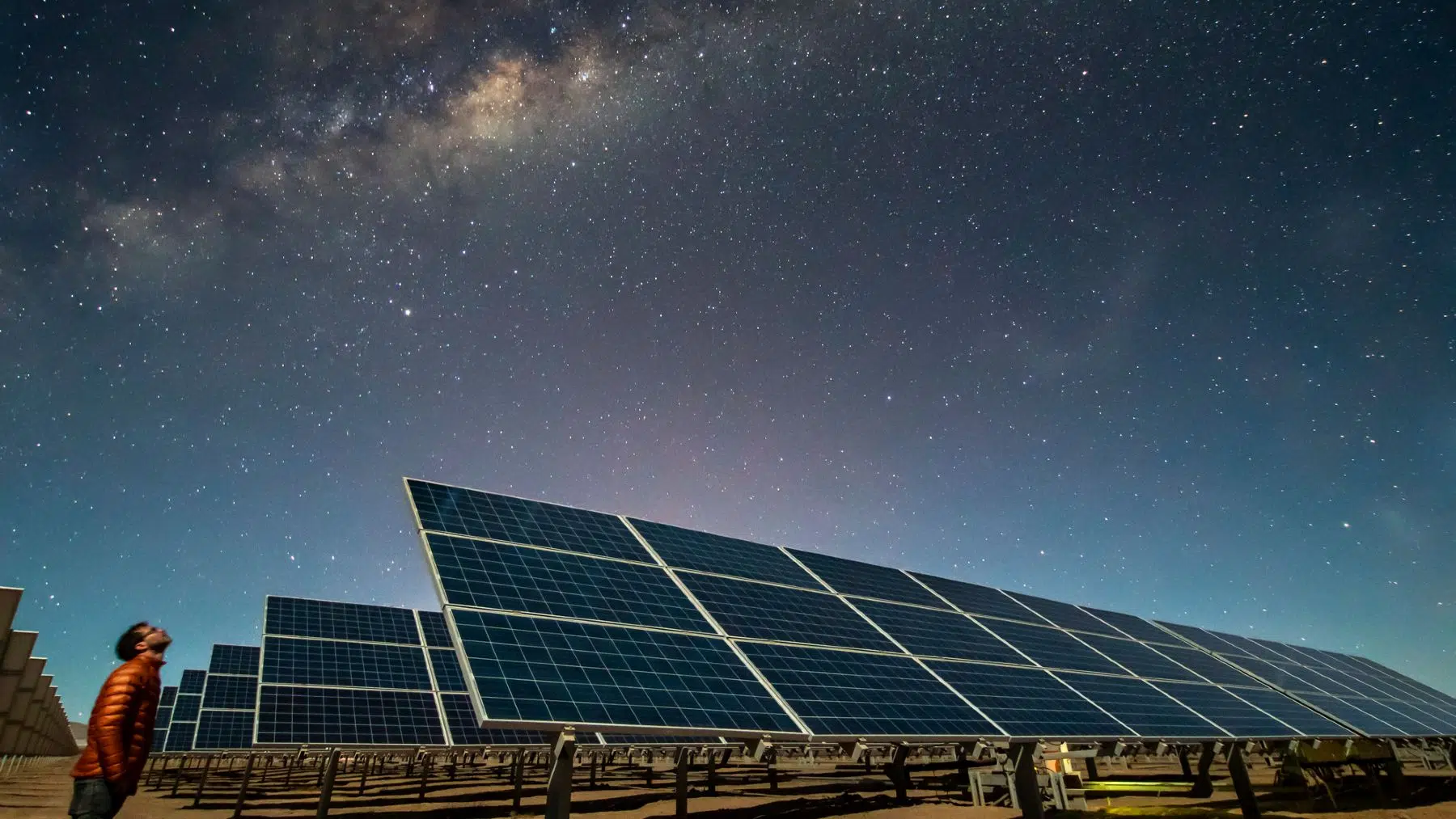
Researchers at Stanford University created solar panels capable of producing electricity during the night thanks to the marvel of radiative cooling. The innovative invention is transformable for sustainable energy, particularly for off-grid applications, although the invention is still at a very early stage.
Night-time solar panels will bridge the gap during the hours of the night or overcast periods during which sunlight is unavailable. As a result, regions with variable cloud cover or limited direct sunlight exposure will be able to adopt solar energy much more efficiently.
This science behind the first moonlight panel
The marvel of radiative cooling naturally occurs as heat moves away from a surface, especially on clear nights when Earth radiates infrared energy toward space. The temperature difference can also be utilized to produce electricity. Stanford’s researchers fixed thermoelectric generators to custom commercial solar panels to collect dispersed heat for small amounts of power. The custom panels produce 50 milliwatts per square meter at night.
The result might be much lower than the 200 watts per square meter produced by traditional solar panels, but it is still enough to power tiny devices such as LEDs and environmental sensors. Professor Shanhui Fan, Stanford’s lead researcher, commented that the energy generation might be very modest, but there is significant potential for improvement.
If the research team continues to improve the design and efficiency, the panels can meet nighttime energy demands, acting as an excellent complement to traditional solar energy. The process would, in fact, be enhanced by a clear night sky, as cloud cover reflects infrared back to the Earth, reducing its cooling. During clear nights, solar panels can reach temperatures several degrees below ambient air, creating the conditions for electricity generation.
The range of applications of moonlight panels
Approximately 770 million people are currently without electricity. The moonlight panels will offer essential lighting and power solutions in those extremely remote areas. Additionally, because this can be modified into existing solar cells, it’ll be useful and cost-effective toward improving renewable energy reliability.
Moonlight panels could minimize the high dependency on costly batteries. This is useful because batteries are also polluting due to mineral extraction. It would result in a reduced ecological footprint from battery production and disposal. Radiative cooling also has various applications during the day.
SkyCool Systems used the concept to invent a zero-energy replacement for air conditioning. ETH Zurich has modified the principles for collecting drinking water in drought-stricken areas. The extent of applications shows the vast sustainability applicability of radiative cooling technologies. The nighttime solar panels thus become advantageous in improving renewable energy reliability, bridging the once-seeming highly impossible gap.
Stanford University’s researchers can be proud. This innovative invention will not only revolutionize the application of sustainable energy but also improve the quality of life of many people in various regions. As the moonlight panels are being developed and enhanced, we cannot begin to imagine how much further the range of applications will extend. One thing is certain for sure, we are extremely excited to see what lies ahead in the future for this revolutionary concept.
Read the whole thing?
Get the week's signal, not the noise
Our sharpest reporting on energy, climate and nature — free, once a week.