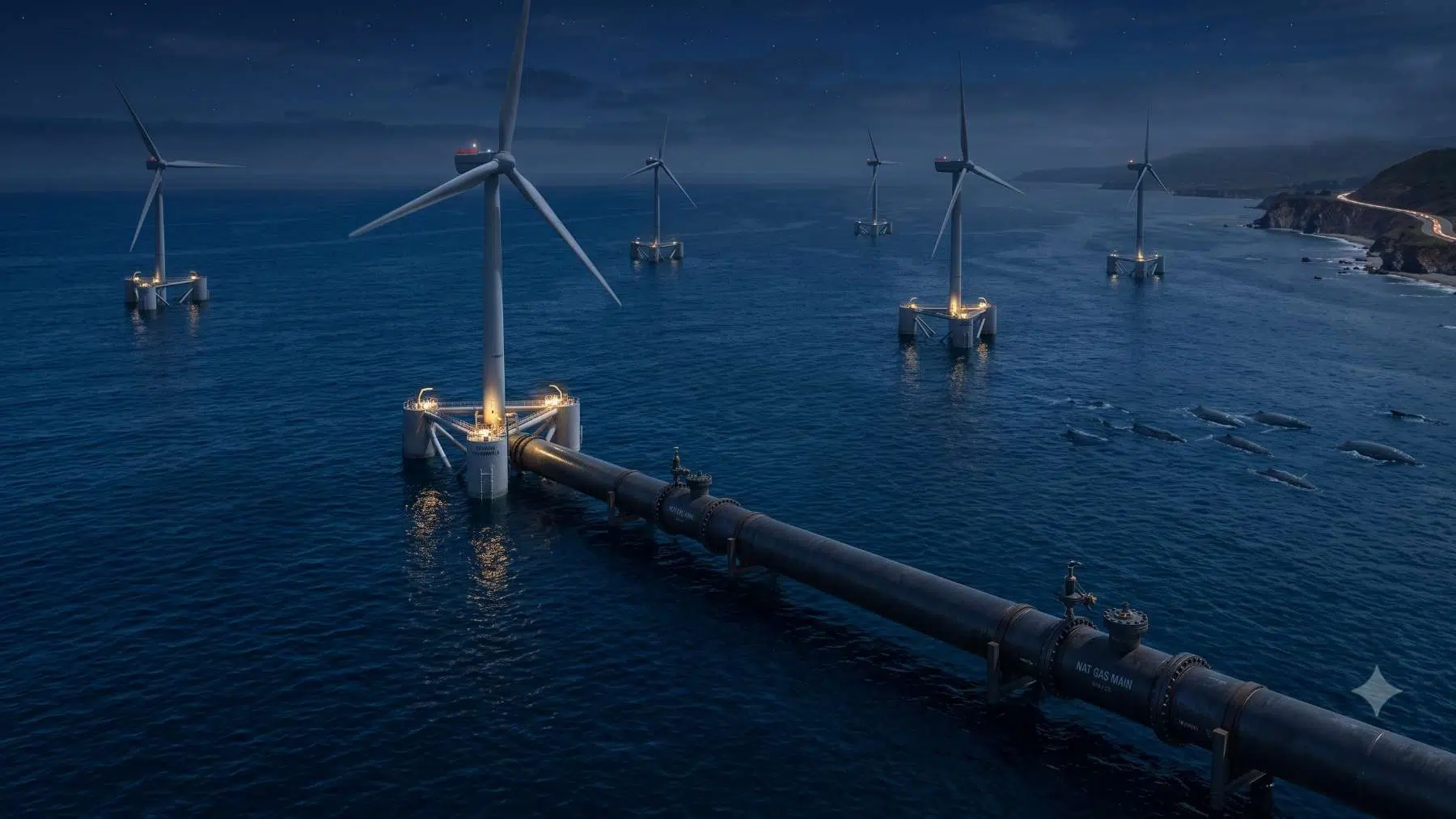
Far offshore, California plans on deploying deep-water floating wind turbines.
These systems will operate in much deeper waters than many existing offshore wind farms.
The moorings that secure floating wind turbines to the seafloor may have to do more than serve as structural elements. That includes information about the structures themselves and potentially the whales moving through those waters.
How could a mooring line continually “hear” whale calls and sense physical impacts in near-real time?
Floating turbines create a different challenge
Many offshore wind projects throughout the world exist in shallower water than California’s coastal location.
California faces a different situation because much of its strongest offshore wind resource lies in deeper water. According to researchers, some of California’s strongest offshore wind resources are located in much deeper water, requiring floating offshore wind systems. Many existing offshore wind farms are built in shallower water where fixed-bottom systems can be used.
Floating systems present additional challenges compared to fixed-bottom systems. Constant ocean motion, changing loads from tides and storms, and distance from shore can make inspection and maintenance more difficult and expensive.
Researchers say there is still limited information about the best long-term ways to design, operate, maintain, and reduce the costs of floating offshore wind systems.
As more floating offshore wind projects move into deeper waters, operators need better tools to understand what is happening around these structures.
Monitoring the ocean is not a trivial task
Floating offshore wind turbines often operate far from shore in harsh ocean conditions.
Routine inspections require considerable amounts of time, labor, and specialized equipment.
Small problems can become much larger and more expensive if they are not detected early. Detecting those issues before they grow can reduce maintenance costs and improve reliability. To address these issues, the California Energy Commission authorized funding for a smart mooring project.
The project is being led by Lawrence Berkeley National Laboratory.
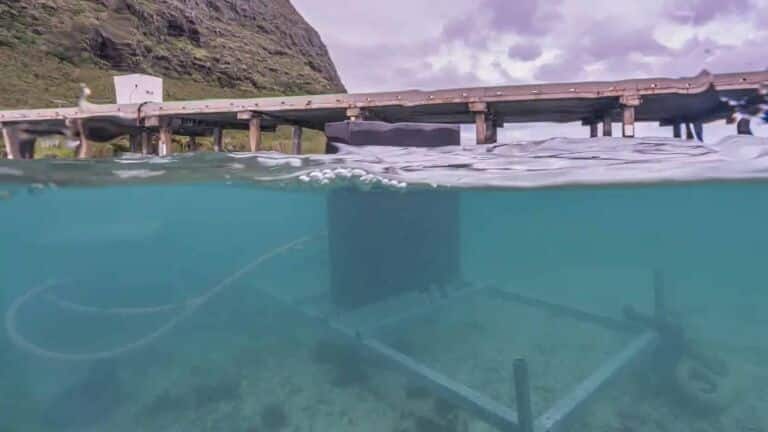
Funding will support development of a smart mooring system for floating offshore wind. The new smart mooring system was developed to provide real-time monitoring of mooring lines.
It is also intended to support environmental acoustic monitoring and entanglement detection. That raises an obvious question about how the system is expected to work.
What technology could allow an underwater cable to continuously monitor both a floating structure and parts of its surrounding environment?
The answer lies in fiber optic sensing
According to Lawrence Berkeley National Laboratory and the California Energy Commission, the project supports development of a smart mooring system.
The system uses distributed fiber optic sensing. Fiber optic sensing sends light down a thin glass core cable and analyzes how it behaves upon returning.
This approach allows operators to monitor vibrations, strain, and temperature inside a structure.
Additionally, according to researchers, it can detect ambient sounds including whale vocalizations. Researchers say the technology can monitor both structural conditions and activity in the surrounding environment at the same time.
The mooring line becomes a monitoring system
By embedding fiber optic sensors into mooring systems, operators may obtain real-time information about the condition of their installations. They may also be able to observe environmental activity occurring around them.
The California Energy Commission identified real-time entanglement detection, structural monitoring, and environmental acoustic monitoring as key goals.
Once this mechanism becomes apparent, the mooring line is no longer viewed solely as a cable that holds a turbine in place. Instead, it becomes a sensing device that monitors the structure and listens to parts of its surrounding ocean environment.
This opens up possibilities for future deployments of similar concepts as developers seek better ways to monitor large structures operating far from shore.
Better monitoring could also improve our understanding of how offshore structures interact with ocean life.
Read the whole thing?
Get the week's signal, not the noise
Our sharpest reporting on energy, climate and nature — free, once a week.