

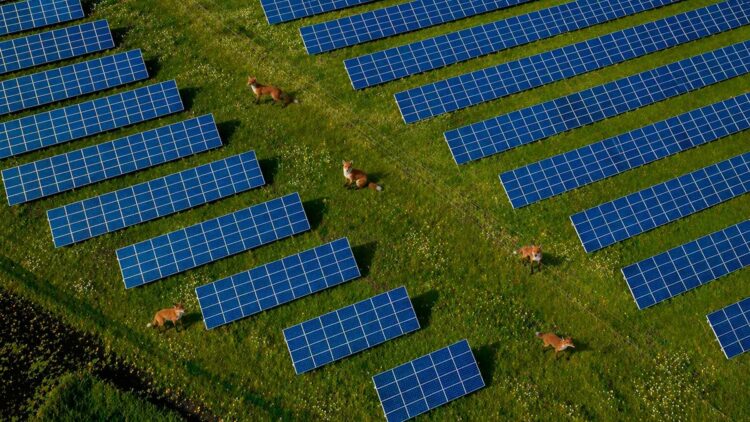
It wasn’t part of the plan.
Solar farms were built to generate clean energy, not to host wildlife. Large, fenced-off areas filled with panels don’t exactly look like a natural habitat.
But when a small, endangered fox was allowed into one of these sites, something unexpected happened.
Instead of struggling to survive, it adapted—quickly. And what researchers saw next began to change how these spaces are understood.
How solar farms started behaving like ecosystems
At first glance, solar farms seem simple.
Rows of panels. Open land. Minimal human presence.
But that last detail turned out to matter more than expected.
Because once construction ends, these areas become relatively undisturbed. No heavy traffic. No constant noise. Limited human activity.
Over time, that creates stability.
Vegetation begins to grow beneath the panels, often encouraged by design. Native plants take hold, insects follow, and small prey species begin to appear.
It doesn’t happen overnight.
But slowly, these sites begin to resemble something else.
Not just infrastructure—but a habitat.
And for some species, that shift is enough to create an opportunity.
A species on the edge finds an unlikely refuge
The San Joaquin kit fox has been struggling for decades.
Native to California’s Central Valley, this small canid has lost more than 95% of its natural habitat due to agriculture and development. Survival has become increasingly difficult.
It relies on space, cover, and access to prey.
And it moves constantly, often using dozens of dens to avoid predators.
So when conservationists began exploring whether solar farms could support wildlife, the idea seemed uncertain.
Could a human-made environment really replace what had been lost?
The only way to know was to try.
And when the foxes entered these sites, their behavior was closely monitored.
What researchers found wasn’t hesitation.
It was adaptation.
What actually happened inside the solar farms
The foxes didn’t just pass through these areas.
They started using them.
Solar farms provided something rare: protection and resources in the same place.
The perimeter fencing, originally designed to secure the site, acted as a barrier against larger predators.
Inside, the environment was rich with small animals—rodents and insects that thrive under the panels.
That meant food was readily available.
The panels themselves created shade, helping regulate ground temperature and making conditions more stable during extreme heat.
And perhaps most importantly, human disturbance was minimal.
The foxes began establishing dens within the solar farms, using the land as part of their regular territory.
In some cases, according to the Bren School of Environmental Science & Management, they returned repeatedly, treating these sites as reliable habitat.
What was meant to be an energy facility had become something more.
Why this changes how we think about how energy and wildlife interact
For years, one of the biggest concerns about renewable energy projects has been land use.
Building large-scale solar farms requires space—and that space often overlaps with natural habitats.
But this example suggests a different possibility.
With the right design and management, these sites don’t have to displace wildlife.
They can support it.
That doesn’t mean every solar farm will have the same effect.
Conditions matter. Location matters. Planning matters.
But the success of the San Joaquin kit fox shows that coexistence is possible.
And in some cases, it may offer a second chance for species that are running out of options.
The idea is still evolving.
But one thing is becoming clear.
What looks like a field of solar panels from the outside might be something very different on the inside—a place where technology and nature are starting to share the same ground.