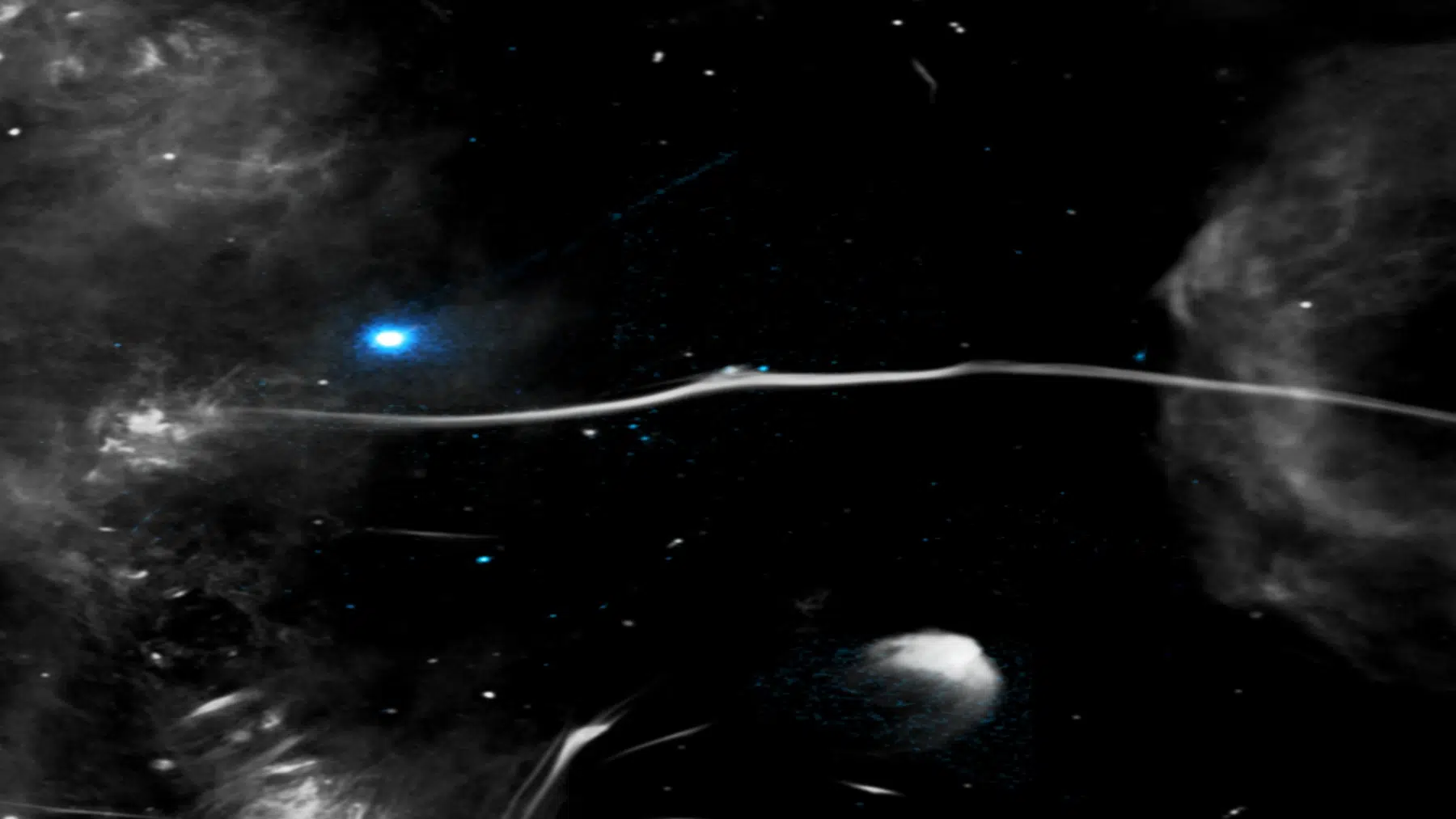
The continuum space-time is not being held together because the universe is made this way. There are invisible forces that scientists from NASA and other space agencies theorize about. Since it can’t be seen, it can’t be proved. Meanwhile, they might have to figure out a way to uncover this to get more knowledge and understanding about why our galaxy, the Milky Way, contains structures that are shaped by forces we can’t fully control or predict, just observe using a special observatory so powerful that it is the only one that can translate the images.
NASA found something new in our galaxy: it was hit by a cosmic object
A cosmic fragmentation is something that we hear more about in sci-fi movies, books, or TV shows, but they are more real than you think. In a cosmos in which many galactic bodies stomp on each other, something new can be born out of the destruction it will cause. Now, imagine this happening with a star. The events are catastrophic.
So far, stars have one of the most powerful destructive powers in the universe. Supernovae and Pulsars (neutron stars) are among the structures capable of whipping out planets if the explosion reaches nearby planets. But, sometimes, they can also interact with other things and create phenomena that are only made visible once NASA uses the correct instrument – and that’s what happened when they used the Chandra X-Ray, pointing out a “bone” appearing in the Milky Way.
Data converted into images: The X-ray observatory was responsible for the discovery
NASA’s Chandra X-ray Observatory often scans deep into our galaxy, and one of those scans revealed something unusual: a fractured “bone.” This bone-like formation was picked up thanks to radio data from the MeerKAT array in South Africa and the National Science Foundation’s Very Large Array in New Mexico. When scientists overlaid Chandra’s X-ray data (shown in bright blue) with the radio information, they saw the fracture. The most likely suspect? A pulsar — a neutron star spinning so fast it shoots out bursts of radiation like a cosmic lighthouse.
Of course, this isn’t an actual bone. What Chandra captured is a galactic center filament — one of the massive, thread-like structures formed by magnetic fields in the heart of the Milky Way. The “bone” in question is cataloged as G359.13142-0.20005. It stretches roughly 230 light-years long and glows as one of the brightest filaments we’ve spotted, sitting about 26,000 light-years away from Earth.
The cause of the phenomenon: It was hit at a million miles per hour
Astronomers believe a pulsar once crashed into the Snake at breakneck speed — somewhere between one and two million miles per hour (1.6 to 3.2 million km/h). With neutron stars being some of the densest objects known in the universe, it doesn’t take much imagination to see how a collision like that could twist the filament’s magnetic field and leave behind the fracture we see today.
Chandra worked with another telescope to capture a strange signal
NASA picked up on a strange cosmic signal pulsing every 44 minutes. The object was named ASKAP J1832-0912 after the Australian Square Kilometre Array Pathfinder (ASKAP) telescope that first caught it, and NASA’s Chandra X-ray Observatory later confirmed the pulses. What made the discovery even possible is that ASKAP and Chandra work in completely different ways. ASKAP scans large swaths of the sky at once, while Chandra zooms in tightly on smaller regions to get sharper detail. By chance, both telescopes were looking at the same patch of sky when the signal came through.
Read the whole thing?
Get the week's signal, not the noise
Our sharpest reporting on energy, climate and nature — free, once a week.