Deep inside a distant galaxy called Mrk 501, something has been orbiting quietly for eons — and for decades, astronomers looking directly at it had no idea.
That changed when an international research team combed through 23 years of radio observations and spotted something that shouldn’t have been there: a second jet of high-energy particles, moving in a way that a single black hole simply can’t produce. The discovery, led by researchers at the Max Planck Institute for Radio Astronomy, points to two supermassive black holes locked in a gravitational embrace at the galaxy’s core.
A second jet hiding in plain sight
Mrk 501 is one of astronomy’s most studied radio galaxies, and for good reason. Its central black hole fires a brilliant jet of particles almost directly toward Earth, making it unusually bright and easy to monitor. Researchers assumed they understood the system well. They didn’t.
Hidden inside 23 years of archival radio data was a second, fainter jet — pointing in a different direction than the first. That misalignment is exactly why it slipped past notice for so long. A single black hole can’t produce two jets aimed in different directions, which meant something else had to be there.
“We searched for it for so long, and then it came as a complete surprise that we could not only see a second jet, but even track its movement,” said lead author Silke Britzen.
Two giants locked in a 121-day orbit
Once researchers identified the second jet, they watched it move — and it moved fast. Over just a few weeks of observations, its position shifted dramatically, sweeping counterclockwise around the primary black hole in a repeating arc that pointed to a regular orbital cycle.
The team calculated a period of approximately 121 days, with the two black holes separated by an estimated 250 to 540 times the Earth-Sun distance. For objects each massing between 100 million and one billion times the Sun, that’s extraordinarily tight.
Britzen described analyzing the data as feeling like being on a ship. “The entire jet system is in motion,” she explained. “A system of two black holes can explain this: the orbital plane sways.” Decades of archival radio data had been encoding that motion all along.
An Einstein ring and a rare gravitational lens
The evidence didn’t stop at jet positions. In June 2022, radiation from the Mrk 501 system briefly formed a ring — a visual clue that something unusual was happening at its core.
This phenomenon is called an Einstein ring. It occurs when gravity bends light so completely around a massive object that it wraps into a circle, essentially a cosmic magnifying glass. If the two black holes and Earth lined up at just the right angle, the gravity of the nearer black hole could have bent light from the second jet into that ring shape — an independent piece of evidence pointing, again, to a second massive object sharing the galaxy’s core.
A merger that could happen in 100 years
The orbital math carries a striking implication. Depending on the actual masses of the two black holes, their separation may be shrinking fast enough for them to collide in as little as 100 years — barely a blink in cosmic terms.
Scientists have long expected that when two galaxies combine, their central black holes eventually follow. Catching a pair this close together, in the final stages of inspiral, has never been reliably done before. Mrk 501 may be the first confirmed example. The discovery could also help explain how the largest supermassive black holes grew so fast, with mergers supplementing slow gas accretion.
Listening for gravitational waves from Mrk 501
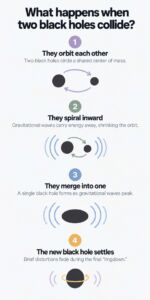
There’s another way to track what’s happening inside Mrk 501 — one that doesn’t require seeing the black holes at all. As the pair orbits, it should generate extremely low-frequency gravitational waves: ripples in spacetime spreading outward across the universe.
Pulsar timing arrays use millisecond pulsars as precise cosmic clocks, and tiny variations in pulse arrival times can reveal passing gravitational waves. In 2023, the European Pulsar Timing Array reported evidence of a gravitational wave background likely produced by many supermassive binary pairs scattered across the cosmos. Mrk 501 is now a prime candidate for linking that background signal to a single, identified source.
Co-author Héctor Olivares put it plainly: “If gravitational waves are detected, we may even see their frequency steadily rise as the two giants spiral toward collision, offering a rare chance to watch a supermassive black hole merger unfold.”
More information is available here: S Britzen, H Olivares, Gopal-Krishna, F Jaron, I N Pashchenko, E Kun, F K Schinzel, J Becerra González, D Paneque, N R MacDonald. Detection of a second jet within the nuclear core of Mrk 501. Monthly Notices of the Royal Astronomical Society, 2026; 548 (4) DOI: 10.1093/mnras/stag291
Read the whole thing?
Get the week's signal, not the noise
Our sharpest reporting on energy, climate and nature — free, once a week.