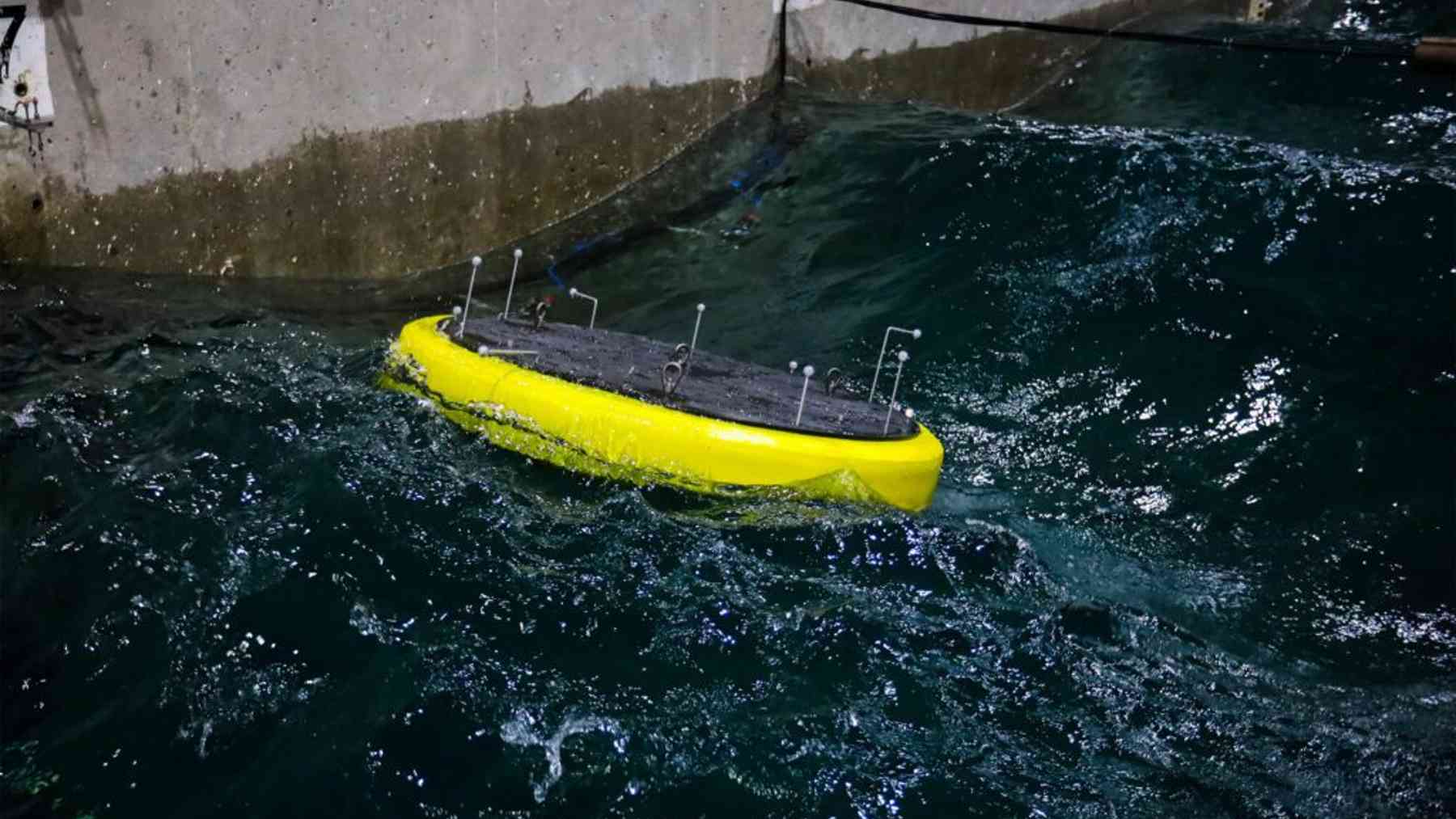
The buoy looks almost comic bobbing in the long channel, a stubby yellow cylinder rolling and dipping as a man made wave rushes toward it.
Thin sensor rods poke from its top like antennae, and cameras overhead track every tilt.
The lab team nicknamed it a pancake, built to catch the power of the wave passing beneath it.
It is tempting to assume a device sitting in open water scoops up nearly everything moving past it.
The tank tells a very different story.
What a wave buoy actually grabs, and what it lets go by
A wave moving across the ocean carries energy the way wind carries it across a field, spread out along the whole crest rather than stacked up in one place. A floating buoy can only reach into the slice of that crest directly beside its own body, so its footprint sets a hard ceiling on how much power it can ever pull out, no matter how clever the machinery inside it gets.
Engineers measure that ceiling with something called the capture width ratio, a comparison between the power a device actually harvests and the power flowing past a stretch of open water exactly as wide as the device itself.
Published reviews of real and modeled wave machines report capture width ratios that vary widely by operating principle, with benchmarking work putting a selection of devices roughly in the 4 to 30 percent band. Values approaching half are reported mainly for optimized designs or idealized conditions, and the rest of the wave simply rolls on past, bending around the hull or slipping beneath it.
So the misleading picture is the open ocean itself, imagined as an endless free battery waiting for a bucket. The real prize is a narrow slice of that battery, and a few points of gain is a serious result in this field.
Inside the tank where Oregon tests its yellow pancake
At Oregon State University’s O.H. Hinsdale Wave Research Laboratory in Corvallis, doctoral students run that exact yellow buoy through a long indoor channel built to recreate ocean swell on command. The lab holds a small scale wave converter in the flume, with the buoy floating in what the team calls an ocean simulator.
The channel is enormous by lab standards, measuring 342 feet long and able to generate waves up to about 5.6 feet.
The sensors mounted on sticks above the buoy let motion capture cameras track its movement in six degrees of freedom, catching every roll, heave and sway so researchers can work out how much of the wave’s energy the shape actually absorbed. The same open source device gets tested two ways, floating on the surface and held fully underwater, because the team studies both. That side by side comparison is helping researchers test assumptions about where in the water column a machine should sit.
Why shape and depth change the number so sharply
Pull one buoy slightly deeper and its capture ratio can shift, because wave energy fades quickly with depth below the surface. A hull that performs well bobbing on top of a swell is not automatically the hull you want holding station well beneath it.
Spacing matters too. Set devices close together and each one radiates and scatters waves of its own, so a neighbor can end up in a calmer patch of water or, with the right geometry, a slightly livelier one.
Engineers call this the park effect, and it is why array layout is treated as a design variable in its own right. That turns a wave farm into a question of arrangement, not just of individual machines, much like the pendulum driven test buoy tried off New Jersey, where tanks remain the honest proving ground before any machine reaches salt water.
The students chasing a few extra percentage points
Three doctoral researchers run experiments with the yellow pancake at Oregon State, each chasing a different piece of the efficiency puzzle. One of them, Raza Ali, said he was “lucky enough to be a part of an internship program at the National Renewable Energy Lab where I was exposed to wave energy converter design and modeling,” an experience that led him to apply to the doctoral program at Oregon State.
His project landing on submerged converters was, in his words, “happenstance, but I enjoy the more niche research field and applications related to submerged WECs.”
That kind of accidental specialization is common in a field still working out its basic trade offs. Their work connects to a wider push across the country, including the way floating panels near Central Point are tested for how shade changes the water beneath them.
What still has to improve before the ocean pays off
Even generous capture width ratios shrink further once that power moves through gears, hydraulics or generators on its way to a usable current. Combined losses can leave a device delivering far less to the grid than its capture width ratio alone would suggest, a gap engineers describe as wave to grid efficiency.
That is part of why no commercial wave farm yet rivals wind or solar in scale, and why so much of this research still happens in tanks rather than oceans.
The ceiling on any single buoy is real, but spacing, shape and depth all still have room to push that modest slice of the wave a little higher. For now, the ocean holds immense power, and today’s machines are still learning how to take even a fair share of it without losing most of it to splash, slip and heat along the way.
Read the whole thing?
Get the week's signal, not the noise
Our sharpest reporting on energy, climate and nature — free, once a week.