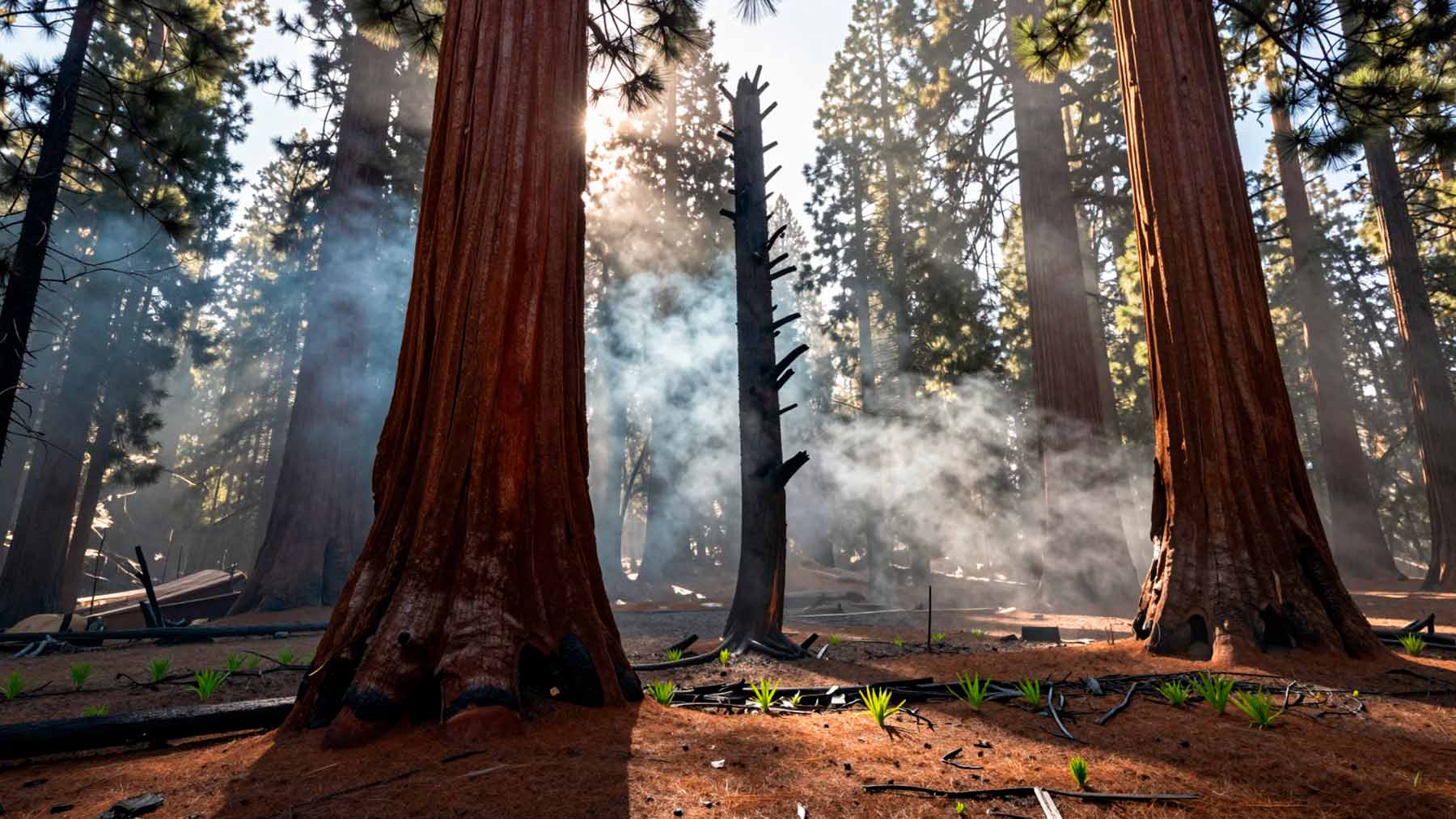
Two consecutive fire seasons in 2020 and 2021 swept through California’s Sierra Nevada and killed thousands of giant sequoias — trees that had survived for centuries, some for more than three millennia. Entire groves were reduced to burned ruins, and images of the destruction sent shockwaves through the scientific community.
For generations, mature sequoias were considered nearly fireproof. Their thick bark and towering canopies had carried them through countless fires. Then, in just two years, thousands died. “Having so many die in just two years was unprecedented,” said lead researcher Dan Dixon of UC Davis.
What made these fires different — and what, if anything, could have saved those ancient trees — is what scientists set out to understand.
Trees built to last millennia, lost in two years
Giant sequoias are extraordinary by almost any measure. A single tree can weigh as much as 15 blue whales and live for more than 3,000 years. They grow only on the western slopes of California’s Sierra Nevada, shaped by millennia of periodic, low-intensity fire. That fire history is written into their biology — thick bark deflects heat, elevated canopies stay above most flames, and ash left behind creates ideal conditions for new seedlings.
For decades, that resilience made mature sequoias seem nearly untouchable. Fire managers and scientists widely believed a healthy adult tree could weather virtually any blaze.
The 2020 Castle Fire and the 2021 KNP Complex Fire ended that assumption. Thousands of trees that had survived centuries of drought, disease, and previous wildfires died within just two fire seasons. Groves that had stood since before European contact were reduced to standing char. The scale of loss was something scientists had never seen — and never expected to see.
A natural experiment decades in the making
Sequoia and Kings Canyon National Parks have operated one of the country’s most extensive prescribed fire programs since the 1960s. Decade after decade of controlled burns gradually created a patchwork of groves with very different fire histories — some treated relatively recently, others untouched by fire for more than a century.
That gap mattered enormously when extreme wildfires arrived. Untreated areas had accumulated deep layers of dead wood, dense shrubs, and other combustible material. When the Castle and KNP Complex fires moved through, those sections burned far more intensely than areas where earlier controlled burns had reduced fuel loads.
Researchers recognized this contrast for what it was: a rare, large-scale, real-world opportunity to measure whether prescribed fire actually protects ancient trees when conditions turn catastrophic.
How scientists measured survival across 26,400 trees
The UC Davis–led team didn’t rely on ground surveys alone. Researchers from UC Davis, the U.S. Geological Survey, and Sequoia and Kings Canyon National Parks combined airborne lidar with high-resolution PlanetScope satellite imagery to assess conditions before and after both fires.
Lidar works by firing laser pulses at the forest canopy and measuring how they bounce back, capturing detailed three-dimensional information about fuel structure. Paired with satellite imagery, that data let the team evaluate outcomes for roughly 26,400 individual giant sequoias across 19 affected groves.
The scale of the analysis set it apart. A rigorous statistical framework allowed researchers to draw conclusions well beyond what traditional field surveys or anecdotal records could support, according to co-author Yufang Jin of UC Davis. The approach made it possible to isolate the specific effect of prescribed fire history on survival — controlling for other variables that might otherwise muddy the picture.
Prescribed burns cut the odds of death by 77%
The results were striking. Giant sequoias that had received prescribed burns within the previous decade were nearly four times more likely to survive than untreated trees in the same groves — controlled burns reduced the probability of death by approximately 77%.
Those numbers translate into real trees. Computer simulations estimated that prescribed burns carried out before the fires prevented around 1,900 sequoia deaths. The researchers went further, calculating that up to 3,900 additional trees could have survived if every grove had been treated beforehand.
“Prescribed burns are effective at reducing giant sequoia mortality, even for today’s extreme wildfires,” Dixon said. “If the goal is protecting giant sequoias, prescribed fire is an essential tool available to managers.”
That framing matters. The study doesn’t position controlled burning as a partial solution or a supplementary measure — it identifies it as a core requirement for keeping these groves intact.
What this means for the future of sequoia conservation
Climate change is pushing wildfires toward intensities that even fire-adapted species struggle to survive. Giant sequoias are naturally resistant to ordinary fire, but this study shows they aren’t invulnerable when flames grow extreme enough and fuel loads climb high enough.
The findings arrive at a critical moment. California has been expanding its fuel-thinning programs in recent years, and a long history of fire suppression across Sierra Nevada forests has left many groves carrying far more combustible material than they would under natural conditions. Jin noted that the study’s combination of scalable remote sensing and rigorous statistical methods reveals insights that traditional approaches simply can’t match — and that makes the findings harder to dismiss.
Researchers are clear about what comes next: prescribed fire must be treated as an essential management tool, not an optional one. As fire seasons grow longer and more severe, groves that receive regular controlled burns will likely fare better than those left untreated. The question now is whether land managers can expand those programs fast enough to protect the ancient trees still standing.
Read the whole thing?
Get the week's signal, not the noise
Our sharpest reporting on energy, climate and nature — free, once a week.