
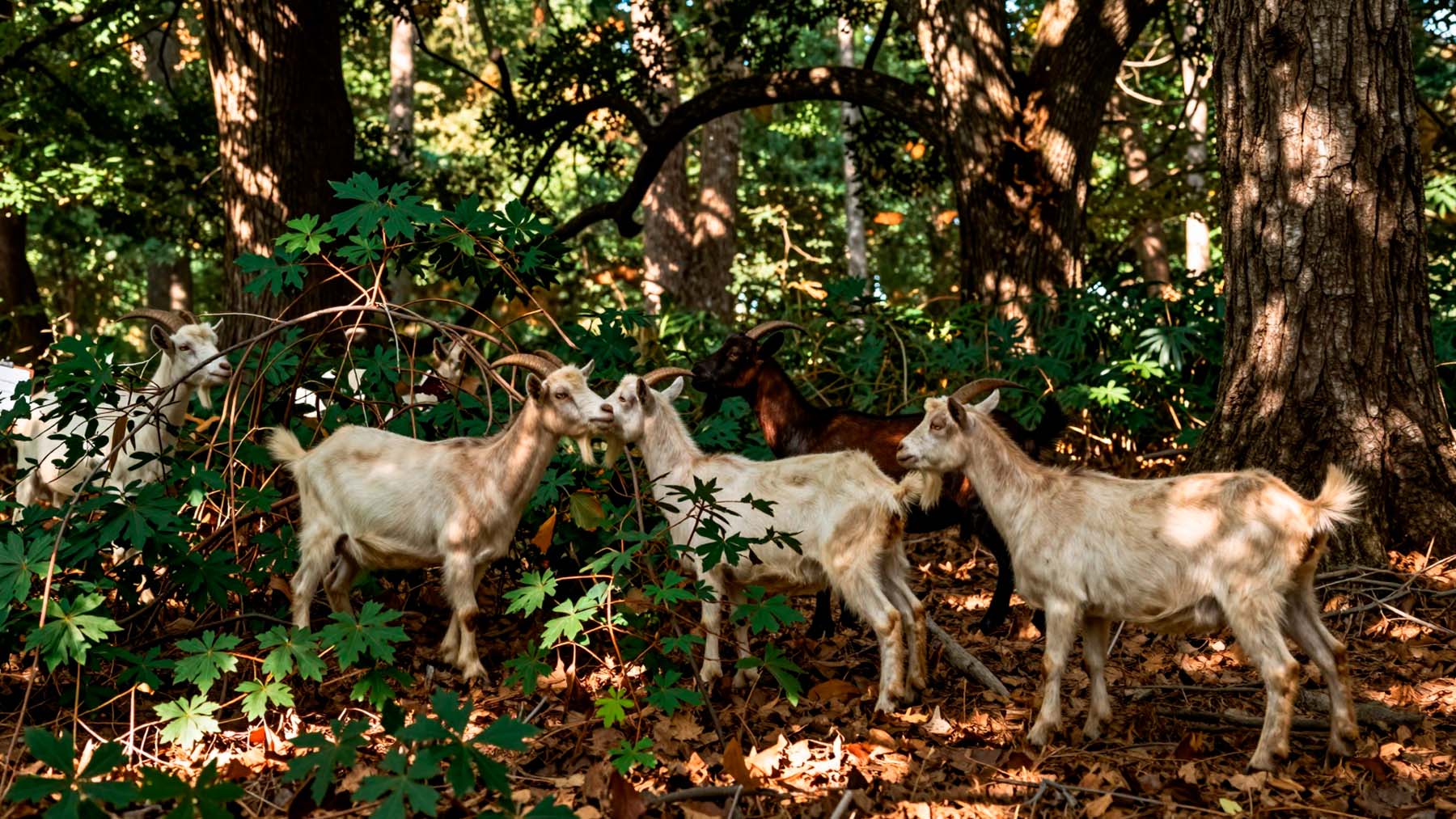
In a dense Ohio oak-hickory forest thick with multiflora rose, oriental bittersweet, and privet, researchers followed a small herd of goats and logged every nibble, sniff, climb, and rest. The goal was to understand how goats actually behave when deployed as a conservation tool — and specifically, what drives them to browse more or less in an invaded forest.
The leading assumption was simple: the more crowded the forest with invasive plants, the more the goats’ behavior would shift to match. But when scientists analyzed what they’d recorded, the data told a different story.
Goats as a forest restoration tool
Oak-hickory forests once covered vast stretches of the eastern United States, shaped by centuries of low-intensity fire that kept shade-tolerant species in check. When fire suppression took hold through the 20th century, maples and beech moved in. Invasive shrubs — multiflora rose, privet, oriental bittersweet — followed close behind, crowding out the oak and hickory seedlings the forest depends on to regenerate.
Land managers have responded with prescribed burns and selective thinning, but those tools have limits. They can even open gaps that invasive species exploit. Conservation grazing has emerged as a complementary approach: bring in livestock to selectively browse unwanted plants, reducing competition for native seedlings without heavy machinery or chemicals.
Goats are a natural fit. Unlike cattle, they prefer woody shrubs over grasses, and they’re agile enough to navigate the dense, tangled understory where invasive plants thrive. Earlier work at the same Ohio site showed goats do browse invasive species selectively — but the deeper question, largely unanswered for eastern North American forests, is how they actually behave while doing it.
What the researchers set out to measure
The study took place at Ohio State University’s Pomerene Forestry Laboratory in Coshocton, Ohio — a secondary hardwood forest logged in 2016 with no follow-up invasive control. The understory had since filled in with multiflora rose, privet, and oriental bittersweet, making it a realistic test case for goat-assisted restoration.
Eight crossbred does — some Boer-influenced, others Nubian dairy-influenced — were observed under two conditions: low browsing pressure and high browsing pressure, split between morning and afternoon periods. The team used focal-animal direct observation, logging ten distinct behaviors: browsing, ruminating, resting, walking, sniffing, climbing, heading, and scratching.
Four hypotheses guided the work. The researchers predicted that browsing pressure, plant availability, time of day, and breed would all shape goat behavior. They also expected that sniffing a plant would reliably signal an animal was about to eat it.
What actually drove goat behavior in the forest
The headline finding is clean: browsing pressure and plant availability had no detectable influence on how the goats behaved. The two factors expected to matter most simply didn’t show up in the data.
Time of day did. Goats spent roughly 70% of observed time either browsing or ruminating, but the balance shifted sharply across the day — browsing increased by 74% in the afternoon, while rumination dropped by 62%.
Breed was the other significant factor. Dairy goats allocated nearly 50% of their time to browsing, significantly higher than Boer goats, who spent more time resting. That gap appeared specifically in plant consumption, not in walking or other plant-interaction behaviors. For managers who focus primarily on stocking density and forage abundance as the main levers for controlling browsing, these findings suggest a different set of variables may deserve more attention: who you put in the forest, and when.
The sniffing hypothesis that didn’t hold up
The prediction about sniffing seemed reasonable enough. Ruminants are known to investigate food carefully before consuming it, and close facial contact with a plant looked like a logical precursor to eating. The data didn’t support that logic.
No correlation emerged between sniffing, climbing, or other plant-interaction behaviors and actual browsing frequency. Sniffing and climbing were instead positively correlated with walking — suggesting these behaviors reflect how goats move through and explore the environment, not some pre-feeding assessment ritual.
The researchers are careful about how far to push this. The study involved only 36 total observations across 8 goats, which limits statistical power considerably. They frame it as a pilot result that opens new questions rather than settles them.
What this means for forest managers
Even with its exploratory scope, the study offers practical takeaways for anyone thinking about deploying goats for forest restoration.
Breed selection looks like a meaningful management decision. Dairy-influenced goats spent significantly more time browsing than Boer goats, and against dense infestations, that difference could add up over a grazing season. Timing matters too — the afternoon surge in browsing activity suggests that scheduling goat access to align with peak browsing hours could improve efficiency. The authors also note that spring deployments may be especially effective, targeting invasive species during early green-up when cooler temperatures could enhance goat intake.
Beyond the practical implications, the study provides a foundational ethogram and time-budget baseline for this type of research in eastern U.S. forests — the kind of documented behavioral framework that makes larger future studies possible.
Where the research goes from here
This study was explicitly designed as a pilot. The authors are transparent about its constraints: small sample size, variable individual behavior, and an experimental design that limited how much the animals could walk.
What comes next is a larger-scale study with more animals, more observations, and a wider range of conditions — different seasons, forest types, and stocking approaches. The breed difference in browsing time, in particular, warrants a closer look with a sample large enough to draw firm conclusions.
For land managers, the practical implications are already worth attention. If afternoon browsing and dairy-influenced breeds consistently outperform other configurations in invasive shrub removal, those are decisions that can be made now. The science of goat-assisted forest restoration is still early, but it’s moving in a direction that could meaningfully change how degraded oak-hickory forests get put back together.
Read the whole thing?
Get the week's signal, not the noise
Our sharpest reporting on energy, climate and nature — free, once a week.




