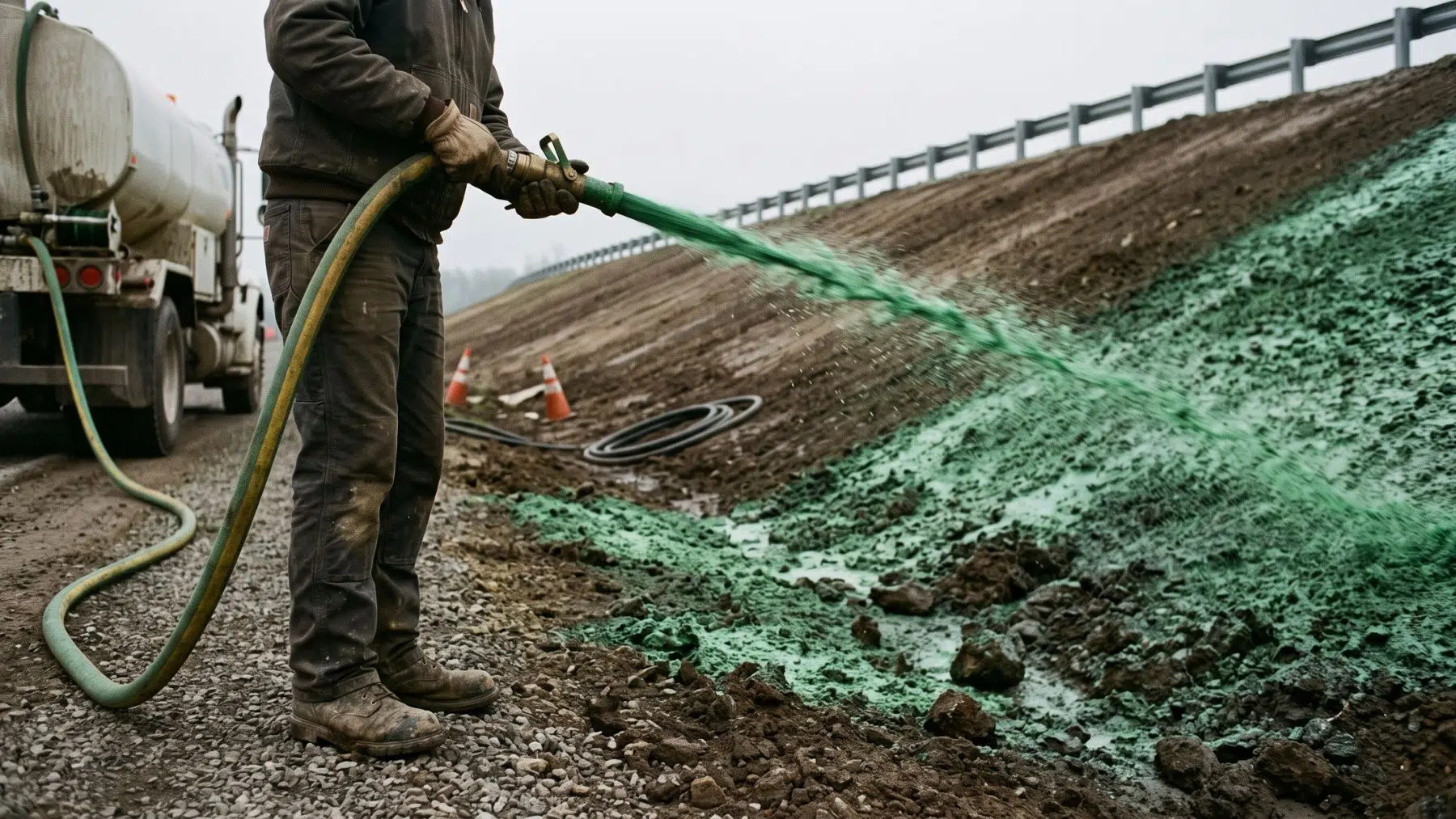
A tanker truck idles on the shoulder of a new highway, a fat hose running off the back.
A worker swings the nozzle, and a bright green jet arcs across the bank.
In minutes the whole slope is golf course green, with no grass on it at all.
The stuff is wet and thick and clings to the bare dirt like paint.
By next week, small green shoots will push up through it.
So what is in that spray, and how does it raise a lawn on bare dirt this fast?
How the mush makes a slope grow
The spray is a slurry, mixed in the truck’s tank and pumped out under pressure. Into the water go grass seed, a thick wad of wood fiber mulch, a shot of fertilizer, and a sticky binder called a tackifier, often made from the guar bean.
Each part has a job.
The mulch settles into a damp blanket that holds water right against the seed, and the tackifier glues that whole mat to the ground so a rain shower cannot rinse it off the slope. Seed pressed into steady moisture and firm contact with soil sprouts far faster than seed flung dry by hand.
That is the trick in one line. A bare bank gets a custom made growing bed and a coat of glue in the same pass, and the seed wakes up in days instead of weeks.
The green is a dye, not the grass
Here is the part that fools almost everyone. That golf course color is not the plants at all. It is a temporary dye stirred into the mix so the operator can see exactly where the spray has already landed.
The color is a guide, not the grass.
Without it, a worker aiming a hose across a wide bank would miss bare patches and double coat others. The dye lights up the wet slurry so the whole slope gets an even layer, then it fades within days as the weather works on it.
By the time real shoots appear, the bright coat is already washing out. The grass that comes up is a softer, paler green, growing straight through the last of the colored crust.
The math against a pallet of sod
The reason crews reach for the hose is money and speed. Spraying a lawn runs about 6 to 20 cents a square foot, while trucking in and laying sod runs closer to a dollar or more. On a normal 5,000 square foot yard, that is roughly 500 to 1,000 dollars against several thousand for sod.
The gap only grows with scale.
Cover a full acre and the spray costs a few thousand dollars where sod can run past 40,000. Landscapers put the savings between half and eighty percent, and the grass shows in about one to two weeks, against up to a month for dry seed scattered on the same dirt.
The same mix does heavier work too. After a wildfire, crews blanket burned slopes with about 2,000 to 3,000 pounds of wood fiber an acre, aiming to keep most of the ground covered through a full growing season so the hillside holds.
Where the green spray falls short
The spray is not magic, and it asks for patience. A fresh coat has to stay damp for weeks, watered almost daily, or the young seedlings dry out and die before they root.
It is also not an instant lawn.
Sod gives you a green yard the day it is rolled out, while hydroseed gives you bare tinted dirt that you cannot walk on for a month or more, the same slow trade behind an offshore wind build. A hard storm before the mat sets can wash the whole thing downhill.
The ground has to cooperate as well. Crews skip slopes buried in loose rock, and the truck can only reach so far, so a bank more than about 300 feet from a road is often out of range, one cost guide notes.
Why crews keep reaching for the hose
Strip away the lawn and the real value shows up on raw land. The spray was born on the steep banks of new highways, where nothing else would hold the bare cuts against the rain.
That is still its best trick.
After a fire, sprayed mulch and seed armor a scorched hillside before winter storms can send mud into homes and reservoirs, the way a fox settles in around some solar panels once a place turns friendly. Mines, pipelines and building sites lean on the same quick cover.
None of it is a finished lawn on day one. It is a cheap, fast bet that seed, mush and a little glue can hold a slope and turn it green, and most of the time the bet pays off.
Read the whole thing?
Get the week's signal, not the noise
Our sharpest reporting on energy, climate and nature — free, once a week.