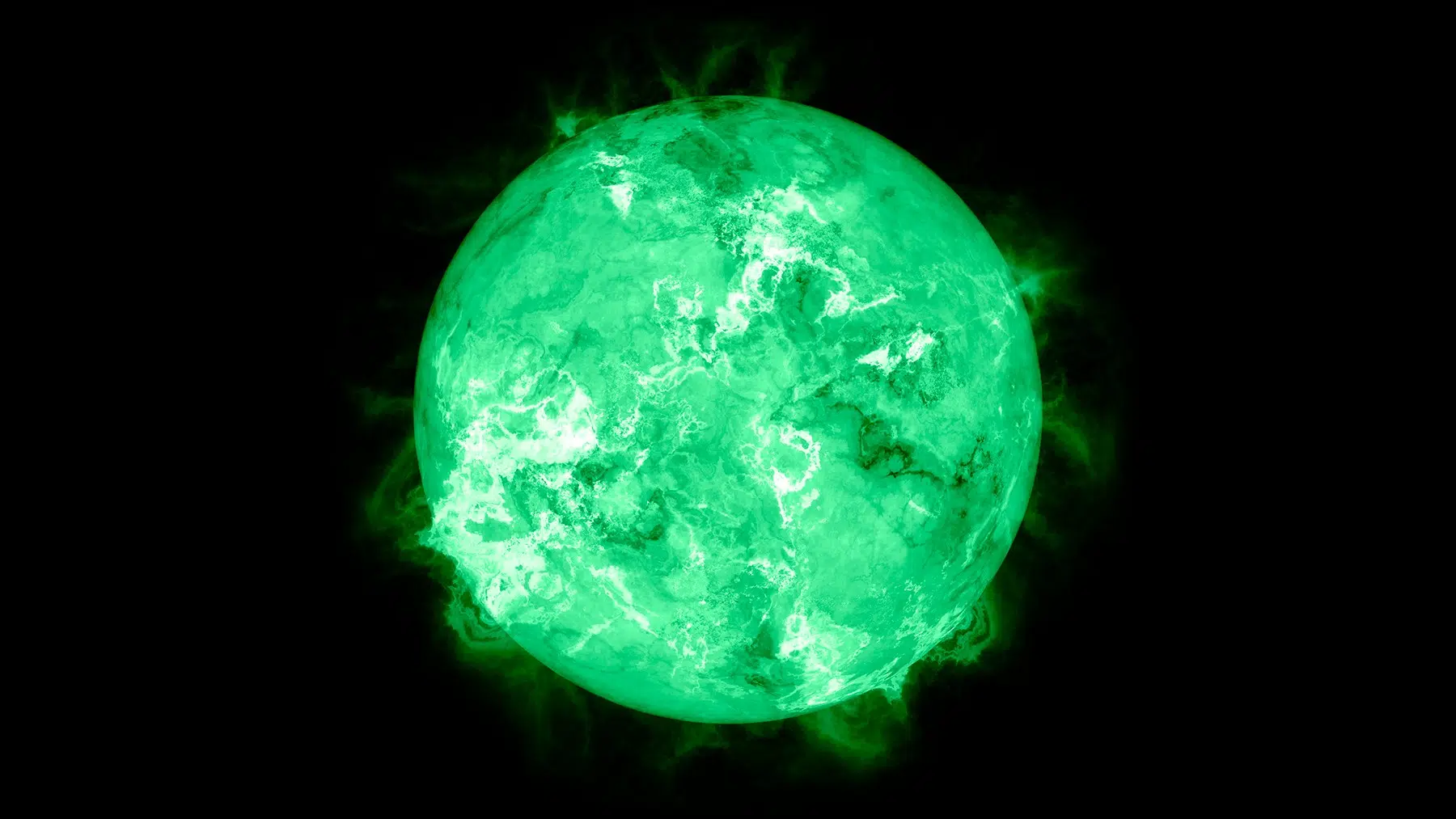
Astronomers have long debated whether a green star can exist. But how? Stars can have many colours. While most people see the sun as yellow, sometimes the Earth’s atmosphere gives it another colour. Our sun, for example, is actually white. The only reason we see it as yellow is because of atmospheric scattering: our planet scatters the blue wavelength of sunlight, and this allows the longer yellow, orange, and red wavelengths to reach our eyes. So, its real colour is white, and even if we were outside our planet, we would see it as white — not yellow.
Stars have all the colours: It shows us only what we are capable of comprehending
Stars emit a full spectrum of colours, including green. However, within the range of wavelengths and intensities found in stars, greens get mixed with other colours. So, according to astrophysicists, stars cannot appear green. For stars, the general colours run from lower to higher temperatures: red, orange, yellow, white, and blue. A green star, in theory, cannot exist. While green is technically in the spectrum, any star peaking in green also emits neighbouring colours, and our eyes blend them — the result is never green.
In the Libra constellation, located between Virgo and Scorpius, the brightest star, Zubeneschamali, is exactly the one astronomers are trying to understand — because it appears green to many observers, even though science says it should look white or blue.
The green star myth unveiled: The reality is very mundane
Zubeneschamali, also known as Beta Librae, is the brightest star in Libra. It edges out Zubenelgenubi by just a little, but for centuries it has sparked more curiosity. Today, most astronomers classify it as a hot blue-white B-type star. However, historical observers swore it shone green, calling it the only naked-eye green star in the entire night sky.
The mystery is that stars do not really appear green. Even if one puts out light strongest in the green range, the yellow and blue wavelengths on either side drown it out. Our eyes blend the colours, and the result is never green. That’s why scientists say we only see stars in shades of red, orange, yellow, white, or blue.
Inside the star’s power: Here’s how Beta Librae shines so brightly
What we do know: Zubeneschamali is a B-type dwarf, blazing at more than 12,000 K. It burns 130 times brighter than the Sun, nearly five times its size, and more than three times its mass. It spins furiously too, more than 100 times faster than the Sun, reaching 250 km/s. At only 80 million years old, this is still a young star.
Science has given Beta Librae the edge over its rival in Libra, Zubenelgenubi. Astronomers now know the beta star burns much brighter than the alpha. From Earth, though, the two look almost equal. That’s only because Zubenelgenubi is closer — 75 light-years away, while Zubeneschamali sits at 185 light-years. In truth, Zubeneschamali shines far brighter than Zubenelgenubi, and about 130 times brighter than our Sun. We still don’t know much about why this spot was hidden all this time.
You can spot the stars yourself: Look at the sky during this time
The “green star” is visible during the summer nights in the Northern Hemisphere. It climbs high in the southern sky and is easy to spot. To find it, start with Antares, the bright red heart of Scorpius. From there, move about two fist-widths to the northwest — the star will be there, shining and waiting to be studied (like this one that blew up, and it’s expanding in our galaxy)
Read the whole thing?
Get the week's signal, not the noise
Our sharpest reporting on energy, climate and nature — free, once a week.