It sounds like noise at first.
Birds calling from every direction. Monkeys shouting from the canopy. Insects filling every gap with a constant hum.
To human ears, the Amazon feels chaotic.
Unpredictable. Overwhelming. Almost random.
But when researchers listened more carefully, something began to emerge.
The noise wasn’t random at all.
It was organized.
And somehow, animals were understanding each other across species.
So what exactly is happening inside this forest?
How scientists realized the forest wasn’t as chaotic as it seemed
A team of ecologists traveled deep into the Peruvian Amazon with a simple goal.
Study how animals respond to predators.
The idea was straightforward: one species detects danger and alerts others nearby.
That’s common in nature.
But almost immediately, something didn’t add up.
Warnings didn’t stop within a species.
They spread.
Birds would call—and animals far beyond their group would react.
Not just other birds. Monkeys.
Different species, responding to the same signal.
At first, it seemed coincidental.
Until it kept happening.
Over and over again.
A chain reaction moving through the canopy
To understand what was happening, researchers began tracking who initiated the alarms—and who responded.
The pattern became clear.
Some of the smallest birds in the forest were the most important.
Species like black-fronted and white-fronted nunbirds acted as early warning systems. When they detected a predator, they produced loud, distinct alarm calls.
Those calls didn’t stay local.
Other birds picked them up and repeated them.
The sound spread outward, like a ripple.
From one part of the forest to another.
But the most surprising part wasn’t how far the signal traveled.
The study, “Small canopy species drive information highways about predators in an Amazonian rainforest,” published in Current Biology, says it was who was listening that was most important.
The hidden network connecting different species
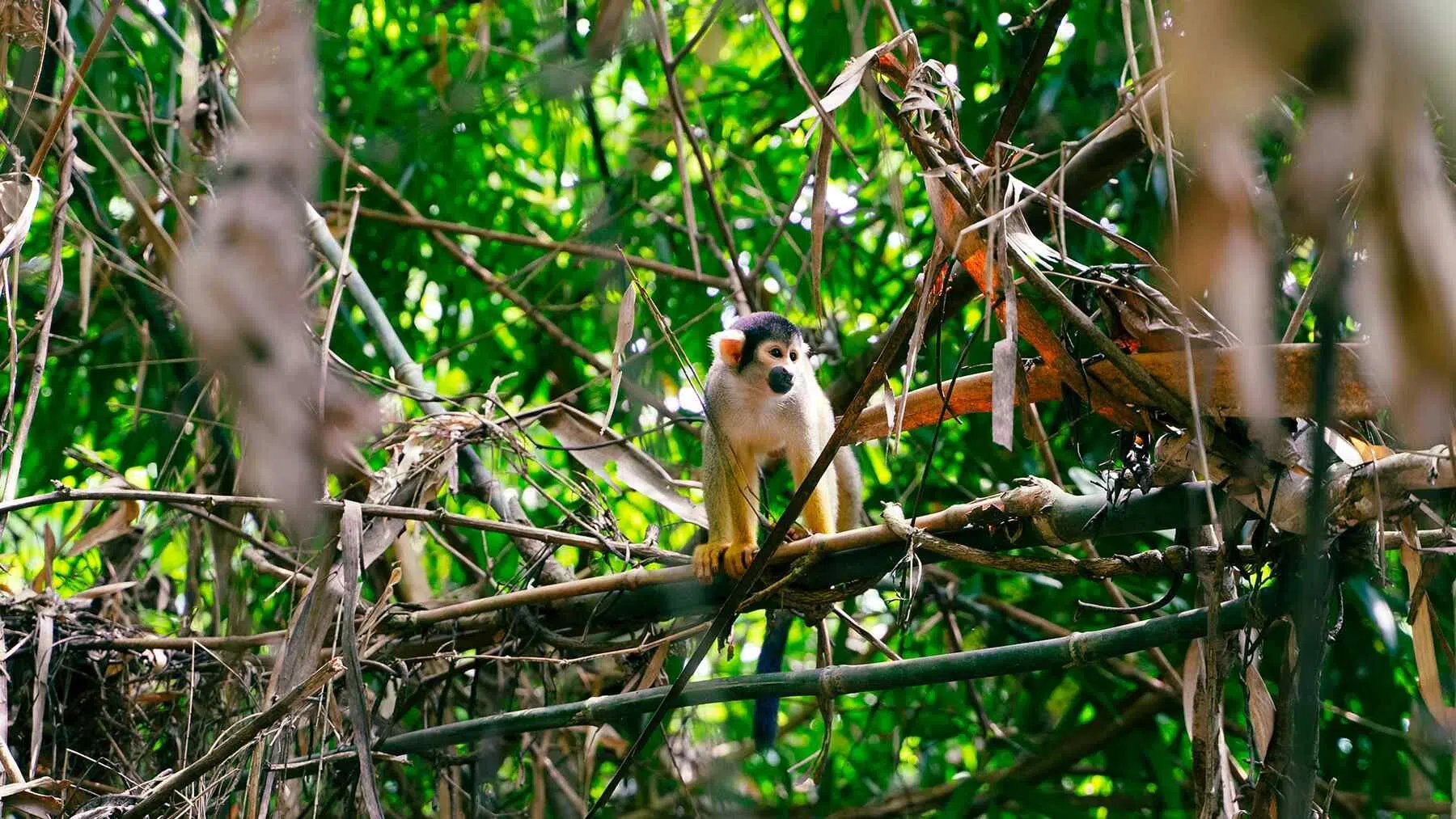
Monkeys, high in the canopy, were reacting to these bird calls.
Not randomly.
Not hesitantly.
But with the same urgency as if one of their own had sounded the alarm.
They recognized the signal.
They understood its meaning.
And they acted on it immediately.
Researchers realized this wasn’t just communication.
A system where information moved between species, carried by sound, interpreted without translation.
An invisible web connecting animals across the forest.
The “language” no one can fully decode
What makes this system so remarkable is how it works.
Each species has its own calls, its own signals.
But certain sounds—especially those linked to danger—are understood across species boundaries.
Birds don’t need to “teach” monkeys.
Monkeys don’t need to learn a new language.
It says in the article, “Birds and monkeys in the Amazon share information via ‘internet of the forest’: new research,” published in The Conversation, they simply recognize patterns.
Tone. urgency. repetition.
Enough to know what matters.
Scientists still don’t fully understand how this recognition works.
But they know it’s happening.
And it’s fast.
Faster than anything humans could coordinate in that environment.
What this hidden network really is
The “hidden network” is not physical.
It’s not built from structures or connections you can see.
It’s a flow of information.
A system of alarm calls shared across species, creating what researchers describe as an “internet of the forest.”
When one animal detects danger, the signal spreads.
Others pick it up, amplify it, and pass it on.
Within seconds, large sections of the forest are aware of a threat.
Even if they never saw it.
Even if they never encountered it directly.
Why this changes how we understand the natural world
For a long time, scientists believed animal communication was mostly limited within species.
Birds talk to birds. Monkeys communicate with monkeys.
But this discovery suggests something more complex.
A shared system.
Different species cooperating indirectly, connected by a common need to survive.
It doesn’t require intention.
It doesn’t require coordination.
It simply works.
A forest that isn’t chaotic—but connected
What once sounded like noise is something else entirely.
A network.
A system built on sound, speed, and survival.
And it has been there all along.
The Amazon isn’t chaotic.
It’s organized in a way we’re only beginning to understand.
And every call that echoes through the trees may be carrying more than just sound.
It may be carrying information—moving silently through a network we can hear, but are only starting to comprehend.
Read the whole thing?
Get the week's signal, not the noise
Our sharpest reporting on energy, climate and nature — free, once a week.