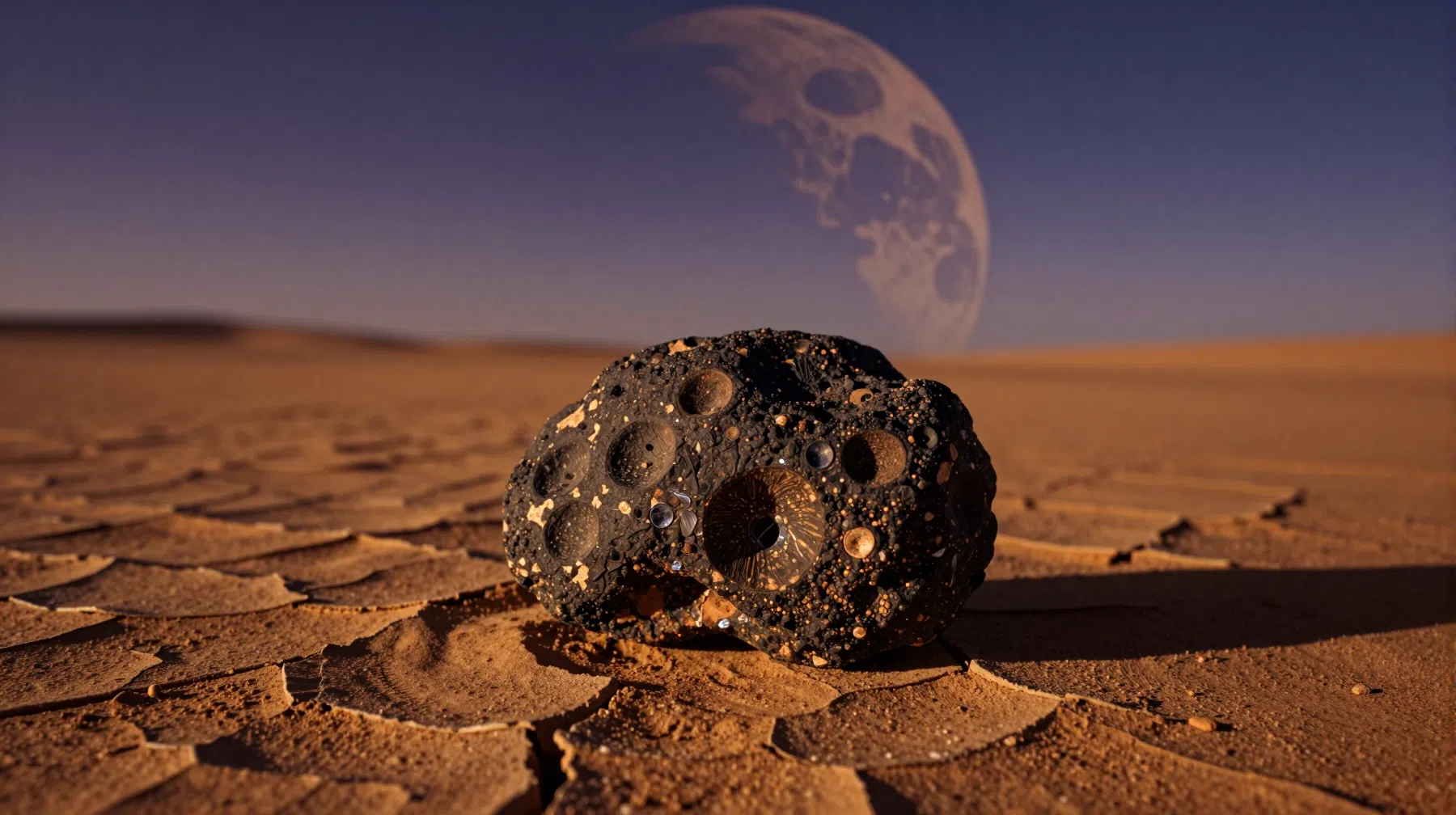
A small, unremarkable rock pulled from the Sahara Desert in 2019 sits among the rarest objects on Earth. Of roughly 80,000 known meteorites, only 68 belong to its category — a class called angrites. For decades, scientists assumed these stones came from a modest asteroid, nothing especially dramatic.
Then researchers looked closer at the minerals locked inside NWA 12774. The pressure readings they uncovered had no business existing in a rock from a small space rock — they pointed somewhere far larger, and far stranger, than anyone had assumed.
A meteorite that defied expectations
NWA 12774 is classified as an angrite — one of only 68 known among roughly 80,000 catalogued meteorites. Angrites also carry a distinctive chemical signature: they are strikingly silica-poor, lacking the silicon dioxide that dominates rocks from large, differentiated worlds like Earth and Mars.
That absence shaped the scientific consensus for decades. On large protoplanets, intense gravity drives differentiation — heavier metals sink to the core, while lighter silicate material floats upward to form a crust. Because angrites lacked that silicate fingerprint, researchers concluded their parent body had never differentiated. The leading assumption: the Angrite Parent Body was a modest asteroid, no more than 200 km in radius.
Researchers at the University of Colorado Boulder decided to examine what was actually inside NWA 12774 — not just what was missing from it.
The pressure hidden inside a crystal
The CU Boulder team found crystals of a mineral called clinopyroxene — unusually rich in aluminum, a property measured by the Ca-Tschermak’s (CaTs) component. Aluminum-rich clinopyroxene requires enormous pressure to form, making it a reliable geological fingerprint for depth.
To translate that fingerprint into a number, the researchers developed a new analytical tool: the CaTs-liquid geobarometer. Using thermodynamic modeling, it calculates the precise conditions under which aluminum-rich clinopyroxene could have crystallized.
The result was striking. The rock had formed under 17.56 kilobars of pressure — for reference, the pressure at the bottom of the Mariana Trench is roughly 1 kilobar. NWA 12774 had crystallized under conditions more than 17 times that intense. No 200 km asteroid could produce anything close to that.
Reconstructing a lost world
Pressure alone told part of the story. The crystals’ edges were sharp and well-defined, a sign the rock was never slowly baked inside a planetary core. Evidence instead points to a rapid volcanic ascent, with the rock crystallizing at less than 200 km below the surface.
That combination — shallow formation depth alongside extreme pressure — creates a tight constraint. For a rock to experience 17.56 kilobars at less than 200 km depth, the surrounding planet had to be massive enough to generate that pressure near its outer layers. The math leaves little room for a small body.
The minimum calculated radius for the Angrite Parent Body is approximately 1,800 km — roughly the size of Earth’s Moon. In some modeled scenarios it could have reached 3,300 km in radius, roughly the size of Mars. This was no asteroid. It was a planetary embryo.
A planet erased by collision
This protoplanet no longer exists. At some point during the chaotic early solar system, it was destroyed in a catastrophic collision — most likely the event that scattered the original angrite meteorites across space.
Planetary embryos like this were not rare in the early solar system; most were either absorbed into growing planets or shattered by violent impacts. Much of the Angrite Parent Body’s material was probably incorporated into the rocky planets we know today, including Earth. Rather than a fragment of some isolated world, NWA 12774 may be a piece of a lost planet that has, in a sense, rejoined its planetary family — billions of years after the collision that separated them.
What one rock can tell us about the solar system’s violent infancy
Meteorites are among the few direct records we have of the solar system’s earliest era. They preserve conditions — pressures, temperatures, chemical compositions — that planets have long since erased through geological activity.
The CaTs-liquid geobarometer is a genuinely new tool. Applied to other rare meteorite classes, it could identify additional hidden protoplanets that shaped the early solar system before vanishing entirely. If the Angrite Parent Body was Moon-to-Mars-sized rather than a modest asteroid, the history of planetary formation may be considerably more complex than current models suggest.
A rock the size of your fist, found in a desert, carries the pressure signature of a planet that ceased to exist billions of years ago — a reminder that the solar system we inhabit was built on the wreckage of worlds we will never see.
Read the whole thing?
Get the week's signal, not the noise
Our sharpest reporting on energy, climate and nature — free, once a week.