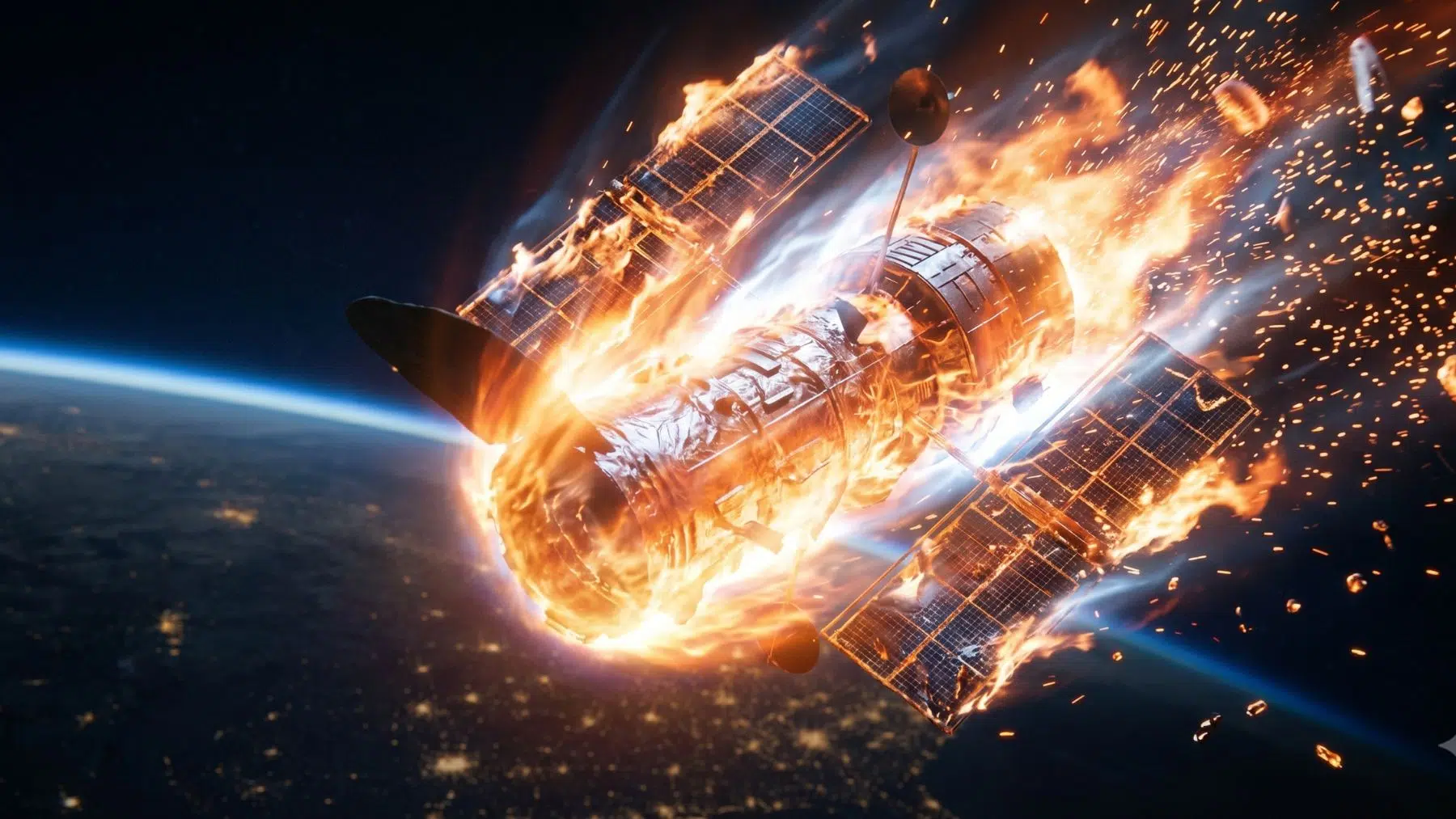
Tens of thousands of satellites now circle the Earth, beaming down internet and filling the night sky with moving points of light.
And when one of them dies, it is designed to do something that sounds almost graceful. It falls back toward the planet and burns up completely on the way down, flaring out like a shooting star and leaving, supposedly, nothing behind.
Clean, tidy, problem solved. Except that when scientists looked closely at that fiery vanishing act, they found it does leave something behind, in a place almost no one was watching.
The clean way to take out the trash
There is a real reason satellites are built to burn.
Dead satellites left drifting in orbit become dangerous space junk, hurtling debris that can smash into working spacecraft and spawn yet more wreckage. To avoid that, engineers design satellites to drop out of orbit at the end of their lives and incinerate themselves in the atmosphere.
For years this was treated as the responsible, consequence free way to dispose of orbital trash. The satellite simply disappears, and the sky stays clear. It seemed like the perfect solution. Space stays clear, the satellite is gone, and everyone moves on.
The trouble is what the satellite turns into on the way down.
What actually happens when a satellite burns
A satellite is, for the most part, a machine made of aluminum.
When it slams into the upper atmosphere at orbital speed, the heat tears it apart and vaporizes that metal, turning it into a fine dust of aluminum oxide particles roughly 50 miles up. A single satellite can leave behind around 30 kilograms of the stuff.
That sounds small, until you count how many are falling. With the giant new fleets now in orbit, there is a reentry almost every single day, and the metal ash from all of them is quietly building up where the air is thin and almost nothing ever clears it away. What looks from the ground like a brief, pretty streak is really a small cloud of metal being left high overhead.
The invisible ash no one was watching
The numbers are already adding up faster than anyone planned for.
In 2022 alone, falling satellites released an estimated 17 tons of aluminum oxide into the upper atmosphere, around a third more than drifts in naturally from burning meteors. And unlike a puff of smoke, these particles can linger up there for decades.
As one researcher put it, almost no one had been thinking about the environmental impact on this part of the sky at all. It was simply assumed to be empty and harmless. That assumption is now starting to look like a serious mistake, because the empty sky was never quite as empty as it seemed.
Why a little dust up there matters so much
The danger is not the metal itself. It is what the metal does to ozone.
High in the atmosphere, aluminum oxide acts as a catalyst, freeing up leftover chlorine from the old era of banned aerosol chemicals and turning it loose to destroy ozone. And the ozone layer is the fragile shield that absorbs the sun’s harshest ultraviolet rays, one of Earth’s most important protective layers, still slowly healing from the hole that opened over Antarctica in the 1980s.
The worry is scale. If the planned mega constellations keep growing toward sixty thousand satellites, the aluminum raining down could rise by hundreds of percent, eventually amounting to the equivalent of scores of space shuttles vaporizing in the sky every single year. That is no longer a rounding error, but a steady new ingredient being stirred into the upper air.
The honest catch, and what can still be done
This is where it pays to stay calm and precise.
Right now, this pollution is still small beside the bigger sources choking the lower atmosphere, and scientists have not yet pinned down exactly how much ozone it will cost. This is an emerging, predicted risk, not a present disaster, and the honesty cuts both ways. It is a warning, not a verdict, and the point is to act while the numbers are still small enough to change.
But the warning is worth heeding before the sky fills up. Researchers are urging the industry to build satellites from different materials, to make them last far longer instead of constantly replacing and burning them, even to refuel and repair them in orbit. The tidy fix for one problem quietly seeded another, higher up, and the time to look closely is now, while it is still a whisper rather than a hole.
Read the whole thing?
Get the week's signal, not the noise
Our sharpest reporting on energy, climate and nature — free, once a week.