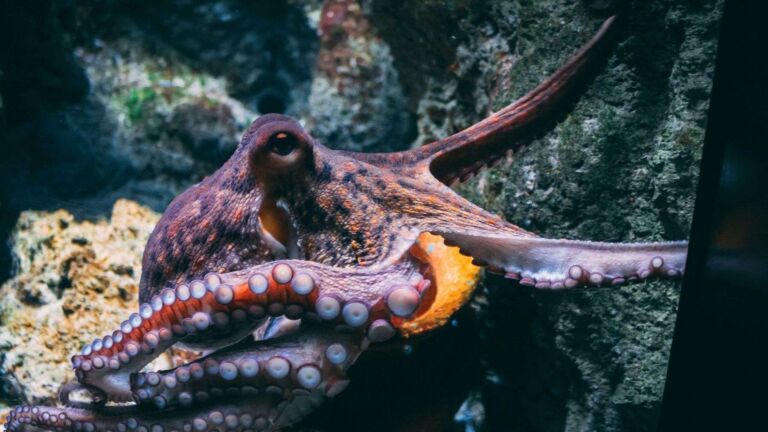
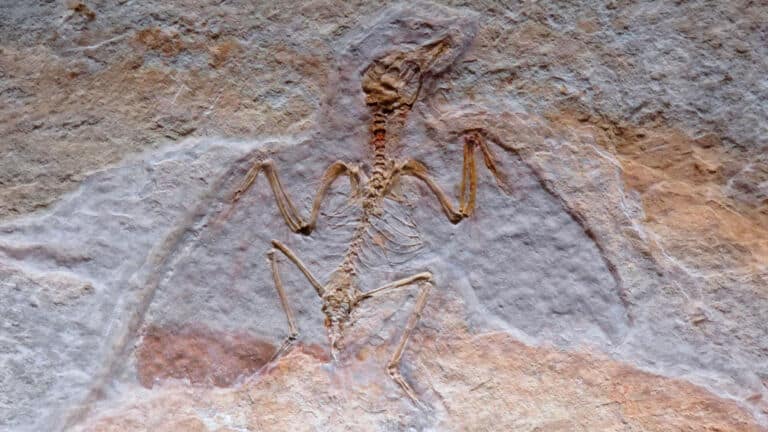
For 25 years, a 300-million-year-old fossil from Illinois held an extraordinary distinction: the oldest octopus ever found, enshrined in the Guinness Book of Records and cited across decades of research on cephalopod evolution. It appeared to push the origin of octopuses back by 150 million years.
Then researchers aimed powerful imaging technology at what lay hidden inside the rock — and the fossil’s identity began to unravel.
A record-breaking fossil that fooled science for decades
When Pohlsepia mazonensis was first described in 2000, it looked like a landmark find. The Illinois specimen appeared to show eight arms, fins, and other distinctly octopus-like features — enough for scientists to declare it the oldest known octopus, some 300 million years old, pushing the presumed origin of the lineage back by roughly 150 million years. That finding earned it a place in the Guinness Book of Records.
For decades it became a standard reference in cephalopod evolutionary studies. Doubt accumulated quietly — some researchers questioned the identification, suspecting the interpretation might be off — but the problem was practical. No available technology could look beneath the rock’s surface to settle the debate. The fossil held its secret, and the record stood.
Synchrotron imaging reveals what the naked eye could not
That changed when researchers at the University of Reading applied synchrotron imaging to the specimen. The technique uses extremely bright beams of light to detect structures hidden within rock, something researchers have compared to running a forensic investigation on material that’s 300 million years old.
What the scans revealed was decisive. Inside the fossil, scientists found a radula: a ribbon-like feeding organ lined with rows of tiny teeth, common across molluscs. The number of teeth per row told the real story — the fossil showed at least 11 tooth-like structures per row. Octopuses have seven or nine. Nautiloids typically have 13.
Those teeth also closely matched those of Paleocadmus pohli, a known fossil nautiloid species recovered from the same Mazon Creek site in Illinois. The match wasn’t coincidental. Pohlsepia was not an octopus at all. It was a relative of the nautilus.
Decay: the biological trickster behind the misidentification
So how did a nautilus relative come to look so convincingly like an octopus?
The creature had partially decomposed for weeks before being buried and preserved in rock. That decomposition reshaped the body in ways that mimicked octopus anatomy once the remains were compressed and fossilized. The distortion was subtle enough to fool researchers working with the tools available in 2000, yet fundamental enough to completely change the animal’s apparent identity.
Dr. Thomas Clements, lead author and lecturer in invertebrate zoology at the University of Reading, explained that the decay process generated convincingly octopus-like features from what was actually a nautiloid. The misidentification wasn’t a failure of scientific rigor — it was a failure of visibility. There’s also an unexpected bonus buried in the correction: because the specimen is now confirmed as a nautiloid, it represents the oldest known preserved soft tissue from that group, surpassing the previous record by approximately 220 million years.
A new timeline for octopus evolution
The reclassification has direct consequences for how scientists understand octopus origins. With Pohlsepia removed from the octopus lineage, current fossil evidence places the first true octopuses in the Jurassic period — significantly later than the Carboniferous-era date the old record implied. The evolutionary split between octopuses and their ten-armed relatives, including squids, is now placed in the Mesozoic era. That’s a substantial revision to the cephalopod family tree, built on evidence no larger than a row of microscopic teeth.
The study, published in Proceedings of the Royal Society B, also highlights persistent challenges in paleontology more broadly. Decay, preservation bias, and the limits of visual interpretation have all shaped — and sometimes distorted — the fossil record scientists rely on. Reexamining contested specimens with modern imaging, the authors suggest, may continue to surface surprises.
As Dr. Clements put it: “It’s amazing to think a row of tiny hidden teeth, hidden in the rock for 300 million years, have fundamentally changed what we know about when and how octopuses evolved.”
There’s something worth sitting with in that observation. A record held for 25 years, cited across generations of research, rested on a misreading that no one at the time had the tools to correct. The fossil wasn’t wrong — science’s interpretation of it was. That distinction matters, because it suggests other long-standing entries in the evolutionary record may be waiting for the same kind of quiet, methodical challenge: not a dramatic new discovery, but a closer look at something already in the collection. What else, preserved in rock for millions of years, might be hiding a different story beneath the surface?
Read the whole thing?
Get the week's signal, not the noise
Our sharpest reporting on energy, climate and nature — free, once a week.