
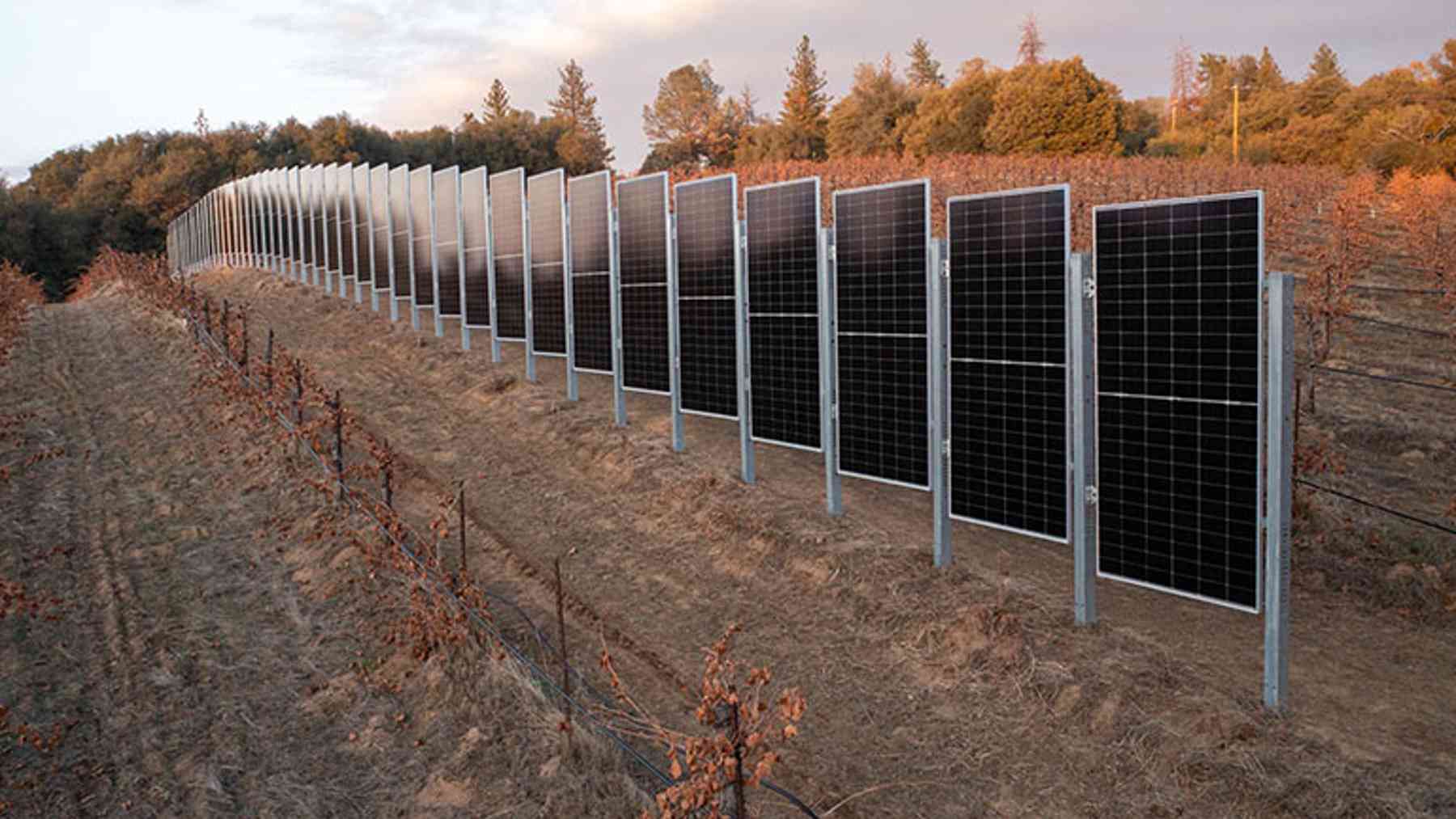
A vineyard in the Sierra foothills does not look like a power plant.
But walk between the rows at a small farm in Somerset, California, and something odd breaks up the vines.
Thin rectangles of glass stand straight up on steel piles, shoulder to shoulder with the grapevines.
They are not tilted toward the sky like a normal panel.
They face east and west instead, slicing right through the row.
So what makes a panel work standing on its edge like that?
How can a solar panel stand on its edge and still work
The trick is a design called a vertical bifacial array, and it flips the usual rulebook. Ordinary panels lie flat or tilt south to catch the sun overhead at midday, which is also the hour when the grid is most likely to have more solar than it can absorb. The vertical panels do the opposite of that approach, standing upright so one face catches the low morning sun and the other catches the low afternoon sun.
Bifacial modules collect light through both glass surfaces rather than one, so a panel turned on its edge produces two peaks in a day instead of a single midday hump. The shade shifts with it, falling sideways early and late and shrinking to almost nothing when the sun sits overhead.
Because the panels are thin and stand on narrow piles driven straight into the soil, they need very little ground at their base. That small footprint is the reason a working vineyard could consider solar inside the rows at all.
What the vineyard actually looks like with panels running through it
The installation runs for more than 200 feet along a hilly stretch of the property, following the slope of the land rather than cutting a flat shelf into it. The system uses 43 bifacial modules rated at 450 watts each, wired to a microinverter and a pair of batteries, and it supplies the farm mainly in the morning and the afternoon.
Clearing the line was not free. One row of vines had to come out so the piles could go in, a single row out of a planting that otherwise kept producing exactly as before.
The panels do not block the farm’s equipment either. Because each module hangs from two slim piles instead of sitting on a wide footing, a harvester can work the ground directly alongside the array without snagging on anything.
The effect is closer to a trellis post that happens to make electricity than to a piece of power plant hardware.
Why this matters beyond one winery in the foothills
Farmland is finite, and that tension runs through almost every solar project proposed on open fields. A vertical row takes up a narrow strip and leaves the ground between rows free to be farmed, which is the entire argument for standing panels on edge.
Timing matters too. An east and west facing array sends power out in the morning and late afternoon, sidestepping the midday oversupply that pushes grid operators to curtail solar.
The makers also promote reduced evaporation from shaded soil as a benefit, though measured water savings from installations this small remain thin on the ground. One developer involved in similar projects put it plainly: the goal is to let a farmer “keep farming the same acre while the fence posts earn their keep.”
Where the idea runs into real limits
None of which means vertical panels are the right fit everywhere. The system needs open sky to the east and west, so a field hemmed in by tall trees or buildings on those sides would lose much of the benefit. Tall crops can shade the lower half of the modules, which is why the approach has so far suited low growing rows like grapevines and strawberries.
There is also a real tradeoff in output. Trade press reporting on a California strawberry operation found that spacing vertical rows 40 feet apart, wide enough to keep the crop in sun, cut generation by roughly half compared with a field given over to solar alone, even though the combined harvest of crops and electricity still came out ahead.
That is the whole bargain on offer here. The evidence base is still small, a handful of commercial sites plus research installations, including a university research farm in New Jersey, gathering numbers one season at a time.
A fence that happens to make power
Even so, something has shifted at this one hillside vineyard. The same push toward getting more use out of less material shows up in a workshop that recovers rare earth magnets from retired turbines instead of mining new ones.
It is a small, almost domestic kind of engineering, closer in spirit to leaving a corridor open for wildlife to pass through than to building a power station. The panels do not dominate the land the way a sprawling solar farm might.
They slip in alongside what was already growing there. One row of vines made way, the rest of the planting carried on, and the panels stood up straight between them so the grapes could keep doing what they were already doing.
Read the whole thing?
Get the week's signal, not the noise
Our sharpest reporting on energy, climate and nature — free, once a week.


