The corn closest to the fence line looked a little behind the rest of the field.
Not stunted, not pale, just slower.
Everywhere else in the plot, the plants were further along.
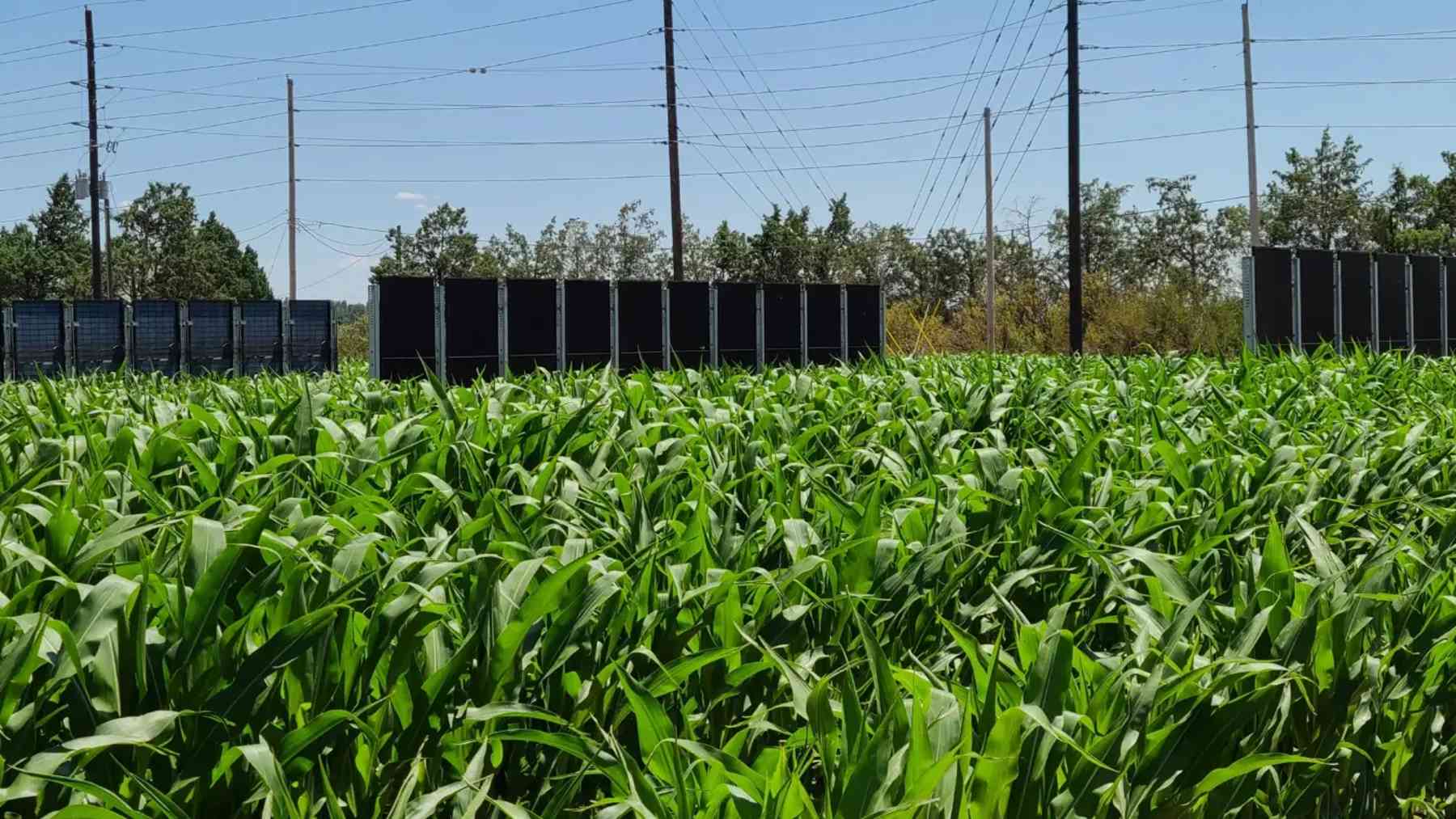
Along two rows pressed right against a line of upright glass panels, development lagged.
Researchers at a Colorado research farm followed those rows through each growth stage, comparing shaded plants with plants in open sun.
What they found reset a basic assumption about putting solar panels and full size farm equipment on the same ground.
Why a vertical panel shifts the shadow instead of holding it
Standard solar farms tilt their panels south and cast a wide shadow that lingers through the hottest hours. A vertical solar fence works differently, standing bifacial panels upright and stationary in narrow north south rows, so that the fixed, record breaking panels capture energy from both sides while occupying minimal ground space.
That geometry also changes when the power arrives. Because a vertical bifacial array faces east and west, generation shifts away from midday and splits into two distinct peaks, one in the morning and one in the late afternoon.
So the panels are working hardest at the same hours their shadow is sweeping across the nearest crop rows, instead of parking over those rows at noon. Only the plants inside that narrow swing path lose much light.
Everything a few rows further out barely registers the structure at all.
Only two rows out of a full field slowed by about 10 days
The two rows of plants closest to the solar fences, which were shaded for part of the day, developed about 10 days slower than the rest of the field, which got full sun. The lag showed up in how quickly those plants moved through their stages, which the team tracked by scouting the field across vegetative and reproductive growth.
Yet the harvest told a different story. Harvesting was slightly delayed for the test plot, but the yield was roughly the same as a plot grown without panels.
So the shaded rows closed most of the gap by the time the ears came off. The shadow changed the calendar of the crop more than it changed the size of it.
A Fort Collins research center tested tractors and crops across two seasons
The test sits at Colorado State University’s Agricultural Research, Development and Education Center South, known as ARDEC, outside Fort Collins. In the summer of 2024, the team planted field corn around three solar fences built at the center, and in 2025 they repeated the experiment with sweet corn.
The project was built around real farm work rather than a lab plot. Project leader Mark Uchanski, an associate professor at the university, framed the aim as assessing whether a static vertical photovoltaic system can work alongside large scale agricultural tillage, planting and irrigation equipment in an irrigated Colorado field, which meant leaving room between the fence rows for full size farm equipment to pass without catching a frame.
The hardware is modest in footprint. The north south rows at the ARDEC South site were spaced about 35 feet apart, with about 2 feet of ground clearance beneath the modules, a layout meant to let ordinary tractors drive straight through rather than around the array.
The first season with field corn pointed the same way
The sweet corn trial followed an earlier run with field corn along the same fence rows. The vertical bifacial system from Sunzaun, three fence like rows of ten panels each, was installed in April 2024 at ARDEC South, and a silage corn hybrid went in on May 8, 2024.
That establishment year was written up for an agrivoltaics conference as a first look at how irrigated field corn performs inside a vertical bifacial system in northern Colorado, a design that has also been tried in other row layouts, including hillside vineyard rows elsewhere.
Uchanski explained the choice of crop plainly. The team wanted the most challenging scenario for a vertical system, “a tall, heat and sun loving crop like corn growing right next to vertical panels,” where shading of both the plants and the panels was expected. Corn was picked precisely because it had the most to lose.
A land squeeze is pushing growers toward the fence shape
Colorado has reason to keep testing this. Agrivoltaics has gained momentum as available land for traditional solar projects declines and demand for renewable energy grows in the state. Public money sits behind the work: Senate Bill 23-092 appropriated $500,000 for agrivoltaics grants in fiscal year 2023 to 2024, and the first round of awards included a Fort Collins installer putting new bifacial vertical panels on an existing demonstration site.
A vertical fence narrows the land fight by taking a sliver of the field instead of all of it, part of the same push to get more out of hardware already in place that shows up in projects like a rebuilt turbine runner.
Even so, the caveat is real. Ten days of delayed maturity matters more where the frost free window is short, or in a year when an early freeze arrives before the shaded rows finish catching up.
None of that changes the shape of the result here. A fence line that used to do nothing but mark a boundary is pulling double duty, making power in the morning and the late afternoon while the corn beside it, almost all of it, grows on schedule anyway.
Read the whole thing?
Get the week's signal, not the noise
Our sharpest reporting on energy, climate and nature — free, once a week.