Ground-based survey astronomers found an ultra-fast rotating white dwarf star magnetized as a cosmic propeller that ejects matter from its companion star into the cosmos.
Binary star systems normally see the death of a star continuously sucking matter from neighboring stars to facilitate an explosion through accretion.
Spectroscopy showed that there is a fast-rotating white dwarf with a strong magnetic field that repels rather than sucks in the incoming matter.
An ultra-fast rotating star discovered in our galaxy
Astrophysicists initially identified the system through an X-ray/optical cross-match combining SRG/eROSITA and Gaia data.
Subsequent archival and high-cadence photometry revealed the brightness variations associated with the fast-spinning white dwarf.
High-cadence optical photometry indicates an exceptionally rapid spin—conservatively estimated at less than 60 seconds—though further observations are required to confirm the exact period, while high-resolution spectroscopy helps characterize the magnetic field rather than establishing the spin rate itself.
Fast spinning gives rise to a very large centrifugal force in the neighborhood of the super-dense stellar core.
The discovery of the fast-spinning star close to our solar system is a rare chance to study magnetism.
Strong magnetic fields preventing the usual accretion processes
According to stellar physics, white dwarfs with active companions are supposed to gradually draw gas towards them using their gravity.
In this specific case, the magnetic field of this star is much stronger compared to other stars of its kind.
The magnetic field prevents the gas from approaching the surface of the star.
The force exerts itself on the approaching gas, and that is why it builds up at a distance from the star.
The magnetic field works as a shield and hinders the evolution of cataclysmic variables.
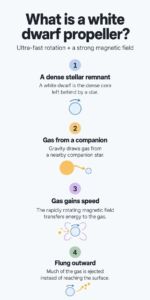
A cosmic propeller against incoming stellar gas
The fast rotation of the star helps to transform the strong magnetic field into a huge mechanical propeller rotating in outer space with supersonic velocity.
The ejected gas from the companion star comes in contact with the rotating magnetic field and gains a lot of kinetic energy.
Under the propeller mechanism, centrifugal force from the rapidly rotating magnetosphere is inferred to expel incoming stellar matter from the binary system, preventing direct accretion without forming collimated plasma jets.
The propeller mechanism significantly suppresses mass accretion by redirecting transferred gas away from the surface.
However, it does not eliminate accretion entirely or guarantee the long-term exclusion of thermonuclear events.
Following evolution paths to magnetic cataclysmic variables
Propeller phase white dwarfs have been studied to gain insight into the evolution of binary stars as active magnetic cataclysmic variables.
While magnetic torque acts to slow the white dwarf’s rotation during the propeller phase, any corresponding reduction in its underlying magnetic field strength is not established by the research.
According to theory, the propeller phase is significant in the formation of compact binaries.
Through the transition phases, it is possible to establish the history of dead stars, according to arXiv.
There are different ways in which magnetic white dwarfs control their partners, and new research offers important insight into these processes that can be applied further afield.
Searching for rare propeller systems in the Milky Way
The discovery of the nearby magnetic propeller body has prompted scientists to look through archived sky surveys to detect other, similar stellar counterparts.
The plan is to concentrate on similar fast rotators with the assistance of space telescopes to gather additional correct measurements of magnetic field strength.
Identifying other similar agents will help map the impact of magnetic fields on mass loss from binary stars.
There is a need for new surveys.
With the discovery of other systems, it becomes possible to convert mysterious cosmic bodies into stages of stellar evolution.
New observations will go further to explain the strange physics of dead stars in our galaxy.
Read the whole thing?
Get the week's signal, not the noise
Our sharpest reporting on energy, climate and nature — free, once a week.