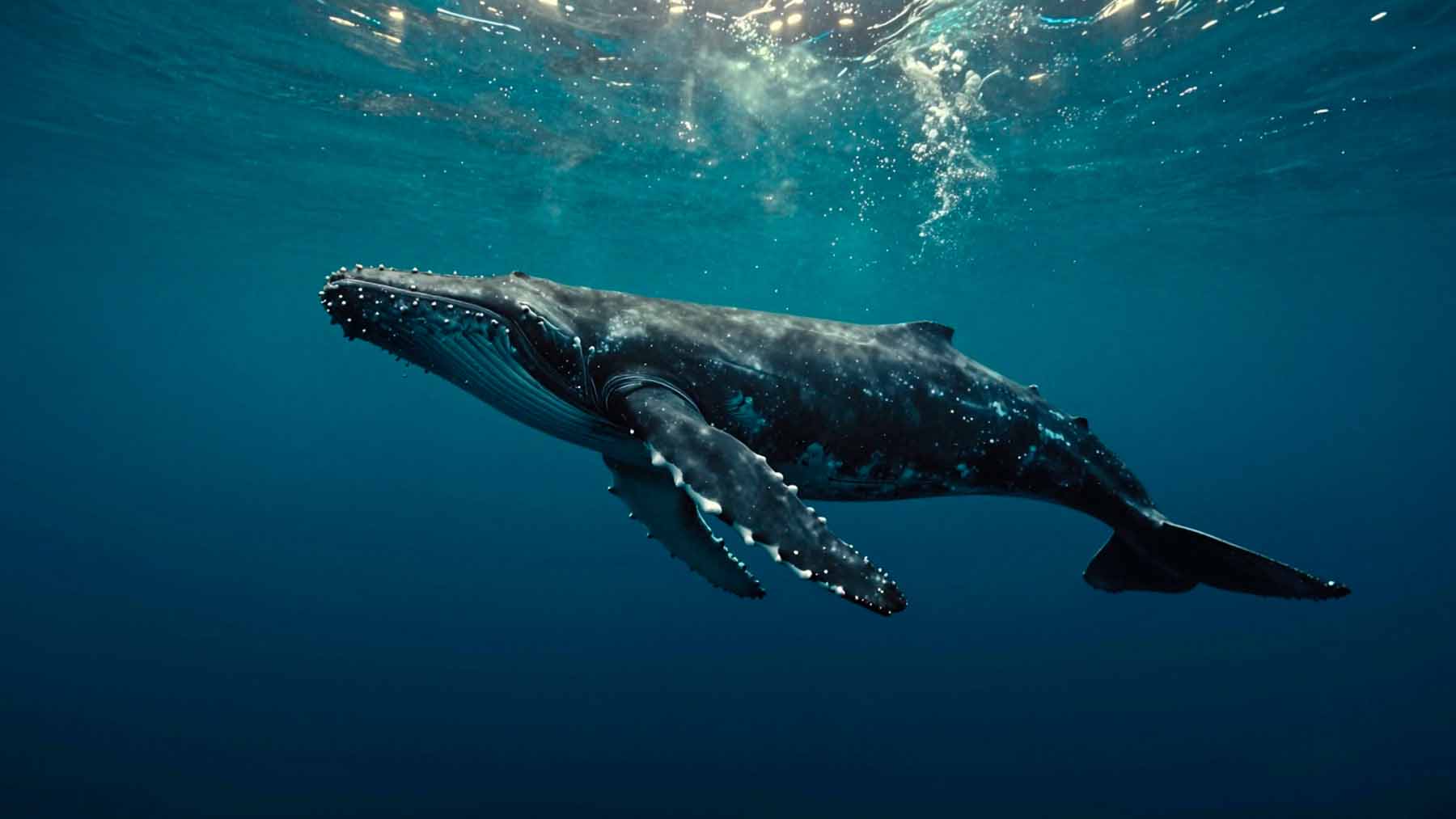
A male humpback whale hovers in the dark waters off Maui, singing without pause for longer than a full workday. Sixteen hours of continuous sound, rising to the surface and traveling for miles — every note captured clearly by researchers listening above.
For decades, that’s where scientific understanding stopped. Recording humpback song has never been the hard part. Knowing what the whale’s body was actually doing hundreds of feet below, at the same moment each phrase left its mouth, was another problem entirely.
A mystery hiding in plain sound
Scientists have recorded humpback whale songs for decades. They knew the songs happened mainly during winter breeding season and almost certainly played a role in attracting mates. But that understanding had a significant gap at its center.
What were the whales actually doing while they sang? Their depth, posture, and movement during those long vocal sessions stayed invisible to researchers listening from above. Tracking a whale hundreds of feet below the surface, at the exact moment it produces each phrase, is something else entirely — a fundamentally different problem from capturing sound that travels for miles.
That gap mattered for practical reasons. Understanding how singing connects to body position could reveal how much energy whales spend on extended vocal sessions, how they manage their air supply, and whether focused singing makes them less alert to dangers like passing ships. Those questions drove a years-long tagging effort off the coast of Maui, Hawaii.
Suction cups, drones, and six years of data
Between 2018 and 2024, researchers temporarily attached small suction-cup recording tags to singing whales off Maui. Long poles from small boats were used initially, and later drones took over the placement work. The tags detach naturally, letting scientists recover them and pull synchronized acoustic and movement data from each deployment.
Over six years, 16 whales were tagged — a solid sample for this kind of behavioral research, where getting close enough to a singing whale is itself a real challenge.
The data held immediate surprises. Some whales sang continuously for up to 16 hours without stopping. That single finding alone reshaped how researchers thought about the stamina involved in humpback vocal behavior.
Song mapped to dive — a first in whale research
The more consequential finding emerged when researchers examined song structure alongside movement data. Humpback songs are built from repeating segments called “themes.” When the team compared those themes to the whales’ dive cycles, a consistent pattern appeared.
Specific themes aligned reliably with specific phases of the dive — the first time scientists have mapped an entire whale song to an entire dive cycle. Previous studies had connected fragments, but never the full sequence from start to finish.
During descent and ascent, the themes were largely similar across all 16 whales studied. That consistent structure suggests those phases may be governed more by physical constraints — air management, buoyancy — than by individual choice.
Why the deepest notes may be about competition
The pattern broke down at depth. Themes sung during the deepest, steadiest part of a dive were the most variable between individual whales — the one stretch of the song where each animal seemed to diverge from the others.
Researchers hypothesize that this variation is shaped by sexual selection. Males may use distinctive vocal signatures at depth to stand out to potential mates, turning that portion of the song into individual advertisement rather than shared script.
“This gives us direction for which parts of the song to investigate if we’re interested in variation, which is likely driven by sexual selection,” said study author Julia Zeh, who now leads the Archival Passive Acoustic Monitoring Team at the Maine Department of Marine Resources. The finding reframes whale song not as uniform sound, but as a structured, behavior-linked signal with real evolutionary stakes.
What a song could tell us without anyone watching
The song-dive link opens a practical door. Because specific themes now correspond to specific dive phases, researchers may be able to estimate a whale’s depth or position from audio recordings alone — no visual observation required.
That capability could help scientists build a clearer behavioral baseline for humpback whales, essential for detecting disruptions caused by vessel traffic or rising ocean noise. Knowing what “normal” looks like makes it easier to spot when something has changed.
The study focused exclusively on Hawaiian humpbacks, so whether the same patterns hold in other populations remains an open question. Zeh notes that humpback songs differ between hemispheres, meaning a global answer would require comparable tag data from breeding grounds around the world. It’s a large-scale effort — but now a defined next step, built on a foundation that didn’t exist before 2024.
You can check the complete study here: Zeh, J. M., Lammers, M. O., Kügler, A., Pack, A. A., Perez-Marrufo, V., Schonwald, M., & Parks, S. E. (2026). Humpback whales match song production to dive patterns. Current Biology.
Read the whole thing?
Get the week's signal, not the noise
Our sharpest reporting on energy, climate and nature — free, once a week.