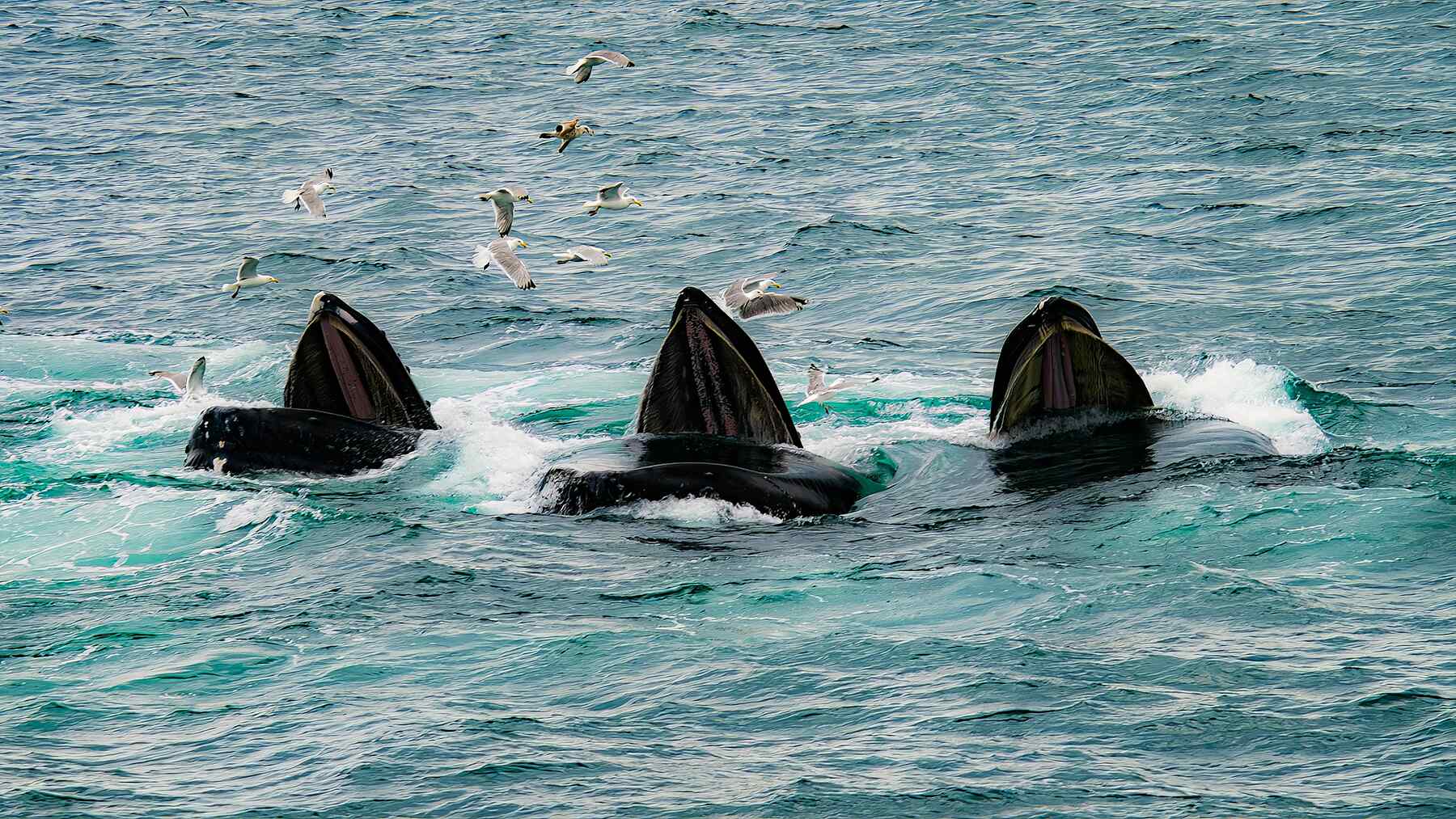
The sound hit first — like “bombs going off,” repeated across the water in every direction. Then came the smell: blowhole spray so thick it stank up the ocean air for miles. Wildlife photographers Chris and Monique Fallows were somewhere in the middle of it, laughing, cameras firing in every direction, struggling to keep up.
What they had stumbled into off the coast of South Africa was a gathering of 304 individual humpback whales — a confirmed world record for a single group. Scientists call these congregations “supergroups,” and while they’ve been documented before, nothing on this scale had ever been recorded. Why whales assemble in such numbers remains, for now, an open question.
What Is a Humpback Supergroup — and Why 304 Whales Is Extraordinary
A supergroup isn’t simply a large gathering. By scientific definition, it requires 20 or more humpback whales swimming within five body lengths of each other — close enough to indicate coordinated behavior rather than chance proximity. Researchers first formally documented that threshold off South Africa’s west coast in 2011, when unusually dense congregations began appearing during the austral summer months.
The number 304 needs context to land with full weight. Previous supergroups had reached into the dozens, occasionally more, but marine biologist Simon Elwen notes that averages have since climbed into the hundreds. Even against that backdrop, 304 confirmed individuals is unprecedented. That count was verified through Happywhale, a citizen science platform that applied AI-powered identification to distinguish individual whales from the 472 photographed by the Fallows. Each whale carries a unique fluke pattern — effectively a fingerprint — and the software matched and tallied them with a precision no field team could replicate in real time.
The Benguela Upwelling: An Ocean Engine Feeding the Spectacle
The location is central to the story. Off South Africa’s west coast, a powerful oceanographic system called the Benguela current draws cold, nutrient-dense water up from depth toward the surface. During the austral summer, this upwelling triggers concentrated blooms of plankton and krill — a seasonal abundance that baleen whales are built to exploit.
Humpbacks feed using keratin plates called baleen, which function as biological sieves. A whale takes in a massive gulp of seawater, then forces it back out through the plates, trapping krill inside. Efficient, yes — but only when prey is dense enough to justify the energy expenditure. The Benguela upwelling reliably creates those conditions.
Research published in 2021, which used chlorophyll-A concentrations as a proxy for ocean plankton density, supports the view that these supergroups are, at their core, feeding events. Whales appear to be actively tracking productive new areas, moving toward wherever the ocean is generating food most abundantly.
Competing Theories: Why Supergroups Are Forming Now
Researchers broadly agree on what supergroups are. They’re considerably less settled on why they occur, or why they appear to be increasing in scale.
Two hypotheses dominate current debate. The first holds that shifts in prey availability have driven a genuinely new feeding strategy — or exposed one that always existed but went unobserved while whale populations were severely reduced. The second, and currently best-supported, explanation is that recovering populations have pushed individuals toward alternative feeding grounds, with South Africa’s productive waters drawing more animals each season. The 2021 chlorophyll-A research offers the most direct support for this view. A third, more observational possibility: supergroups may have always formed at roughly this scale, simply going unseen when humpback numbers were far lower. As populations rebound, so does the probability of encounter.
None of these explanations has been eliminated. Scientists are candid that a definitive answer remains out of reach, keeping humpback supergroups an active and genuinely unresolved area of marine research.
A Conservation Success Story Written in the Water
Industrial whaling pushed humpback whales to the edge. Their recovery since international protections took effect is one of the more consequential turnarounds in modern conservation history — the global population has now surpassed 125,000 known individuals, a figure that would have seemed implausible at the industry’s peak.
The Fallows’ encounter reflects how far that recovery has come. Many of the whales they photographed had no prior documentation, suggesting the population continues to grow and push into new areas.
Simon Elwen frames it plainly: the surprise today is no longer seeing a supergroup. It’s going out and not seeing one. That quiet inversion — from rarity to expectation — may be the clearest measure of how much has changed. It also raises a question worth holding onto: what else might be possible when ocean ecosystems are given the space and time to recover?
Read the whole thing?
Get the week's signal, not the noise
Our sharpest reporting on energy, climate and nature — free, once a week.