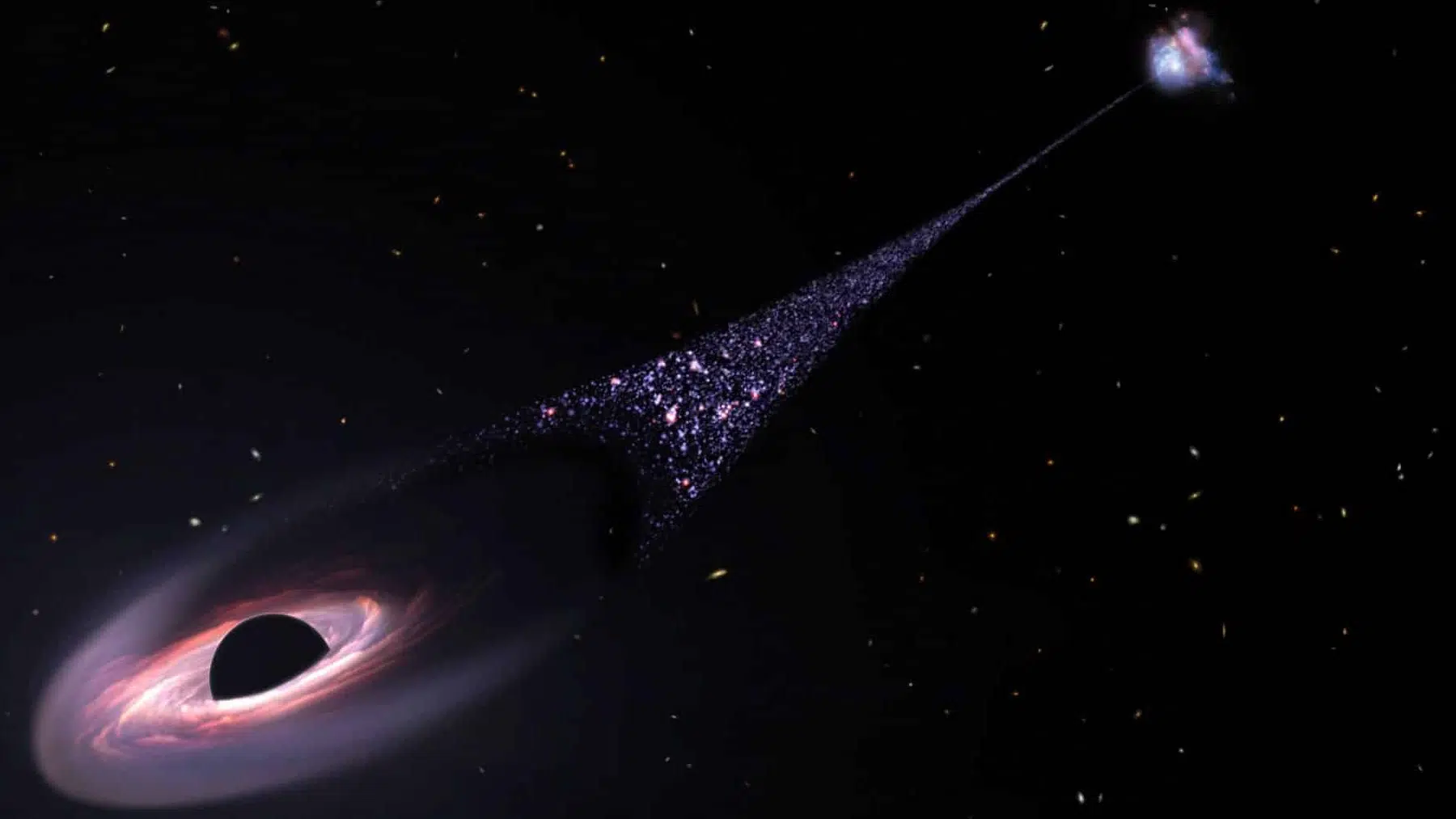
An intriguing discovery has been made by scientists with strong evidence of a supermassive black hole in a Large Magellanic Cloud (LMC); astronomers claim it is next to our galaxy, a “next-door neighbour”. There are stars that have been moving at exceptionally high speeds, connected to this supermassive black hole and have been evicted. In an article by NPR, the black hole is 600,000 times the mass of the Sun. This discovery adds to other phenomena regarding black holes in the universe. NPR reported that until now, no one, not even researchers, knew about this giant black hole outside our Milky Way galaxy.
This is how astronomers and scientists discovered the giant black hole in the Large Magellanic Cloud
According to Wired, this discovery came to be when experts were intrigued by the Hypervelocity stars that were travelling at high speeds away from their parent galaxies. Data that was produced by the European Space Agency’s Gaia mission spacecraft was used to trace about 21 stars in the galaxy. During that process, 50% of the stars were found leaving something interesting, a previously undetected supermassive black hole in the LMC.
If it was not for the stars travelling at high speeds, perhaps scientists would not have discovered the black hole. The supermassive black hole is powerful, and two stars orbiting one another can be torn apart by the black hole’s powerful gravitational force. Wired explains it this way: Due to its powerful force, one star is taken out while the other remains trapped in the black hole.
Jesse Han of the Center for Astrophysics, Harvard & Smithsonian, who led the study, according to NPR expressed his thoughts and observations regarding the star that gets kicked out of the galaxy and said,
“They’re just on their way out. They’re never going to come back again. We’re catching them as their last glimpse before they’re leaving the galaxy forever.”
Rethinking galactic evolution and dynamics in the context of a giant black hole in a dwarf galaxy
Every time researchers discover something scientifically intriguing, it always questions everything the scientific community knows or comprehends regarding that element of discovery, and the finding of this supermassive black hole and stars moving at excessively high speeds has done just that. Since it is something astronomers were not aware of, it means supermassive black holes are more common in dwarf galaxies than we thought.
This discovery pushes scientists to tap into another element of study, and that is the evolution of galaxies and dwarf galaxies as a whole. Supermassive black holes and dwarf galaxies are a combination never thought to have existed but that now calls everything into question. There are also implications that can come with the integration between the Milky Way and LMCs.
It’s firing stars at us: A cosmic intrusion
When astronomers state that it is firing stars at us, they discovered this behaviour of stars and connected them to the giant black hole. They were thought not to be dangerous to Earth or our universe, but their rapid and excessive speed is evidence of how black holes can be strong and active in a manner never thought to have been. Additionally, it offers us a broader understanding of space and the galaxy and its mysteries.
According to a study published by the Center for Astrophysics, the scientists calculated that the mass of the LMC black hole is roughly 600,000 times that of the Sun, confirming NPR’s report, by comparing the relative numbers of ones expelled by the LMC and Milky Way supermassive black holes with the star speeds. In contrast, the Milky Way’s supermassive black hole has roughly 4 million solar masses. Supermassive black holes with billions of times the mass of the Sun can be found elsewhere in the universe. Furthermore, as researchers keep searching, we are anticipating more complex and mysterious discoveries.
Read the whole thing?
Get the week's signal, not the noise
Our sharpest reporting on energy, climate and nature — free, once a week.