A rehabilitation centre in the South African lowveld built a walled camp for one animal it could not release.
Over the following years the staff removed every single thing he had used to get out.
The trees came down. The tools were taken away. The gate got a second lock.
He answered every one of them, and the last answer is the one that made him famous.
What eventually held him was not a taller wall but a live wire.
What he actually used
The first escapes were opportunistic, put together from whatever had been left lying around in the dirt.
Mud balls, stones, a spade and a rake, dragged to the wall and piled into a step.
So the gate got a double lock, the loose tools were carried out, and the trees inside the camp were pruned back hard.
He simply climbed what was left of them, so the trees were then cut down entirely.
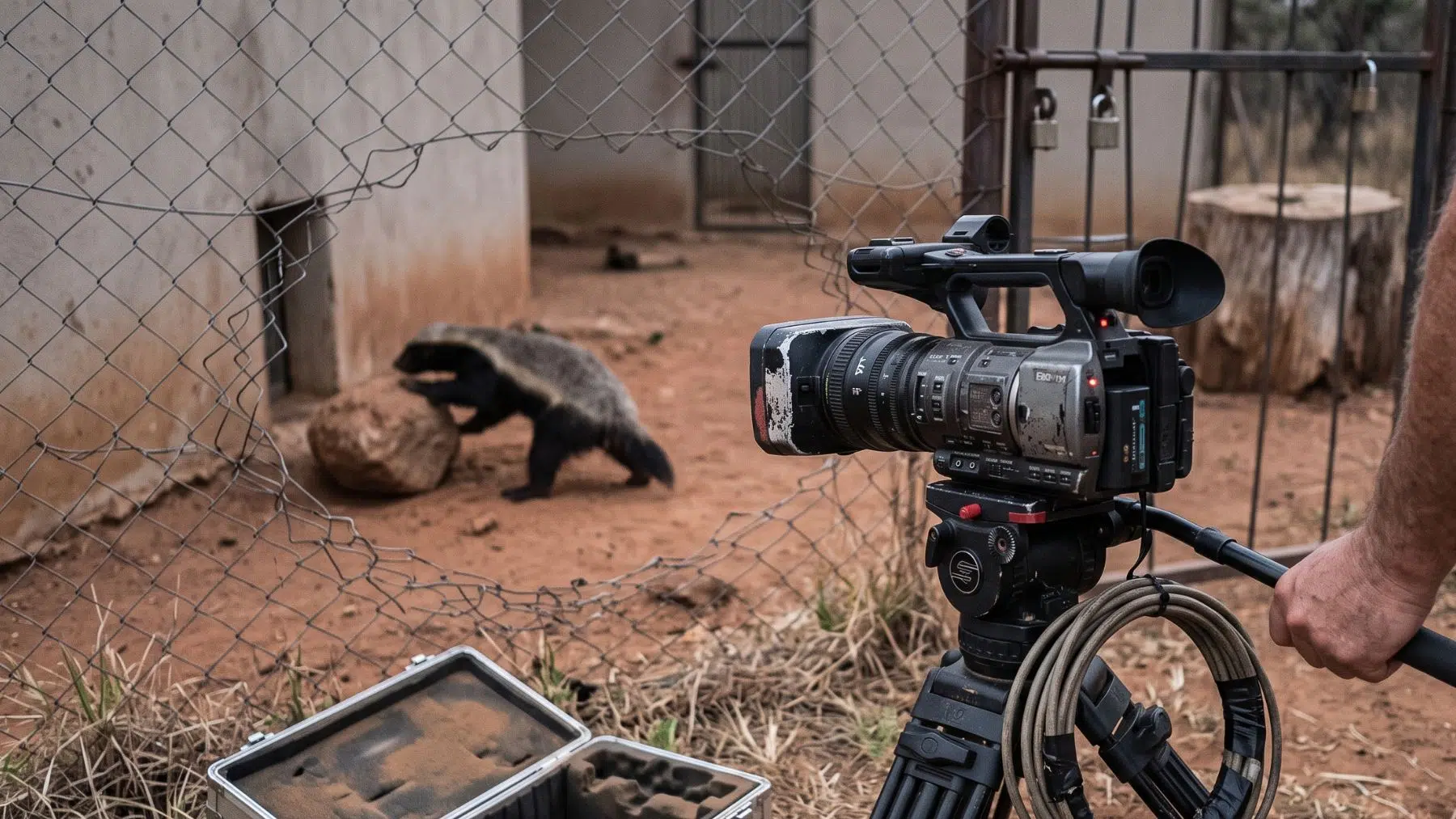
Then came the part that got the attention. He dug rocks out of the ground, rolled them with his hind legs to the base of the wall, and stacked them until the pile was tall enough.
The keeper’s own summary is blunt, which is that they installed a double lock gate, cut down the trees, built high walls and removed the garden implements, and nothing stopped him.
Where this happened and who he is
The place is a wildlife rehabilitation centre near Hoedspruit in Limpopo, at the foot of the northern Drakensberg, and it has been running since 1991.
He was hand raised by a farmer before he ever arrived there, and that is the whole reason he stayed.
An animal imprinted on people that young cannot be put back into the bush, so the camp was built around him instead.
He was eighteen when the film crew turned up, and he is in his late twenties now.
That alone is remarkable, because the usual ceiling for the species in captivity sits somewhere around twenty four years.
He has also gone through the wall to fight lions, and needed two months of treatment afterwards.
What the primatologist actually said
The line that travels is that a Cambridge primatologist compared the footage to classic chimpanzee work, and he did.
The reference is to a set of box stacking experiments from the 1920s, in which chimpanzees piled crates on top of each other to reach fruit hung out of arm’s reach.
But the full quote has three parts and the retellings usually carry one and a half of them.
What the emeritus professor said was that it is astonishing, and that either the species has been underestimated, or this is a one off genius, or the whole thing is a hoax.
He listed the hoax option himself, in the same breath as the other two, and it belongs in any honest version of the story.
His actual recommendation was not a headline. It was that somebody should run proper problem solving tests on captive honey badgers and find out.
The part nobody can check
Which brings up the hole in the middle of all of this.
There is no peer reviewed research on honey badger cognition. None, as one primatologist pointed out when asked.
Everything anybody has is anecdote, documentary footage and stories told by the people who work with them, and none of it was ever set up as a test.
That is not nothing, and the keeper has stated flatly that none of it was trained and that people who assume a hoax are wrong, as the centre told reporters.
But an eyewitness account is not a controlled test, and the difference is the entire argument.
The same gap turns up around an offshore array or a fenced solar site, where the striking behavior gets filmed years before anybody gets round to measuring it.
What is left standing
One caution is worth stating plainly, because it is the strongest counterargument anybody has.
A bored animal in a small space with unlimited time is not a normal animal, and captivity can manufacture behavior the wild never asks for.
Set against that, honey badgers in the wild already raid beehives straight through the stings and take kills off much larger predators, so the boldness itself is no artifact of a cage.
What remains unproven is the planning behind it, which is the interesting bit and also the one bit nobody has ever properly tested.
The camp, meanwhile, is still standing, and so is the electric wire that finally brought the escapes to an end.
More than a decade after the film crew left, the animal it was built for is still in there, digging.
Read the whole thing?
Get the week's signal, not the noise
Our sharpest reporting on energy, climate and nature — free, once a week.