

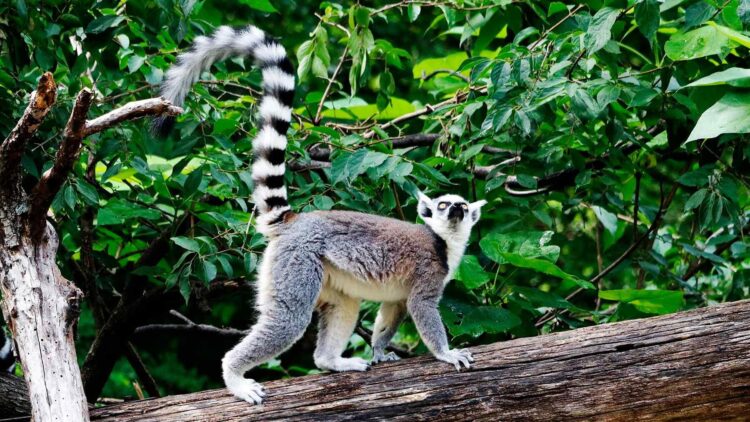
Researchers hid a puzzle box inside an enclosure to see if an “innovator” could spark a troop-wide revolution.
The task was simple: slide a lid to reveal a grape.
The shock wasn’t the solve—it was who the lemur chose to watch.
It gatekept the solution, sharing the trick with a select VIP list while turning its back on others inches away.
What did it know about the hierarchy that researchers hadn’t discovered?
Gatekeeping the Grapes: How an invisible hierarchy controls lemur intelligence
Scientists studied Lemur catta, a species where females lead, and social hierarchies are enforced through ‘stink fights’ and grooming.
Researchers introduced puzzle boxes containing food rewards and watched how the animals reacted.
At first, only a few individuals learned how to open them.
Scientists wanted to see how the behavior spread through the troop afterward.
Data showed that ‘social tolerance’—the willingness to let another sit close—dictated who learned the trick.
Lemurs often live in tightly structured groups where grooming reveals long-term relationships.
The food boxes suddenly made those hidden connections visible.
Researchers started tracking who interacted with whom throughout the day.
Lemurs only gathered around ‘preferred partners’—animals they had groomed for hours in previous weeks.
Not just monkeys see, monkeys do: Why lemurs only learn from friends
Scientists have studied social learning in animals for years.
While chimps might copy any successful peer, lemurs require a ‘social license’ to observe and learn.
But the lemurs showed something more selective.
The animals did not simply imitate whichever group member solved the puzzle first.
They paid closer attention to preferred companions.
Information flow mapped perfectly onto grooming charts; if Lemur A didn’t groom Lemur B, the knowledge hit a dead end.
Animals with weaker relationships often remained outside the learning chain entirely.
The troop was operating through an internal social network built on trust, familiarity, and repeated interaction.
The troop functioned as a biological circuit board where social bonds acted as the copper wiring.
Some lemurs acted almost like social hubs.
Others remained more isolated.
The structure influenced how quickly knowledge moved through the group.
Princeton University researchers found that central ‘social butterflies’ learn faster than isolated outcasts.
More socially connected individuals often gained access to information faster than isolated animals.
Scientists realized the lemurs were not “teaching” randomly.
Their social bonds shaped who received information first.
That created small behavioral pathways inside the troop.
Some connections carried knowledge repeatedly.
Others barely transmitted anything at all.
Researchers began comparing the troop to a living social map.
This “social network” has been detailed by the study, “Social tolerance mediates social learning in wild red-fronted lemurs, Eulemur rufifrons, and ring-tailed lemurs, Lemur catta,” published in Animal Behaviour.
VIP grooming: The hidden “invite-only” network of the lemur world
The lemur gatekept the secret because in lemur society, information is a currency traded only between trusted grooming partners.
The ‘strange jungle social network’ is a complex grooming matrix where one minute of combing fur buys one minute of close-range observation.
It was the troop’s invisible web of friendships, grooming partnerships, trust, and daily interaction patterns.
Researchers found that the learned food-box behavior spread between socially connected animals rather than across the troop evenly.
That meant the troop’s social structure directly controlled how knowledge moved through the group.
The lemurs only shared knowledge through trusted social ties
The animals were not simply reacting to food. They were filtering information socially.
Some lemurs became central information carriers because many others trusted or followed them.
Others stayed disconnected from the learning chain for much longer.
This explains ‘cultural transmission’: why certain lemur groups use specific tools or calls while neighboring groups do not.
Not through random observation. But through friendship networks hidden inside daily social life.
For the researchers, the food box revealed far more than problem-solving ability.
It exposed a quiet social system shaping who learns, who shares, and who gets left behind.