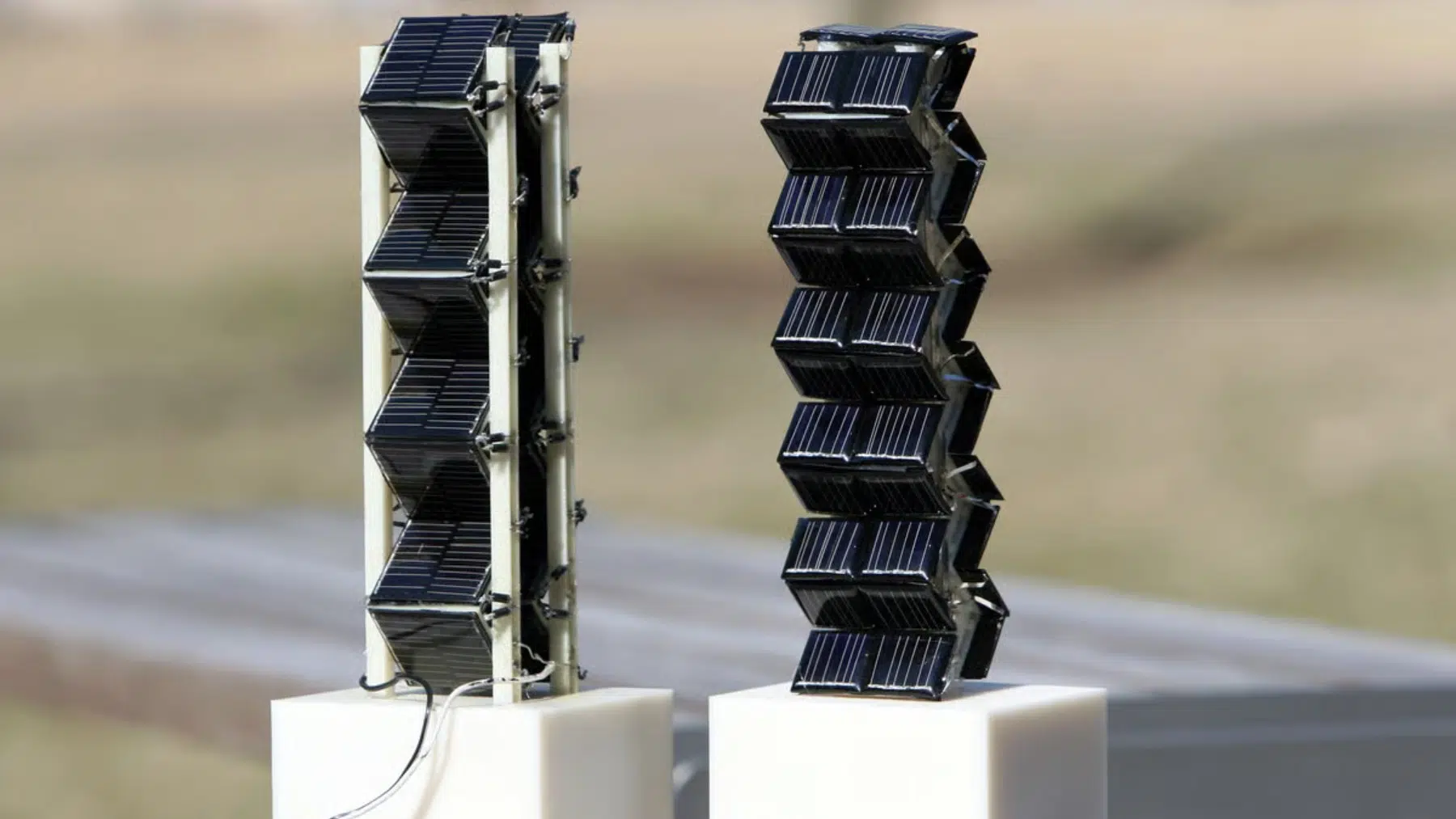
Solar panels have been around for decades, and in an era where looks are (almost) everything, innovative thinkers and creators have been working hard to improve solar technology’s efficiency whilst keeping it as aesthetically pleasing as possible. One such invention is cube-shaped and has caught the attention of many, as it functions like 20 solar panels activated at the same time.
The team that combined efficiency with aesthetics
Solar photovoltaic cells generally face challenges with upkeep costs and efficiency, which is why most people have been focusing on improving those areas until now. A research team from the Massachusetts Institute of Technology (MIT) thought it best to focus on how those cells are arranged. Usually, solar panels are positioned flat on surfaces such as rooftops or even mechanized structures to keep the cells facing the sun.
The MIT team decided to deviate from the norm by inventing three-dimensional, cube-shaped solar panels that extend the cell upward. Sounds crazy? Well, according to their results, it’s just crazy enough to work.
“I think this concept could become an important part of the future of photovoltaics.” Senior author and Carl Richard Soderberg Career Development Associate Professor of Power Engineering at MIT, Jeffrey Grossman.
The cube-shaped solar panels that will blow your mind
Traditional panels that are secured on a rooftop have the highest efficiency when the sun is close to directly overhead. As the day goes by, the sun’s rays’ angle shifts, and efficiency decreases. This is also true for mornings, evenings, cooler months, and locations far from the equator. The team created three varying 3D prototypes and ran tests for several weeks on the MIT lab roof, considering all those conditions. The results will blow your mind, as the resulting power output varied from double to more than 20 times that of traditional panels’ output with the same base area.
The biggest output increases were seen in these conditions:
- Days with cloudier weather
- Winter months
- Locations further from the equator
“The basic physical reason for the improvement in power output — and for the more uniform output over time — is that the 3-D structures’ vertical surfaces can collect much more sunlight during mornings, evenings and winters, when the sun is closer to the horizon.” – Co-author and graduate student in MIT’s Department of Materials Science and Engineering (DMSE), Marco Bernardi.
A new dimension for a new era in solar energy technology
According to the MIT research team, their results indicate an increase in energy uniformity, overcoming solar energy’s biggest challenge, the predictability of electricity supply. Predictability usually complicates the integration of solar power sources into the grid.
The benefits of the cube-shaped solar panels also include:
- Increased applicability, such as installation in parking lots’ EV charging stations
- Easier to install in urban environments with limited space
- Potential in larger-scale applications, such as solar farms
- Solar cells are cheap in general
“Even 10 years ago, this idea wouldn’t have been economically justified because the modules cost so much. But now the cost for silicon cells is a fraction of the total cost, a trend that will continue downward in the near future.” – Grossman
In conclusion, in this case, it’s about what is on the inside and outside that matters. This innovative 3D design, once cost-effectively developed for mass production, will revolutionize solar power technology. It’s not just aesthetically pleasing, but it will also play a crucial role in the global transition to renewable energy and our overall carbon footprint.
Read the whole thing?
Get the week's signal, not the noise
Our sharpest reporting on energy, climate and nature — free, once a week.