
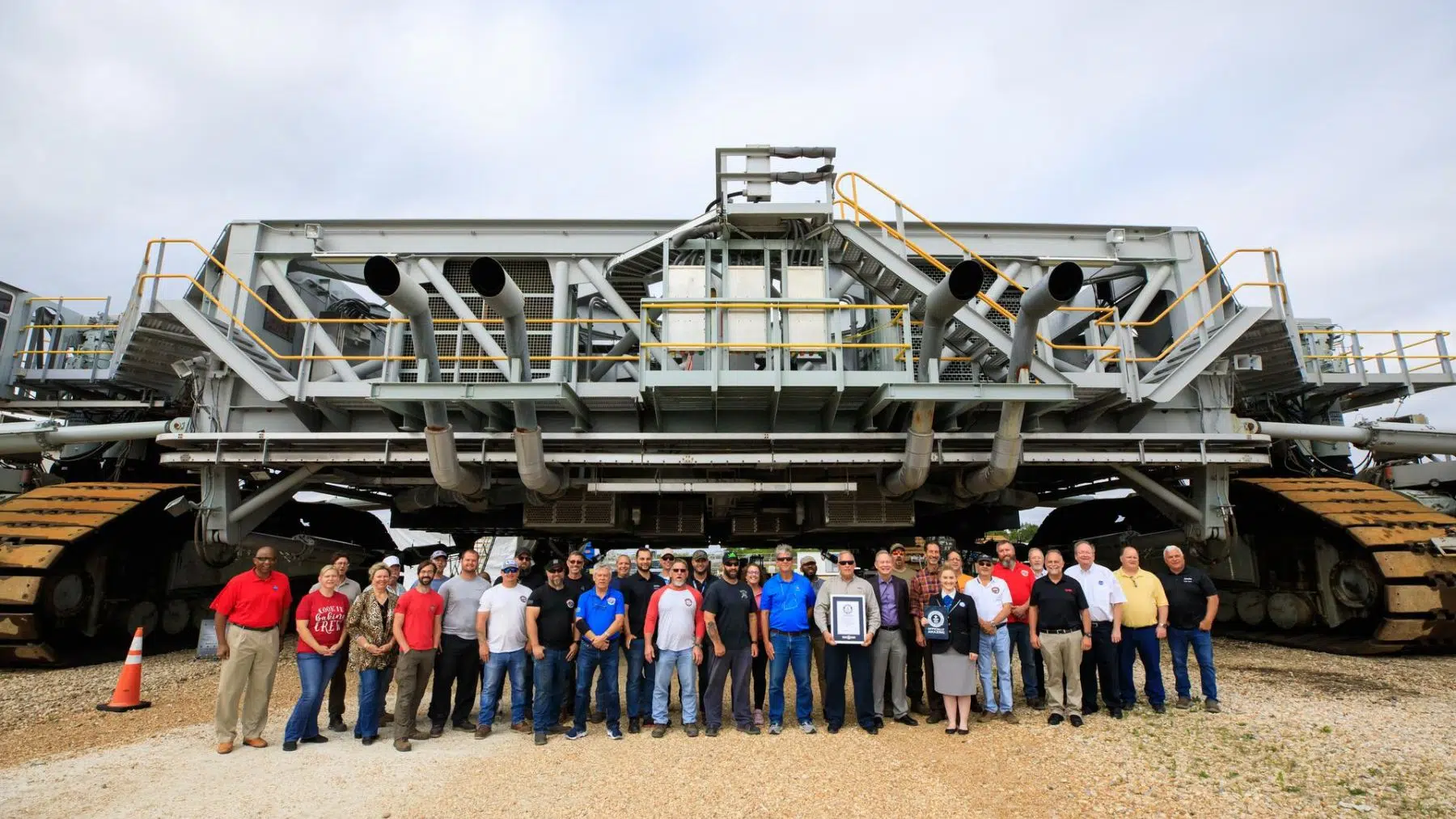
At Kennedy Space Center, a door the height of a skyscraper rolls open, and something impossible starts to move.
It is not the rocket everyone came to see. It is the machine underneath it, a steel platform so vast it could wear a baseball field as a hat, easing out of the building slower than you walk to your kitchen.
It carries the rocket on its back and will spend most of a working day going just four miles. The real puzzle is not its size. It is why something this powerful is built to move this slowly.
A vehicle so heavy it holds a world record just for existing
Meet Crawler Transporter 2, one of a pair NASA has used for decades to haul rockets out to the launch pad.
Empty, it weighs about six and a half million pounds. That is the weight of roughly a thousand pickup trucks, pressed onto one slow moving deck.
In 2023, Guinness World Records made it official and named the crawler the heaviest self powered vehicle on the planet.
Its top deck is flat and square and about the size of a baseball infield, ninety feet on a side. People stand on it and still look small.
This is not a machine you measure in the usual way. You measure it against landmarks.
It drinks a gallon of fuel every thirty two feet
The numbers only get stranger once it starts moving.
Each of its tracks carries fifty seven steel shoes, and every single shoe weighs about a ton. There are eight tracks, so the crawler walks on its own small mountain of metal.
Loaded with a rocket, its top speed is one mile an hour. A determined toddler could keep pace.
It is also monstrously thirsty. The crawler burns roughly a gallon of diesel every thirty two feet, which adds up to about a hundred and sixty gallons for a single mile.
A crew of nearly thirty people runs it from two control cabs at opposite ends, talking constantly as it creeps along.
It was built for the Moon landings and never retired
Here is the part that catches people off guard. None of this is new technology.
Both crawlers were built in 1965, to carry the Saturn V rockets of the Apollo program out to the pad. They are sixty years old.
When the Moon missions ended, they did not stop. They spent thirty years moving Space Shuttles, and now they carry the Artemis rockets meant to return astronauts to the Moon.
The machines are considered so important that they sit on the National Register of Historic Places. They were listed not as objects, but as structures, like a bridge or a lighthouse.
A rocket more than three hundred feet tall still rides to the sky on a frame older than almost everyone watching it go.
The real marvel is not the brute force, it is the surgeon’s touch
So why does the heaviest self powered vehicle on Earth creep along at walking pace? Not because it cannot go faster.
It crawls because of what it is protecting. The launch pad sits on top of a gently sloping pyramid, and the crawler has to climb a five percent grade to reach it.
As it climbs, the rocket on its back has to stay perfectly upright. So the crawler runs a laser guided leveling system that lifts and lowers its corners on the move.
It holds the top of a three hundred foot rocket vertical to within about the width of a basketball. Let it tip much more than that, and the most valuable machine in the building is suddenly in danger.
That is the real secret. The crawler is not a brute at all. It is a delicate instrument wearing the body of a giant, and that precision is the whole reason it cannot rush.
Carrying the future at one mile an hour
For the people who run it, that slow march is the most nerve testing job at the spaceport.
The crew knows the crawler is the single point where everything could go wrong. One bad move under a rocket worth billions, and years of work could tip over with it.
So they take it gently, the way you carry something irreplaceable, because that is exactly what it is.
Moving a giant load with this kind of care is its own quiet branch of engineering, the same patience you see when an oversize transport inches one enormous part across a country, or when crews raise a hundred towers piece by piece.
A machine from the age of the Moon landings, still here, still working, still carrying the next chapter of spaceflight to the pad at the speed of a slow walk.
Read the whole thing?
Get the week's signal, not the noise
Our sharpest reporting on energy, climate and nature — free, once a week.


