For decades, the crown-of-thorns starfish has been cast as one of the Great Barrier Reef’s most destructive villains — spiny, venomous, and capable of stripping vast stretches of coral bare. Since the 1960s, four major outbreaks have swept across the reef roughly every 15 years, leaving behind widespread devastation. Now, new research from the University of Sydney is complicating that story.
A predator with a devastating reputation
The crown-of-thorns starfish is hard to misread. Covered in sharp, toxin-filled spines and capable of consuming coral at an alarming pace, it looks and behaves like a threat. Since the 1960s, four major outbreaks have rolled across the Great Barrier Reef in roughly 15-year cycles, leaving behind stretches of bleached, stripped reef.
Part of what makes outbreaks so difficult to manage is the collapse of natural checks. Tritons and several reef fish species prey on crown-of-thorns starfish, but their numbers have declined sharply. Without those predators, the reef grows more vulnerable to explosive population growth — a dynamic that turns a native species into a destructive force. The conventional response has always seemed obvious: control the starfish, reduce the numbers, protect the coral.
What researchers actually found when starfish feed
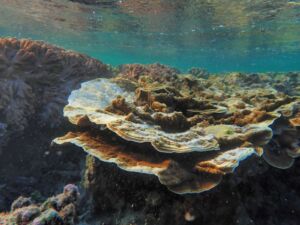
The new study, published in Ecology and Evolution, didn’t ask whether starfish eat coral. It asked what happens to coral after they do. Researchers from the University of Sydney conducted their work at the One Tree Island Research Station, within a protected area of the Great Barrier Reef — a site with healthy fish populations that keep crown-of-thorns numbers naturally low, a reef closer to balance than to crisis.
The team examined feeding scars left by individual starfish. Living coral tissue survived nearly 75% of observed feeding events, a finding that shifts the picture of what low-density starfish predation actually looks like.
“At One Tree Reef, COTS appear to consume a relatively consistent amount of coral during each meal and move on, rather than demolishing the entire coral colony,” said Dr. Shawna Foo, a University of Sydney Horizon Fellow. “This meant live coral tissue remnants were frequently left behind.”
How a coral predator can become a biodiversity builder
Fast-growing coral species — particularly those in the Acropora family — spread quickly and can dominate large reef areas, crowding out slower-growing varieties. A reef dominated by a handful of fast-growing species becomes less diverse over time, and potentially less resilient to stress.
Crown-of-thorns starfish preferentially target these fast-growing corals. By feeding on Acropora and leaving living tissue behind, they open up space without eliminating colonies entirely. Surviving Acroporidae fragments didn’t regenerate over damaged areas — slower-growing corals, Montipora and Porites, moved in instead.
“By feeding on fast-growing corals such as Acropora, low-density COTS populations create space for slower-growing coral species to persist, helping to increase coral diversity,” Dr. Foo said.
The fine line between balance and destruction
None of this means the crown-of-thorns starfish should be left unchecked. Large outbreaks remain a serious, documented threat — when populations explode, starfish consume coral faster than it can recover, and reefs can struggle for years afterward. The beneficial effects described here are specific to naturally low population levels, not outbreak conditions.
“Once an outbreak is suppressed, the goal should not necessarily be to eliminate COTS entirely,” the research team noted. “Culling needs to be complemented by strong marine management to protect COTS predators and keep COTS populations in check.” The goal is balance, not eradication.
An old ecological idea finds a new reef-side example
Research co-author Professor Maria Byrne connected the findings to the intermediate disturbance hypothesis — the idea that moderate, occasional disturbances can prevent any single species from monopolizing resources, creating room for diversity to develop.
The crown-of-thorns findings may be one of the clearest real-world examples of this principle playing out on a coral reef. At low densities, the starfish functions as a natural disruptor, loosening the grip of dominant species without tearing the system apart. It’s a reminder that a species whose role depends entirely on the health of the surrounding ecosystem resists easy categorization — neither straightforward villain nor simple asset.
Read the whole thing?
Get the week's signal, not the noise
Our sharpest reporting on energy, climate and nature — free, once a week.