Your gas stove is off right now.
Burners cold, every knob turned to the stop, nothing lit for hours.
It is still leaking.
Not dramatically, and not with any smell you would notice.
Just a steady invisible trickle of methane working its way out through fittings and valves.
The molecule slipping out of that pipe is the one astronomers look for on other planets.
Three quarters of it escapes while nothing is cooking
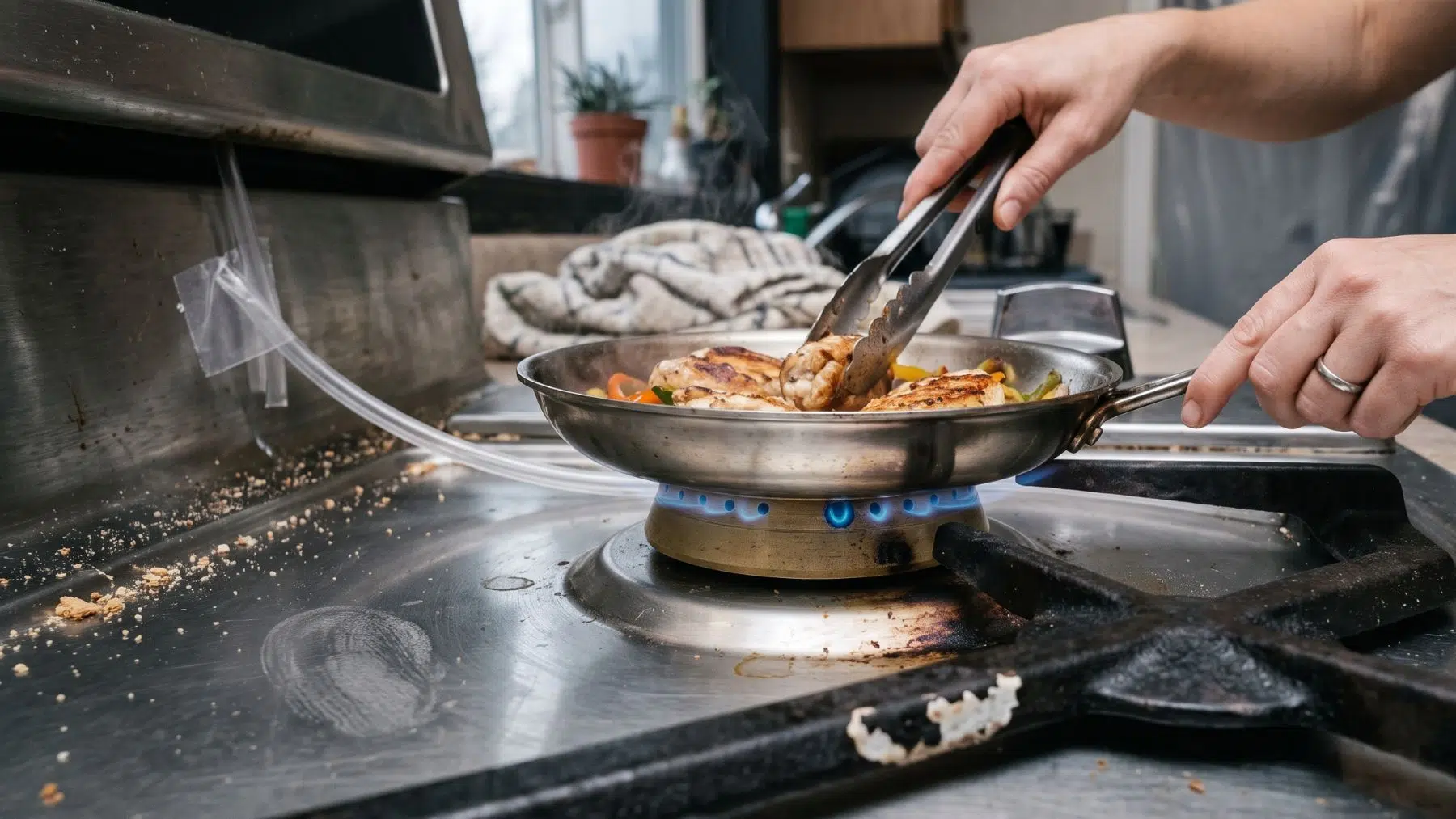
A team sealed kitchens in 53 California homes with plastic sheeting and measured the air through every stage of stove use. They covered ignition, full flame, oven cycles and long idle stretches.
The idle stretches turned out to be the story.
More than three quarters of all the methane those stoves released escaped while the burners were completely switched off. Nobody was cooking. The appliances were bleeding gas through small gaps in valves, and in the leakiest cases 1.3 percent of the gas going in never burned.
“Surprisingly, there are very few measurements of how much natural gas escapes into the air from inside homes and buildings through leaks,” said Eric Lebel, the lead author.
The numbers hiding inside the appliance
Scaled to the whole country, methane from American gas stoves carries a climate impact comparable to half a million gasoline cars over a year. That figure covers everything the appliances emit, cooking included, and since three quarters happens with the burners off, the idle share alone runs to several hundred thousand cars.
More than forty million American homes cook this way, over a third of households.
The stoves tested ranged from three to thirty years old and covered eighteen different brands, and age and brand mattered less than anyone expected. A new stove leaked much like an old one, which points at the design of the system rather than any one product.
There is a second emission that has nothing to do with climate. Gas stoves also release nitrogen oxides, and in a small kitchen with no hood running, levels can pass federal exposure guidelines within minutes of lighting a burner.
Why a telescope cares about your kitchen
Methane has been picked up in traces on Mars, and it is one of the molecules astronomers watch hardest when an instrument turns on a planet orbiting another star.
The reason is that on Earth, most of it is made by things that are alive.
Here is where the popular version goes wrong, though. Methane on its own proves nothing, because plenty of dead processes make it too. Volcanoes make it, so do reactions at mid ocean ridges, hydrothermal vents and comet impacts, and Uranus, Neptune and Titan are full of it with no biology anywhere near.
What astronomers actually look for is a combination. Methane and carbon dioxide together, with more methane than carbon monoxide, on a rocky planet that is not drowning in water. That arrangement is hard for geology to fake, and it is the pattern rather than the molecule that counts as evidence.
Where Earth’s methane really comes from
The living sources are the ones people picture. Bacteria in wetlands, microbes in soil, the digestive systems of cattle, rice paddies and landfills all push methane into the air, and together they make the largest share of the global total.
That soil biology is easy to take for granted until it stops. Where the ground gets sealed under something, the soil beneath quietly stops behaving like a living system at all.
But roughly a third of the world’s methane comes from fossil fuel operations, from wells and pipelines and compressor stations, and from appliances at the end of the line. The stove in the study belongs to that third, not to the biological majority, which makes it an awkward mascot for a molecule sold as the fingerprint of life.
The switch most often suggested is an induction hob, and that only helps if the power behind it is clean, which is the argument for an offshore wind farm.
What this does and does not mean
This is not a reason to panic about your kitchen. The methane problem here is atmospheric rather than personal, a design failure spread across tens of millions of appliances, and no household fixes it by feeling guilty.
The nitrogen oxides are the genuinely local part, and the fix is boring and effective. Run the hood.
“Why not reduce the risk entirely,” the study’s senior author Rob Jackson said. “Switching to electric stoves will cut greenhouse gas emissions and indoor air pollution.” The full study summary is worth reading before anyone rips out a working stove.
The symmetry is the part that stays. Out at the edge of what a telescope resolves, a whiff of this molecule alongside the right companions would be the biggest result in the history of science, and the researchers behind that biosignature work attach conditions to every word of it. In here, the same molecule seeps past a valve in a cold kitchen and nobody notices at all.
Read the whole thing?
Get the week's signal, not the noise
Our sharpest reporting on energy, climate and nature — free, once a week.