Most missions launched by NASA focus on the search for water in a liquid state in the universe, going beyond the borders of the solar system. The ultimate goal is to find any type of organic life in an environment where it can proliferate, but the only planet scientists know that it’s capable of doing so is Earth, and the main reason is the Sun. The giant star heats the planet enough to not let humans and all the species freeze, but it can also end life as we know it with a single burst.
NASA is keeping track of the sunlight in space
NASA is constantly launching missions to study different parts of space, and most of them are parallel to others that might get more attention. However, the vast void yet to be explored has many secrets to be revealed, and one of them was shown within a new operation called Polarimeter to Unify the Corona and Heliosphere (PUNCH), designed to study how the Sun’s outer atmosphere transitions into the solar wind – the potential reason why Mars don’t have water in liquid state on the surface.
The PUNCH mission was also launched for scientists to have a better understanding of the space weather phenomena that can impact Earth’s technology in the future. With a single strike, if powerful enough, the geomagnetic storm caused by the Sun can provoke a major blackout and damage satellites and electronic devices by overloading undersea cables. While studying these scenarios, NASA found one of the most beautiful colors out here.
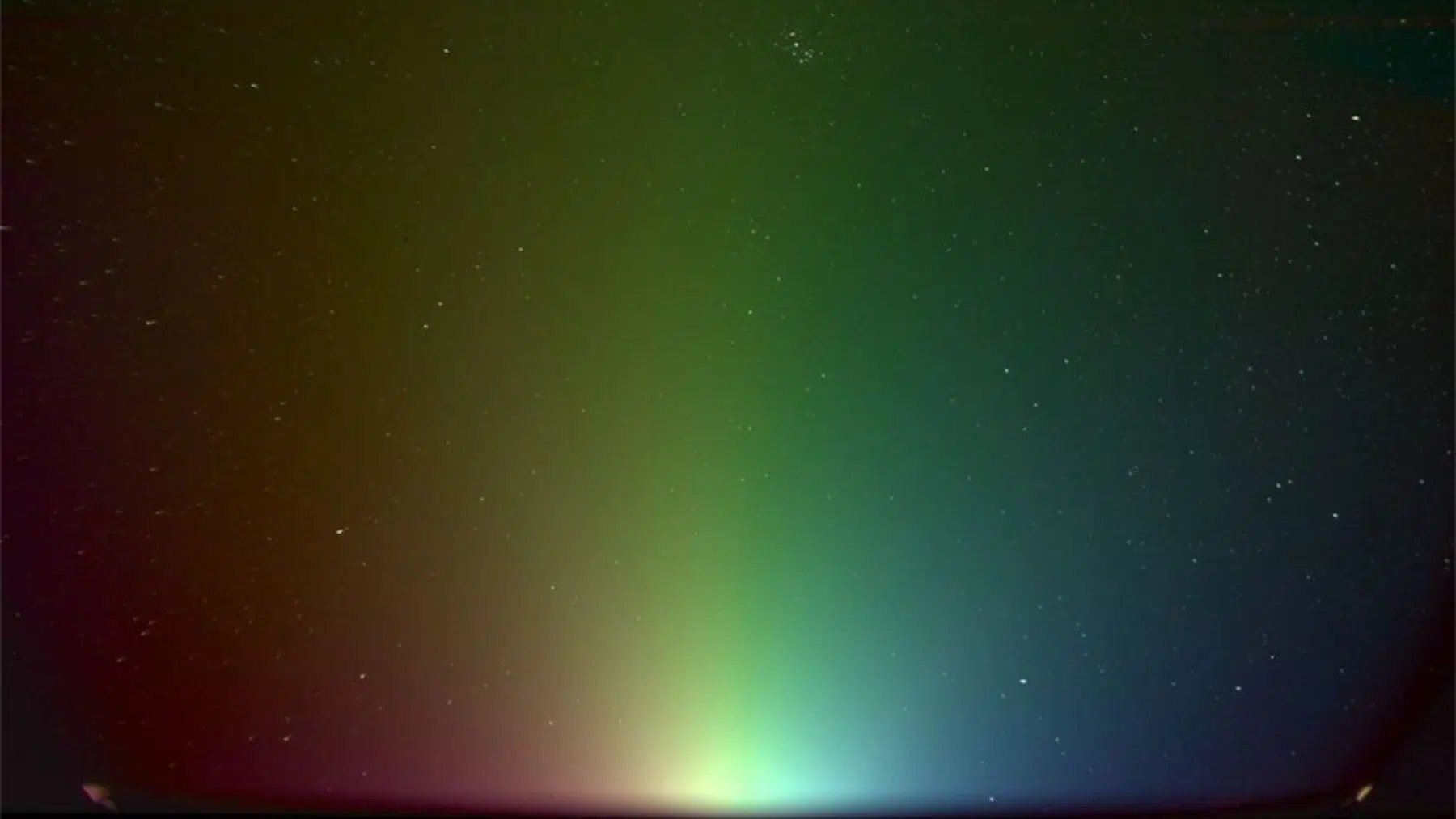
On April 18, 2025, the mission achieved a milestone by capturing a rainbow-colored image of the zodiacal light – a diffuse glow caused by sunlight when it interacts with dust particles in space. Although it’s very similar to the Northern Lights phenomenon, the lights that fill up the sky in Nordic countries, Canada, and Alaska happen when charged solar wind particles interact with Earth’s magnetic field and atmosphere.
4 Microsatellites are needed to capture the phenomenon
The image was taken by a set of specially designed cameras onboard the PUNCH’s four microsatellites, equipped with Narrow Field Imager (NFI) and Wide Field Imagers (WFI). The core mission is to measure the solar winds and the corona, the outer atmosphere of the sun, in three dimensions through the polarization of light. The NFI helps by blocking the bright sunlight to have a better view of the corona. On the other hand, the WFI has a different function as it is designed to see the edge of the corona and the solar wind.
PUNCH was launched on March 2025, onboard of the SpaceX Falcon 9 rocket. Meanwhile, NASA is also launching another telescope called SPHEREx – short for Spectro-Photometer for the History of the Universe Epoch of Reionization and Ices Explorer – to serve in a separate mission.
James Webb-like telescope goes to space
The SPHEREx it’s very similar to the James Webb Telescope (it uses infrared technology to look at the cosmos), but its assignment is to generate a wider view of the universe to create an updated map of the visible sky. NASA shared in a conference in late January that they were mapping the celestial sky in 102 infrared colors.
The SPHEREx mission is designed to map the entire sky in those 102 infrared colors, providing a wide-angle perspective of the cosmos. PUNCH, by contrast, focuses on the Sun’s corona and solar wind, measuring how the solar atmosphere unfolds and streams through the solar system in three dimensions.
Read the whole thing?
Get the week's signal, not the noise
Our sharpest reporting on energy, climate and nature — free, once a week.