
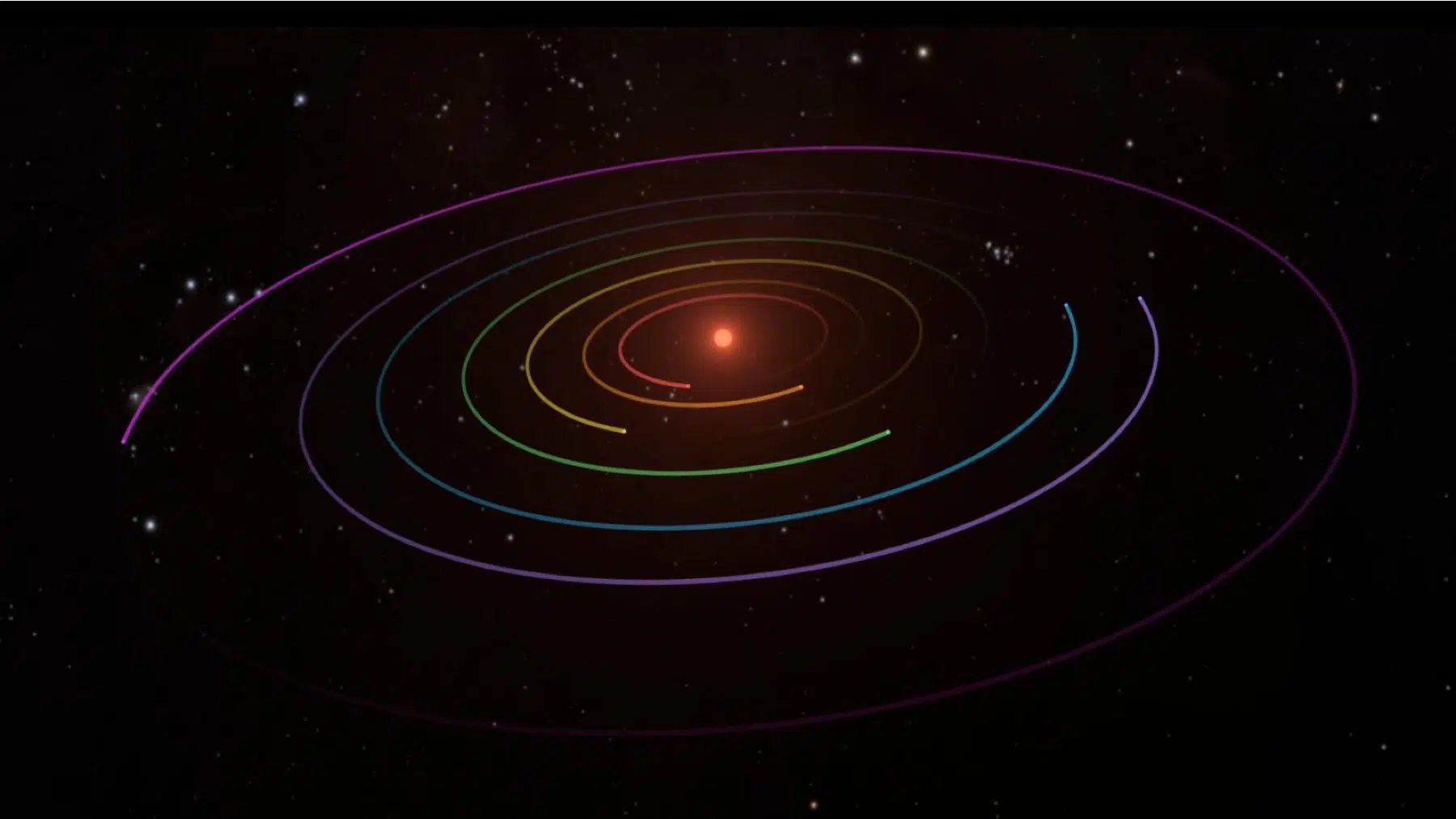
Earth is still the only planet we know to have life in the universe, but other planets could be capable of holding life. This is why NASA is so intrigued by Mars. It is near us, has rocky structures, and a similar atmosphere. Now, there could be another planet inside what astronomers call the habitable zone that could have an Earth-like atmosphere – or at least they thought so. New findings show that the exoplanet Trappist-1 d might not be like our planet after all.
NASA and the exoplanet: Narrowing down the possibilities
An exoplanet is the terminology used to classify a planet that is outside our solar system and orbits a star – which may not be as massive or powerful as our sun. Planets like these are often being studied for having similar conditions to Earth and could have liquid water on their surface, theoretically. Until now, no planet with liquid water on its surface was found.
Meanwhile, water is not exclusive to Earth. When our planet was still forming, asteroids brought water molecules to it, and eventually the oceans were formed. Since this happened here, it means it could have happened elsewhere, but not necessarily generated life as we know it, but it could mean that planets like ours are out there. Well, NASA thought this about the Trappist-1 d, but it turns out they were wrong.
First impressions of the Trappist-1 d: It is not what it looked like
Astronomers first looked at Trappist-1 d as a candidate for habitability because the planet is rocky, similar in size to Earth, and sits close enough to its star for liquid water to be possible on the surface. But recent data collected by NASA’s James Webb Space Telescope show that the planet does not have an atmosphere like ours.
The Trappist-1 system, found about 40 light-years away, made headlines back in 2017 when NASA’s Spitzer Space Telescope revealed seven rocky, Earth-sized planets around the same star. This star is a red dwarf, which is smaller and cooler than the Sun – its “habitable zone,” the range where temperatures could allow liquid water, is located much closer in. Trappist-1 d orbits right on the edge of this zone. To put its distance into perspective, it is only about 2 percent of the Earth-Sun distance, placing it in a challenging environment despite sitting on the cusp of the temperate zone.
James Webb observed the world using NIRSpec
When Webb observed the planet using its Near-Infrared Spectrograph (NIRSpec), it found no traces of key atmospheric gases such as water vapor, methane, or carbon dioxide. Researchers, including Caroline Piaulet-Ghorayeb from the Université de Montréal, note that this does not close the case entirely but narrows down the possibilities for what type of atmosphere – if any – the planet could still hold.
Life near a red dwarf star is not easy. These stars are known for violent flares that release high-energy radiation capable of stripping away the atmospheres of nearby planets. Still, scientists continue to study them because red dwarfs are the most common type of star in our galaxy. If planets can survive here with atmospheres intact, it would mean they can exist almost anywhere.
New planets will be unveiled soon: NASA is working on
As Björn Benneke, a co-author of the study, explained in NASA’s release, Webb now gives astronomers the sensitivity to study the atmospheres of small, rocky planets in detail. Webb will also keep observing the outer Trappist-1 planets – labeled e, f, g, and h. According to Benneke, these worlds may have a better chance of preserving atmospheres because they orbit farther from the star’s energetic eruptions, though their colder and more distant environment will also make atmospheric signatures more difficult to detect.
Read the whole thing?
Get the week's signal, not the noise
Our sharpest reporting on energy, climate and nature — free, once a week.


