Four researchers at NASA’s Glenn Research Center in Cleveland guide a small blue crane as it hoists a cylindrical device — silver and gold layers stacked like flattened soda cans — into a wheeled cart. Nearly 270 sensors and 1,000 components are packed inside. Tubes and wires spiral outward in every direction.
“It’s a behemoth; it’s a researcher’s dream,” said Dr. Kerrigan Cain, the lead engineer overseeing what comes next.
Roughly the length of a sedan and as tall as a person, this machine is now at the center of a critical test at NASA Glenn — one that its builders believe could determine whether humans can survive on the Moon when the lights go out.
A machine unlike any battery NASA has built before
What sits inside that wheeled cart is not a battery in any conventional sense. The regenerative fuel cell system operates through a two-step chemical loop: it combines hydrogen and oxygen gas to generate electricity and water, then reverses the process — splitting that water back into hydrogen and oxygen to recharge itself. No outside input required. No replacement parts shipped from Earth.
That self-sustaining loop is what separates it from standard battery technology. Conventional batteries store a fixed amount of energy and eventually run out; this system cycles its own byproducts back into fuel. NASA says it can store the same amount of energy as comparable battery systems while weighing less — a meaningful advantage when every kilogram launched into space carries a steep cost.
Nearly 270 sensors monitor conditions across 1,000 internal components. The tangle of tubes and wires visible from the outside is not chaos. It is instrumentation, built to capture every variable during testing.
Why the lunar night is such a brutal problem
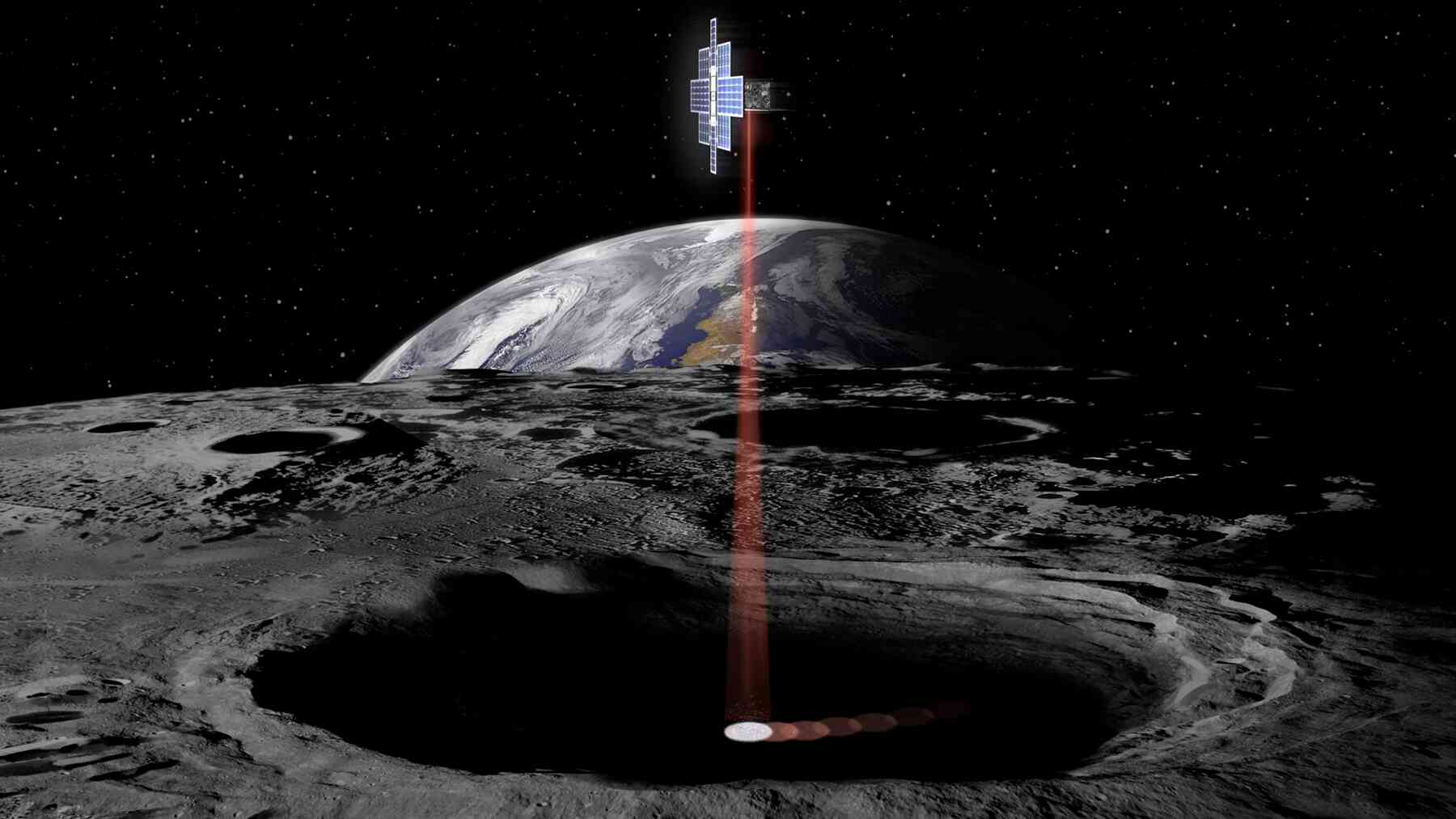
The Moon does not experience night the way Earth does. Near the lunar south pole — the target region for Artemis surface missions — darkness can persist for nearly two weeks at a stretch. Solar panels produce nothing during that window. Any crew, habitat, or rover depending entirely on solar power would simply go dark.
Conventional batteries can bridge short gaps, but a two-week blackout is a different problem entirely. The weight required to store enough energy for that duration would be prohibitive, and resupply missions from Earth are neither fast nor cheap.
This is the infrastructure gap the regenerative fuel cell system is designed to fill. As Cain put it, the technology is “ideal for habitats, exploration with rovers, and many of the systems envisioned under Artemis.” A sustainable human presence on the Moon requires power that works through the dark — and that solution has to be self-sufficient.
Five years of work leading to one critical milestone
The system now being tested at NASA Glenn’s Fuel Cell Testing Laboratory is the product of more than five years of design and assembly. Researchers completed initial testing in 2025, focusing on basic functionality and making early modifications based on what they observed.
The current phase represents a meaningful step forward. For the first time, the team is operating the complete system and storing the hydrogen and oxygen gas generated during recharge — something not previously achieved with this configuration. It is the difference between testing individual components and proving the entire loop works end to end.
Day-to-day testing follows a careful protocol. Researchers secure the thick double doors of the test cell, move to a nearby control room, and start the system remotely. Once a test begins, the technology runs autonomously.
“This testing is going to generate crucial data, so every day is exciting,” Cain said. The goal is to gather performance benchmarks, identify remaining challenges, and build a clear picture of what the system needs before it can be considered ready for a lunar mission.

From the lab to the lunar surface: what comes next
Lab testing is only the opening phase. Temperature swings, vacuum conditions, and the mechanical stress of a real mission are far harsher than anything a clean test facility can replicate — and before this system goes anywhere near a rocket, it will need to prove itself under all of them.
Lessons from the current round of testing will directly shape the next design refinements. Every anomaly logged, every performance gap identified, feeds into an iterative process aimed at making the hardware launch-ready. That cycle — test, learn, refine — is how complex space systems mature.
The project receives funding through NASA’s Space Technology Mission Directorate Game Changing Development Program, managed at Langley Research Center in Hampton, Virginia. That backing reflects how seriously the agency treats energy storage as a foundational challenge for Artemis.
Cain has been clear that no single organization will solve this alone. “Creating a sustainable presence on the Moon is a team effort requiring a lot of collaboration between NASA and industry,” he said. As testing continues, the data gathered at Glenn will shape not just one machine, but the broader energy architecture that future lunar crews will depend on to survive the dark.
Read the whole thing?
Get the week's signal, not the noise
Our sharpest reporting on energy, climate and nature — free, once a week.