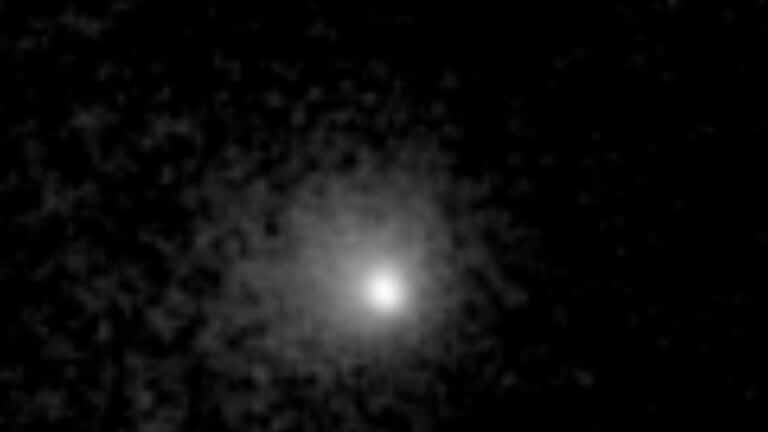
Something is occurring in faraway space, drawing energy from an unknown source.
It does not act like a normal explosion; this supernova is not fading but appears “powered,” shining much longer than expected.
That leads to a very odd question—one that does not have an immediate explanation.
What is this “glowing structure,” and how is it “fueling” the supernova in a way that allows it to continue shining?
A supernova that refuses to behave like the rest
Why does this supernova look so different from others? In general, these events are relatively short-lived.
A massive star will collapse or explode and release vast amounts of energy into the universe.
Over time, that energy begins to decay at a predictable rate, creating a baseline against which other events of this nature are measured.
However, the data collected on this particular event did not follow that predictability.
After exploding, the supernova’s energy did not dissipate as expected.
In fact, it continued to produce energy as if it had an unlimited supply, rather than fading over time. Initially, it may appear to be just another extremely powerful explosion occurring in space.
However, after observing it over time, it became clear that something was maintaining it.
It looked as though this event was being held in place by some form of unseen power.
The possible causes provided by traditional models were unable to explain everything that was happening.
When the evidence began to point elsewhere
The longer this object remained under study, the stranger it appeared.
Instead of losing strength, it maintained it, as if it were being continually fed by something.

This is not characteristic of most similar events. It was suggested that something surrounds it.
There was faint light coming from outside it that could now be clearly observed. At first, it was barely visible.
Over time, however, it grew stronger and more noticeable.
At times, it even appeared as though a defined outline or shape was beginning to take hold of the explosion.
The relationship between the supernova and its immediate surroundings began to look connected.
If no unknown energy source was fueling this phenomenon, why did it behave as though it was receiving continuous energy?
For more detail on this phenomenon, see research from NASA Science.
The source behind the glowing structure and its energy
At first, the glowing may be seen as leftover energy from the explosion or scattered light moving through space.
However, as closer examination occurs, subtle patterns begin to appear.
The glow remains constant, and the energy continues without fading.
Something does not allow it to dissipate, as if a steady source is sustaining it.
A force that keeps the energy from fading
Scientists believe the glowing structure around the supernova is a shell of heavy material from before the event.
When it pushes outward into space, it does not move freely.
Rather, it runs directly into this pre-existing mass and generates interactions where previously free-moving energy is converted into a more stable form.
Each time the shockwave impacts this shell, additional energy is created.
The event produces energy not just once, but continuously as the shockwave travels through the material.
This process is responsible for giving the appearance of something that is “receiving energy,” as if it is connected to an external power source.
The supernova does not fade, as its interaction with the shell keeps producing light. A superluminous one forms—shining far brighter and lasting longer as the motion is converted into sustained energy.
A seemingly singular event extends over time and does not follow what would normally be expected.
If structures like this exist around other stars, how many similar events are still being misread from a distance?
Read the whole thing?
Get the week's signal, not the noise
Our sharpest reporting on energy, climate and nature — free, once a week.