NASA has spent decades trying to answer one of the most compelling questions in space exploration: Did life ever exist on Mars, and could it still exist there today? Recently, a signal from the Red Planet added a new twist to that story—one that has scientists and volunteers alike reconsidering what we know about our neighboring world. Nothing was said directly, and decoding the message proved far more challenging than expected. A father-and-daughter team of regular people eventually cracked the pattern and shared what they found with the rest of the world.
NASA has been trying to get to the Red Planet
Mars is the most Earth-like planet in our solar system. It has a rocky terrain, recognizable weather patterns, and a relatively predictable environment. Unlike Venus, which destroys anything that lands on it, Mars allows exploration without immediate disaster. Over the years, rovers have been sent to investigate the soil, rocks, and atmosphere, preparing the groundwork for human missions. These machines have collected valuable evidence, but none of it has made the journey back to Earth—there simply isn’t enough fuel for a return trip with current technology.
NASA has relied on robotic missions, often spaced years apart, to slowly peel back the mysteries of the Red Planet. Each rover arrives, gathers data, and stays permanently on the surface. The Perseverance rover, for example, carries built-in compartments to store Martian soil samples, keeping them ready for potential retrieval in the future. But that retrieval depends on rockets and fuel systems that don’t exist yet.
Mars is trying to tell us something: What is it?
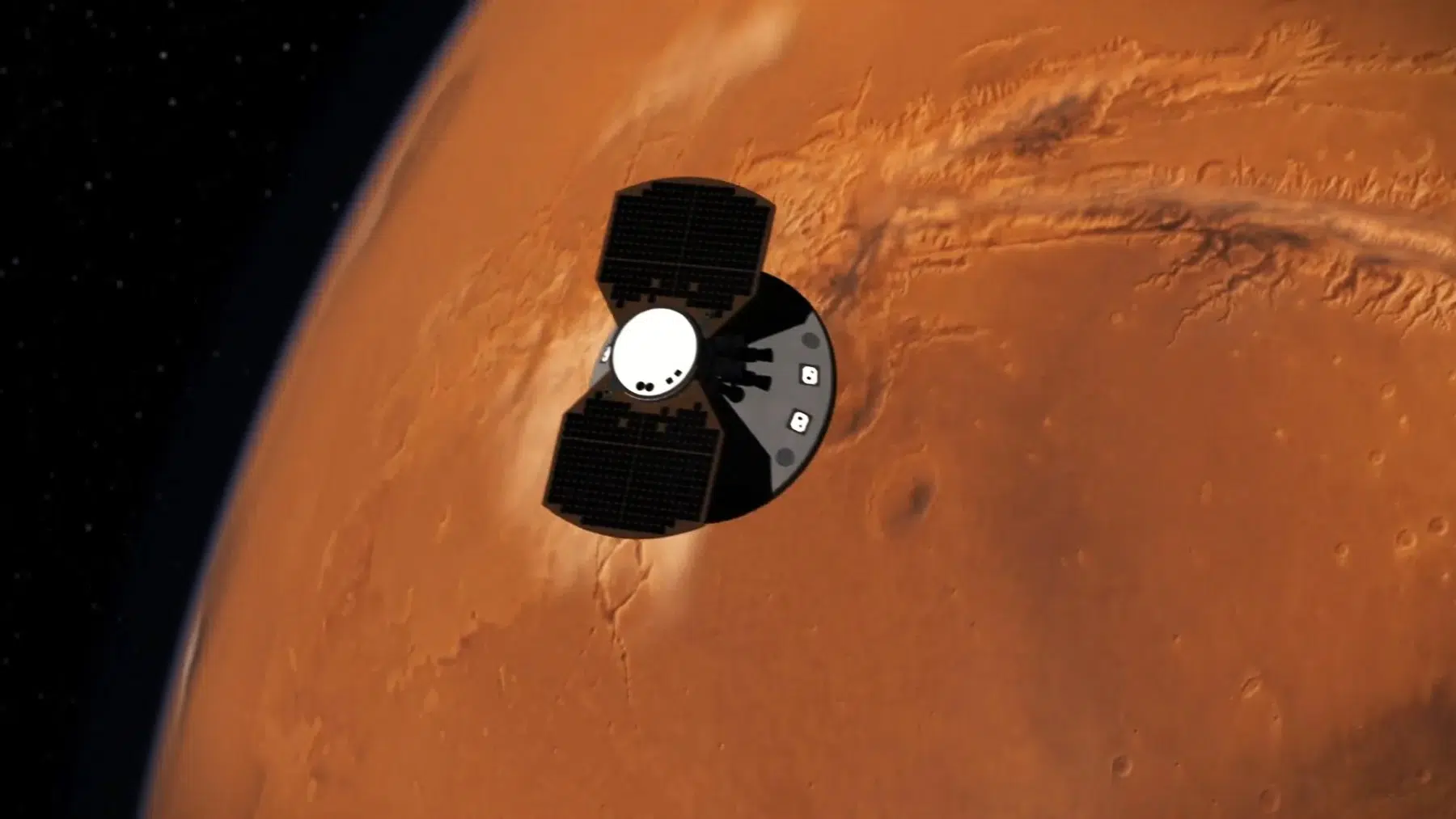
The European Space Agency’s ExoMars Trace Gas Orbiter sent a curious signal back to Earth in May 2023. This was part of ‘A Sign in Space’, an international art and science project led by media artist Daniela de Paulis, crafted with a small group of astronomers and computer scientists, with support from ESA, the SETI Institute and the Green Bank Observatory. The project was designed to simulate how humanity might react if it ever received a genuine alien signal. More than 5,000 volunteers contributed to extracting the message from the raw radio data in just 10 days. Decoding the message proved far more challenging.
Months passed as the community worked to crack the code. A father-and-daughter team, Ken and Keli Chaffin, spent countless hours running simulations until they found a pattern. The transmission didn’t reveal words or images. Instead, it displayed flickering clusters of white dots against a dark background. Five distinct shapes appeared—shapes that mirrored the chemical structures of amino acids, the basic building blocks of life.
How the message works: DNA x mRNA correlation
Amino acids are critical for forming proteins, which are assembled according to instructions carried by DNA and transcribed into mRNA. They are essential to life as we know it. The Chaffins discovered that the message contained movement, suggesting some sort of cellular formation and life forms. The signal’s display immediately raised questions: was it a coincidence, deliberate design, or something else entirely? The interpretation of the message, like any art piece, remains open.
Everybody can contribute: Try it yourself
Projects like A Sign in Space show that the search for life beyond Earth isn’t confined to professional scientists. The organizers behind the project are now witnessing how citizen scientists are shaping the challenge on their own, offering platforms where volunteers can analyze data and detect anomalies. Some of the most recent findings in space have come from ordinary people contributing their time and insight. The Mars signal illustrates the potential of collaboration. It is a reminder that exploration isn’t just about machines or missions—it’s about global engagement. Even the most improbable group of people can crack a difficult message hidden in something common to us.
Read the whole thing?
Get the week's signal, not the noise
Our sharpest reporting on energy, climate and nature — free, once a week.