Is there another way a galaxy from eons ago could have grown differently than scientists expect?
Recently, astronomers took a closer look at a peculiar object in the evening sky.
They used a unique situation to observe a distant galaxy from the deep past. This method gave them unprecedented access to the structure.
What the astronomers saw inside surprised them. The findings challenged every existing model of how galaxies form over time.
Could this ancient structure hold clues about our galaxy?
An ancient celestial enigma
Many of the universe’s greatest mysteries lie shrouded in distances of many light-years of empty space.
Astronomers use gravity to provide a giant telescope of sorts, allowing us to probe the deep reaches of space and time.
Gravity acts as a tool to focus and amplify light from remote objects. This method is called gravitational lensing.
Gravitational lensing enables astronomers to view extremely faint objects. It allows us to see what would otherwise be undetectable with even our most advanced technology.
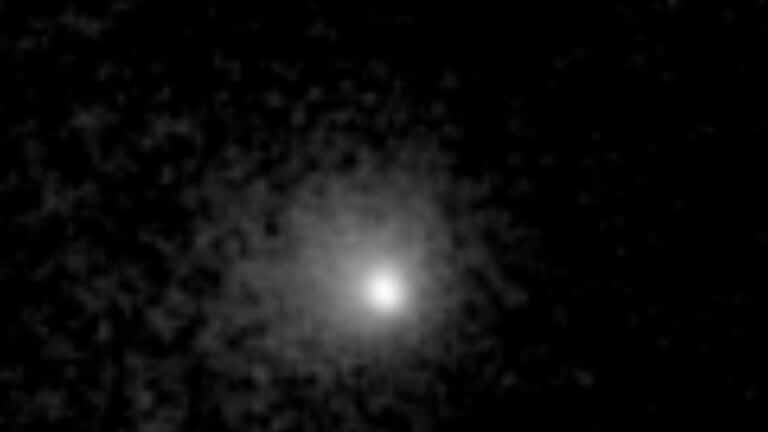
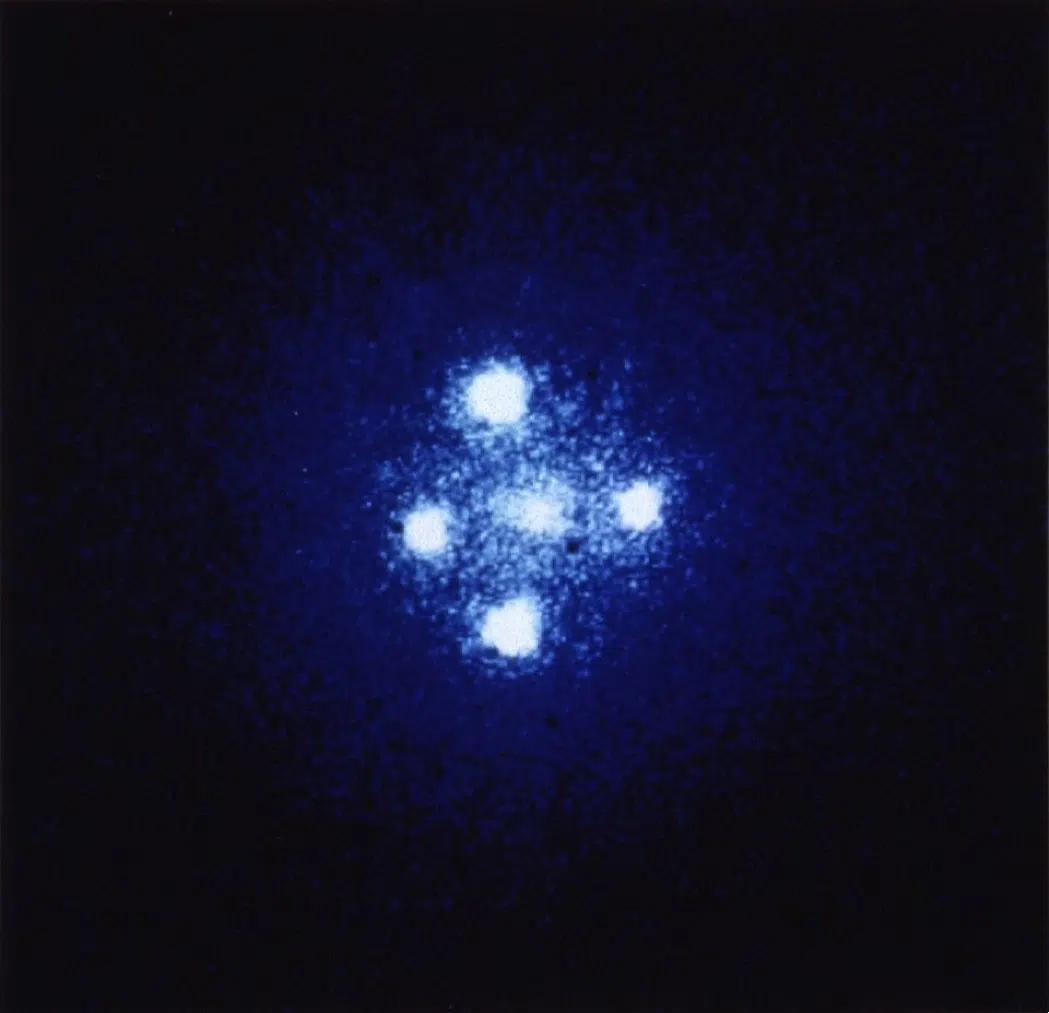
Astronomers used an Einstein Cross caused by a distant quasar to identify a unique configuration. This setup revealed four distinct light points around the central lens galaxy known as J1453g.
This alignment offers a rare, clear pathway into the galaxy’s interior. Researchers hoped to gather enough data to determine how stars are distributed at the center.
Their aim was to learn how this galaxy formed its core during the universe’s childhood.
Conventional theories of galaxy development suggest that they develop large cores due to rapid, intense gravitational collapse.
Unraveling the heart of a youthful giant
The researchers used the magnified images of the background quasar to measure the stellar masses with great accuracy.
They also investigated the Initial Mass Function (IMF), which explains how the number of stars varies in relation to their mass.
Data related to the IMF is necessary for determining exactly how a galaxy develops its structure through time. In general, astronomers believe that the central regions of elliptical galaxies should be primarily composed of low-mass stars.
This expectation comes from the “two-stage” model, which is one of the foundational stones of modern astrophysics. The researchers tested several different assumptions regarding J1453g.
Even so, the results did not align with the expectations of the conventional two-stage model.
The age of the star population resembled that of a much older galaxy than J1453g should be, according to its redshift.
The chemical composition also indicated a complex buildup pattern. This pattern differed from the predictions of standard models.
It appeared that their theoretical representations of the galaxy’s development were flawed. The growth history did not match their models.
Scientists felt they had uncovered a significant difference. The theoretical descriptions did not align with the empirical observations they gathered.
Something was clearly amiss in the cosmological storyline describing how this ancient galaxy grew.
Finding a link back home
This is detailed in the study “Milky-Way-like stars in a galaxy core 8 billion years ago revealed by gravitational lensing,” published in Nature. The researchers analyzed their models to resolve the disparity between theory and observational evidence.
The rare Einstein Cross was the gravitational lensing effect that split the background quasar into four visible points around J1453g.
They discovered they had omitted a major, hidden factor when developing their earlier models.
A mirror to our own galaxy?
The rate at which J1453g forms stars closely matches the star-forming rates of our own Milky Way. The levels of total galactic activity in the two galaxies are also very similar.
These similarities lead us to be much more confident about a new idea.
It appears that J1453g was not subject to short, intense bursts of star formation.
Other galaxies are thought to experience these explosive periods. Instead, this galaxy may have evolved through gradual star formation.
Or, it possibly faced sudden disruptions before settling into its current state.
If J1453 is a mirror of our own past, it suggests that the Milky Way’s story is far more unique than we ever imagined. And far more complex.
Read the whole thing?
Get the week's signal, not the noise
Our sharpest reporting on energy, climate and nature — free, once a week.